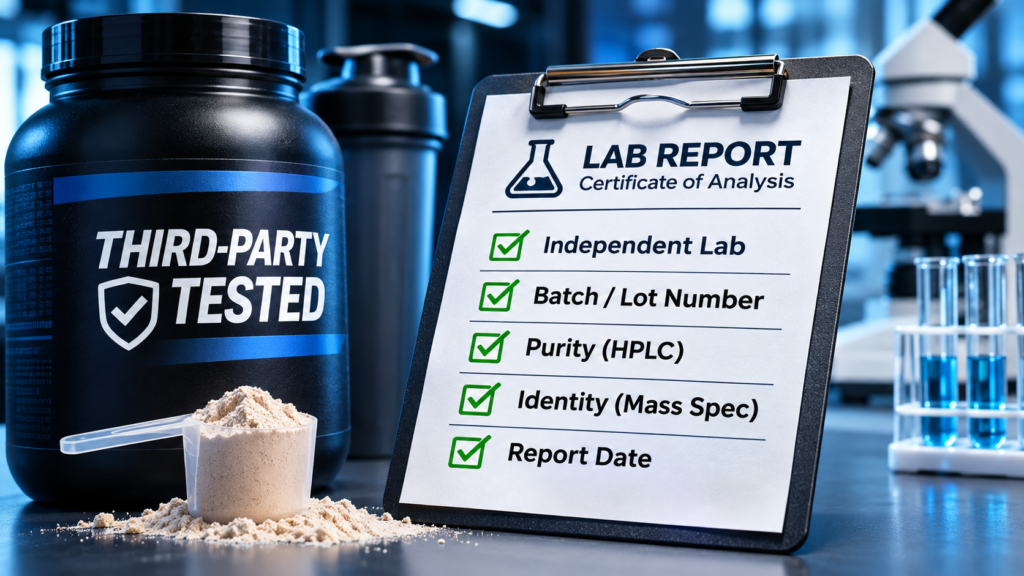
Fitness professionals hear “third-party tested” constantly. It sits on protein tubs, pre-workout labels and sports nutrition websites, and clients often repeat it as if it settles the question of quality. Sometimes it does. Often it means much less than it sounds like.
The useful habit is not to trust or distrust the phrase, but to ask for the report behind it and know how to read one. The same few checks apply whether the product is a supplement, a reagent sold to a laboratory, or anything else that arrives with a certificate.
Understanding supplement quality and evaluating product claims are important skills for fitness professionals. Our Fitness Nutrition Specialist Certification covers sports nutrition, supplementation, and evidence-based nutrition coaching to help trainers better educate their clients.
Who did the testing?
The first question is the simplest. A “certificate of analysis” written by the company that made or sells the product is an in-house document. It may be accurate, but it isn’t independent. A genuinely third-party report names an outside laboratory, carries that lab’s own reference number and is dated. If the lab’s name is missing, or the report looks like a template with the numbers typed in, treat it as marketing rather than evidence.
Is it about this batch?
Every production run is different. A report is only useful if its batch or lot number matches the number printed on the container in front of you. A supplier that shows one impressive certificate for every batch it has ever sold is showing you the best day, not the product you received. Good suppliers publish a report per batch and make the batch number easy to find.
What does the purity number mean?
Most reports for purified compounds quote a purity measured by HPLC, high-performance liquid chromatography. The sample is pushed through a packed column, and different molecules come out at different times. A detector records each one as a peak, and the purity figure is the share of the total signal that belongs to the main peak.
That makes “98% pure” a precise statement with clear limits. It says the main compound dominates what the detector could see. It doesn’t say what the main compound is, and it doesn’t count things the detector can’t see, such as water or salts. A report that gives the method, the wavelength used and a copy of the chromatogram is far more convincing than a bare percentage. For a longer walk-through, Amidae’s library explains how HPLC purity is worked out, peak by peak.
Is it the right molecule at all?
Purity and identity are separate questions. A powder can be 99% pure and still be the wrong substance. Identity is usually confirmed by mass spectrometry, which measures the mass of the molecules in the sample and compares it with the mass the compound should have. A report with purity and no identity test answers only half the question.
A worked example from the research bench
Laboratory reagents show these checks most clearly, because buyers there expect the full set. Take BPC-157, a short synthetic peptide sold to researchers for laboratory use only. It is a chain of 15 amino acids:
Gly-Glu-Pro-Pro-Pro-Gly-Lys-Pro-Ala-Asp-Asp-Ala-Gly-Leu-Val
From that sequence comes a molecular formula of C62H98N16O22 and a calculated molecular weight of about 1419.5. Its CAS registry number is 137525-51-0. A UK listing for BPC-157 peptide sets out exactly those details alongside the storage conditions, which is what makes a report checkable. When the batch report arrives, the mass found by mass spectrometry should sit within about one unit of 1419.5, the HPLC purity should be stated with its method, and the batch number should match the vial.
None of that requires a chemistry degree. It requires knowing which numbers belong together and noticing when one is missing.
A short checklist
When a client, colleague or supplier says something is third-party tested, ask:
- Which lab? A named, independent laboratory, not the seller.
- Which batch? A batch or lot number that matches the product.
- Purity by what method? HPLC with the conditions stated, ideally with the trace.
- Identity confirmed how? Usually mass spectrometry, with the measured mass.
- How recent? A dated report, not one recycled for years.
A product that passes all five has earned the phrase. One that can’t answer the first two hasn’t, however good the label looks. Teaching clients to ask these questions is one of the more practical things a fitness professional can do: it travels from the supplement shelf to any product that claims a lab has vouched for it.