
If you train people for a living, you have heard the word “tesamorelin” by now. It comes up between sets, in DMs, in the comments under a physique update. Usually it arrives with a story attached: a friend of a friend, a forum post, a screenshot of a listing that promises the world.
As trainers, we are not chemists and we are not physicians. But we are often the first person a curious client asks, and that puts us in a position of responsibility. This guide is written from that point of view. It explains what tesamorelin actually is, why it is a research compound and not a gym supplement, and what separates a legitimate research supplier from the noise when someone wants to buy tesamorelin for laboratory work.
First, what tesamorelin is (and is not)
Tesamorelin is a synthetic peptide modeled on growth hormone-releasing hormone, the signal the body uses to tell the pituitary gland to release growth hormone. Chemically, it is a 44-amino-acid chain with a small modification that makes it more stable than the natural version. In scientific literature it is best known for research on visceral fat, the deep fat stored around the organs.
A version of the compound has regulatory approval in the United States for a narrow medical indication, and it is prescribed under medical supervision in that setting. Outside of that, what you see listed online is research material. It is sold for laboratory use, not for people. That distinction is not a technicality. It is the line between a controlled, studied therapy and an unregulated product with no clinical oversight.
So when a client asks “should I try it?”, the honest trainer answer is simple: that is a question for a physician, not for us, and not for a forum.
Why it keeps showing up in fitness conversations
Fitness culture is drawn to anything associated with leanness and recovery, and research on GHRH analogues touches both topics. Add the general buzz around peptides and you get a compound that gets talked about far more than it gets understood.
That buzz has created a crowded online market. Some sellers are serious research suppliers with documentation and quality control. Others are reselling material of unknown origin with copy-and-paste labels. From the outside, they can look almost identical.
A trainer’s checklist for spotting a serious research supplier
Many of us also work with university labs, sports-science departments or research groups, where people genuinely need to buy tesamorelin for laboratory study. If you are ever asked to point a research contact in the right direction, these are the signals that matter.
Lot-specific certificates of analysis
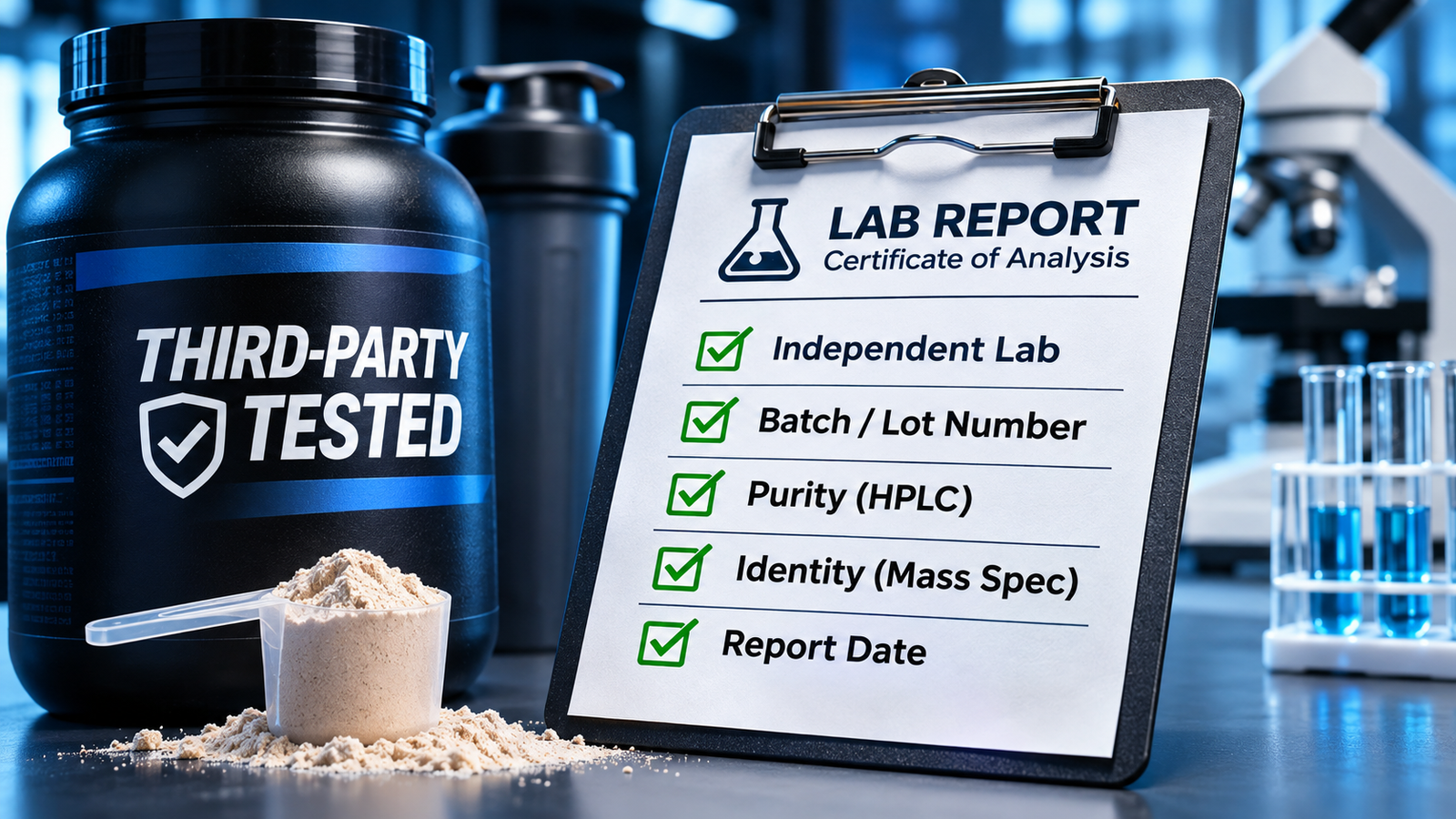
A certificate of analysis (COA) is a lab report for a specific batch. A real one lists the lot number, the test date, the purity result and the method used. The lot number should match the vial. If a seller shows one generic certificate for everything it sells, that is a red flag.
Identity testing, not just a purity number
Purity is measured by HPLC, a technique that separates a sample into its components. Identity is usually confirmed with mass spectrometry, which checks that the molecule weighs what tesamorelin should weigh. You want to see both. A high purity number for the wrong molecule is still the wrong molecule.
Proper form and handling information
Research tesamorelin is normally sold as a lyophilized, freeze-dried powder. That form holds up well if it is kept cold and dry. Serious suppliers explain storage and shipping clearly. Vague handling information usually means vague handling.
No health claims, no usage advice
This one is the easiest to spot. A research supplier does not promise fat loss, muscle gain, better sleep or anything else. It does not post “protocols.” When a seller starts sounding like a supplement ad, it is telling you exactly how it views the rules, and you can assume the same attitude applies to quality control.
Domestic stock and quick shipping
Peptides held in the country and shipped quickly spend less time in hot trucks and customs queues. For a lab running a study on a schedule, reliable dispatch matters as much as price.
What we tell clients, word for word
After years of these conversations, a few scripts have stuck because they are honest and they do not lecture.
“That’s a research compound.” It is sold for lab use. Anything about using it on yourself is a conversation for your doctor.
“Look at what the seller doesn’t say.” No lot numbers, no lab reports, lots of before-and-after hype? That tells you most of what you need to know.
“Your training and nutrition are the things you control.” Sleep, protein, progressive overload and consistency are still the foundation. No vial changes that.
Most clients appreciate a straight answer. The ones who push harder are usually the ones who most need to hear it from a professional rather than an algorithm.
Common myths we hear on the gym floor
“It’s basically a natural supplement.”
It is not. Tesamorelin is a synthetic peptide built in a laboratory, one amino acid at a time. The fact that it is modeled on a hormone the body makes does not make it natural, and it certainly does not make it a supplement. Supplements are a separate regulatory category entirely.
“If it’s sold online, it must be legal to use.”
Being listed for sale as a research chemical does not mean a product is approved for personal use. Research suppliers sell to laboratories. The “research use only” label is there for a reason, and serious sellers mean it.
“All peptides are the same quality.”
Quality varies enormously. Making a 44-amino-acid peptide correctly is demanding work. Errors in synthesis can leave fragments, extra residues or chemical leftovers behind. Without testing, nobody can tell by looking at a white powder in a vial.
“The higher the purity number, the better.”
A purity number is only useful if you know what was tested, when, and on which lot. A 99% figure copied onto every product page is marketing, not data.
How peptide quality actually gets checked
It helps to understand, in broad strokes, what a testing lab does with a peptide sample. First, HPLC separates the sample into its components and measures how much of the total is the main compound. That gives the purity percentage. Then mass spectrometry measures the molecular weight of what is in the sample, confirming whether the main compound is actually tesamorelin and not a similar molecule. Some suppliers also report peptide content, water content or endotoxin testing, depending on how the material will be used in research.
None of this requires a trainer to become a chemist. It simply means that when someone shows you a “lab report,” you know the basic questions to ask: which lot, which test, which date, and does the identity result match?
Research grade is a standard, not a sticker
“Research grade” gets printed on nearly every listing. On its own it means nothing. It becomes meaningful only when there is documentation behind it: a lot number, a test date, purity and identity data, and a supplier willing to show all of it before an order is placed.
That is why the conversation around tesamorelin peptide sourcing should always start with paperwork. If the paperwork is missing, nothing else on the page matters.
One supplier that gets the basics right
When research contacts ask where documentation-first suppliers can be found, HEEZ Research is a reasonable example of what to look for. Its product pages show lot-specific certificates of analysis with the lot number listed next to the results, the tesamorelin is sold as a lyophilized research vial, stock is held in the United States, and weekday orders placed before the midday cutoff generally ship the same day. The pages also avoid health claims and usage advice, which is exactly how a research supplier should present itself.
Why this matters for our profession
Trainers build careers on trust. Clients follow our advice on how to move, what to eat and how to recover. That trust gets damaged quickly when a trainer casually recommends something they do not understand.
Knowing the difference between a regulated therapy and a research compound, and knowing how a legitimate research supplier operates, makes us better at the job. It lets us answer honestly, steer people toward medical professionals when that is appropriate, and keep the focus on the things that reliably work: training, food, sleep and patience.
That is the real takeaway. Tesamorelin is a genuinely interesting research molecule with a serious scientific history. It deserves to be talked about accurately, sourced carefully by the labs that study it, and kept out of the locker-room rumor mill.
Products referenced in this article are sold strictly for laboratory research use and are not intended for human consumption. This article is not medical advice. Always consult a licensed physician for any medical need.