Survey Results: The Best In Personal Training & Fitness Industry Trends for 2026

It comes as no surprise that the fitness industry’s personal training is rapidly growing, especially during COVID times, where at-home and virtual workouts have exploded. As a whole, the personal training industry is growing at a rate of 8.7% per year, with the demand for personal trainers expected to grow 13% between now and 2028.
For CPTs within this highly dynamic and steadily expanding industry, fitness trends change annually. Fitness Mentors surveyednearly 500 personal trainers to determine their preferences for the best fitness-related brands, technologies, workout strategies, services, education, client acquisition tactics, and more.
The categories and topics we’ll touch on include:
- Personal trainer client acquisition: Where are clients coming from?
- The best fitness apps, software, and technology
- The best personal training workouts
- Best personal trainer certification.
- Fitness Trend Projections For 2026
Some of the survey results were even a bit unexpected! Read on to see what we found.


Personal Trainer Client Acquisition
Let’s start at the beginning. Where are we getting our clients? There’s not much sense in knowing the best workout strategies if we don’t have the clientele.
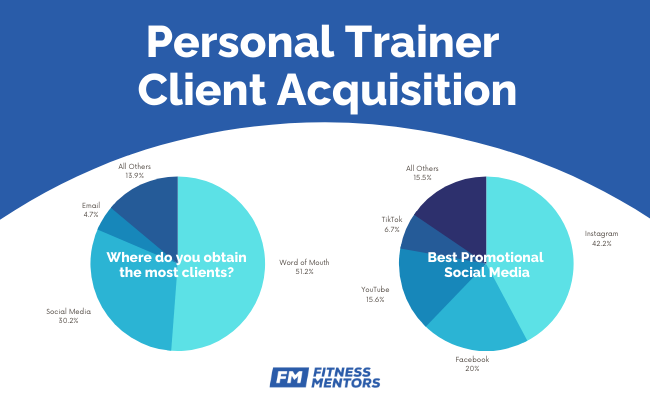
Over 50% of those surveyed by Fitness Mentors said their primary way to obtain clients is by word of mouth and referrals. Whether it’s a current client that recommended their services to someone else, or they just let members of their community know what they offer, most of their clients came this way.
Second to that was social media, where 30.2% of those surveyed said they obtain the most clients. So what’s the best social media platform for personal trainers to use? According to 42.2% of the personal trainers we asked, Instagram is the best place to promote their personal training business, followed by 20% that suggested Facebook is best and 15.6% that prefer YouTube.
Why did the majority choose Instagram? Likely because Instagram’s heavy reliance on photos makes for a great way to promote a business whose results are highly visual.
Fitness Apps, Software And Technology
Once we have our clients, what are the best ways to record their data and manage them?
Best CMS
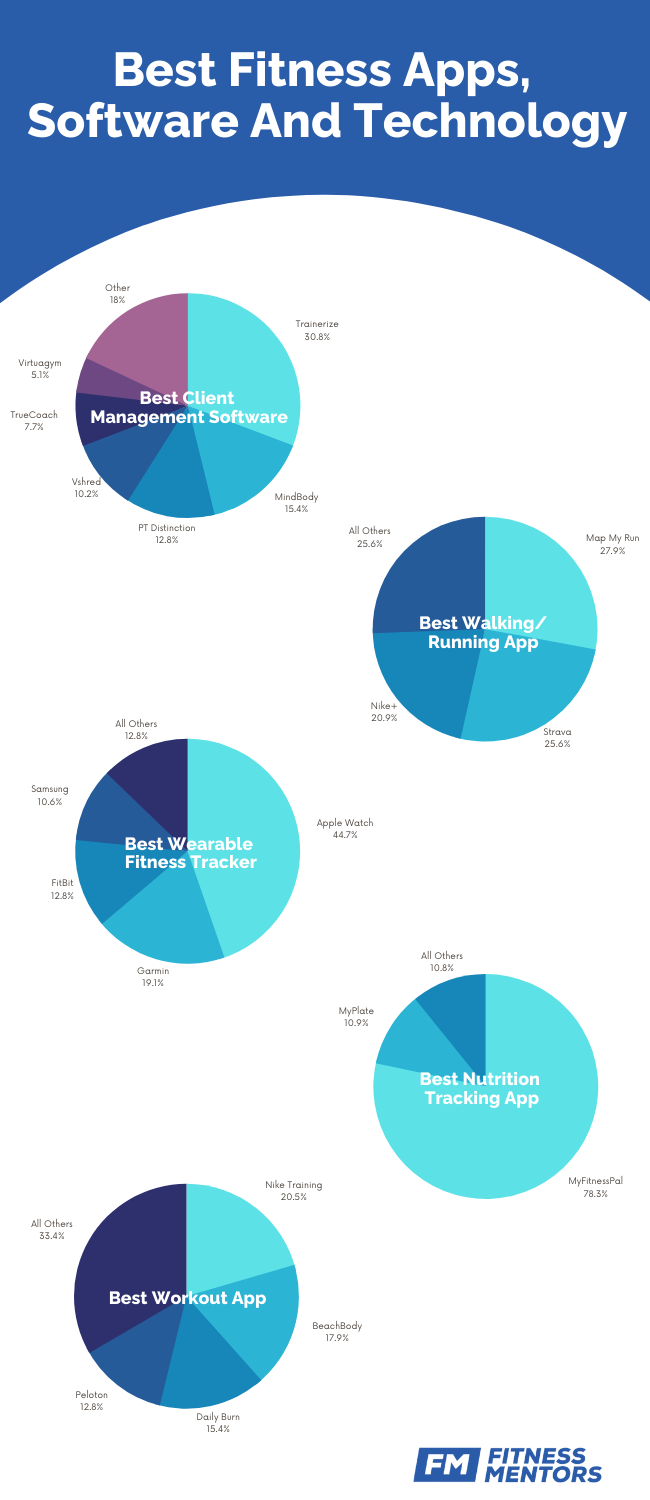
We asked our survey respondents what their choice is for the best client management software. The results were not unanimous, but nearly 31% of personal trainers said Trainerize is the best software, followed by MindBody at 15.4% and PT Distinction at 12.8%.
When we asked why Trainerize is their favorite, they talked about the many features like the ability to build customized training programs for their clients, track their progress, and even accept payments from them using the software.
So what about fitness and nutrition apps that personal trainers recommend for their own use and for their clients?
Best Nutrition App
Let’s start with nutrition – a big part of any personal trainer’s programs. The best nutrition tracking app that CPTs suggest their clients use is MyFitnessPal, which came in at 78.3%! Their many reasons involved the ease of use and the especially comprehensive database of foods and exercises.
Best Walking And Running Apps
When it came to walking and running apps to track your routes and progress, results were fairly close between three: Map My Run came in at 27.9%, Strava at 25.6%, and Nike+ at 20.9%. While it was a close call, the preference for Map My Run came because of the ability to track other activities besides just running. The app tracks cycling, interval training, walking, and more.
Best Fitness Training Apps
For virtual classes and training session apps, 20.5% of our surveyed trainers recommended Nike Training, while 17.9% preferred Beach Body. Both options allow the CPT’s clients to supplement their workouts with digital training that boasts anywhere-you-need-it accessibility.
Best Wearable Fitness Tracker
When it came to the best wearable fitness trackers, 44.7% of personal trainers answered their favorite was the Apple Watch. This was followed by 19.10% choosing Garmin, 12.8% who selected FitBit, and 10.6% who preferred Samsung.
With Apple and Garmin being two of the biggest names when it comes to wearable fitness trackers, you may wonder why CPTs lean more towards Apple. When we asked some of our voters, they said they prefer the Apple Watch because of the advanced features, such as the ECG and pulse oximeter sensors in the newer models.
The Personal Training Workouts
On to the single-handed most important aspect of personal training: the workouts themselves. With so many new trends and fitness strategies, it’s no surprise that personal trainers may differ on what they feel is the best. We surveyed to find out what the majority prefer, and here’s what we found.
Best Workout For Weight Loss
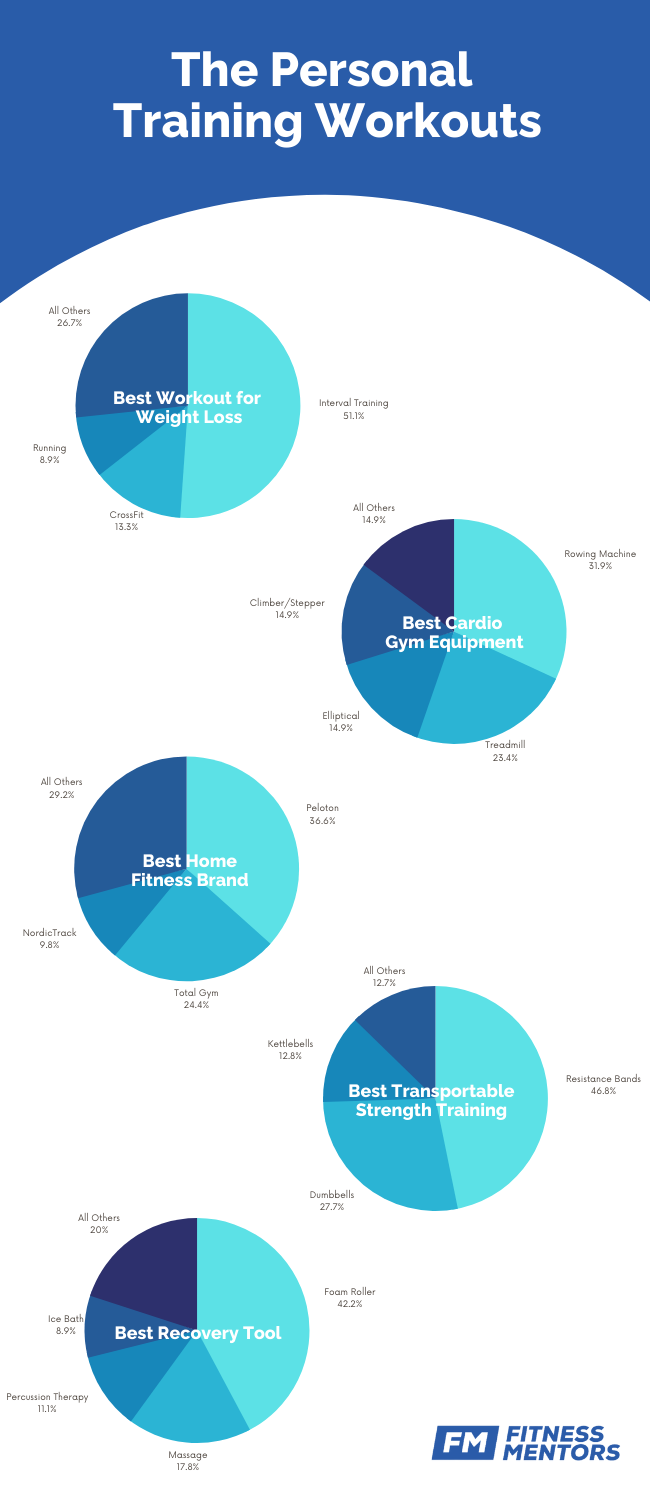
When we asked personal trainers what they think the best workout for weight loss is, the majority, 51.10%, said interval training. 13.3% answered that CrossFit is their preferred method, and 8/9% answered running.
The trainers who chose interval training said they did so because it helps your body continue to burn fat even after the workout is over.
Best Cardio Equipment
For those trainers working in gyms or studios, or recommending equipment to their clients, we asked what the best is for cardio. 31.9% chose a rowing machine, compared to 23.4% who said a treadmill. Ellipticals and steppers tied up at around 15%.
Rowing machines were a top choice because of their workout efficiency. They target 85% of your body’s muscles, which makes them the perfect workout if you had to choose just one piece of equipment.
Home Fitness Brand
So which equipment brand is a favorite amongst our surveyed personal trainers? 36.6% chose Peloton, while 24.4% chose Total Gym.
Peloton, which was once known solely for its stationary bikes, now offers treadmills as well. When we asked why the preference towards the brand, many responders told us it’s about the quality and technology within the fitness equipment. Since Peloton integrates with its app to allow motivation and tracking, it’s often a choice for those looking for that extra support.
Transportable Strength Training
One of the beautiful things about being a personal trainer is the ability to provide your services anywhere. We asked our group of personal trainers what their favorite transportable strength training is. 46.8% answered resistance bands, while 27.7% preferred dumbbells.
The trainers who preferred resistance bands did so because of their lightweight functionality, making them effective at muscle building, yet easier to travel with.
Workout Delivery
COVID-19 put a huge emphasis on at-home workouts, which includes virtual personal training. When we asked our surveyors what their preference was for delivering their sessions to their clients, 58.7% chose a hybrid combination of in-person and virtual to obtain the most success. 32.6% preferred completely in person, while 8.7% said purely remote.
The combination of virtual and in-person training was a clear winner.
Workout Recovery
Personal trainers have preferences for how they recommend their clients recover from a workout, as well. While resting is certainly one option, as far as other tools and techniques go, a foam roller was the highest recommended at 42.2%. This was followed by massage at 17.8% and percussion therapy at 11.1%.
The trainers said they preferred foam rollers because of their self-myofascial release that assists with tightness and soreness. They’re also easy to carry around and don’t take up a lot of space.
Personal Training Certification
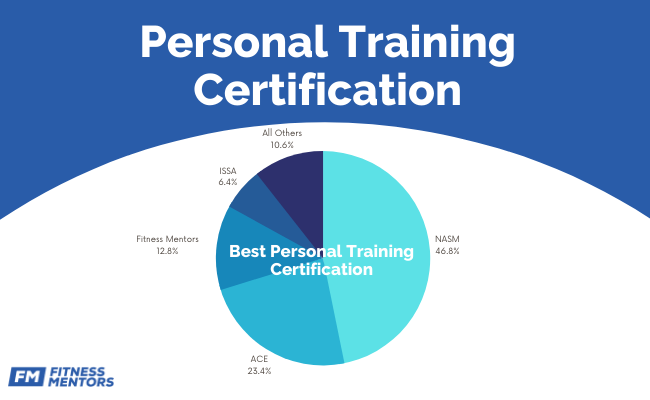
No two personal training certifications are exactly the same, and each has its own set of pros and cons that may make it better for one person over another. We asked our pool of personal trainers what their preference was for certification and CEUs. 46.8% answered NASM, while 23.4% said ACE, and 12.8% responded Fitness Mentors own certification.
You can read more about each certification here to mak the best choice for you.
Fitness Industry Trend Projections For 2026
If you’ve been wondering which fitness trends in 2026 are worth your timeand which ones are just hype you’re in the right place.
Whether you’re a personal trainer trying to stay ahead of the curve, or someone who wants to make smarter choices about your health routine, I’ve broken down the top fitness industry trends projected to dominate 2026 so you can make informed decisions fast.
Let’s get into it.
Why Fitness Trends Matter More in 2026 Than Ever Before
The fitness industry isn’t slowing down. Consumer expectations are higher, technology is smarter, and the way people define “working out” has fundamentally shifted since the pandemic. If I’m being honest with you, the trainers and health-focused individuals who pay attention to these shifts will build better habits, better businesses, and better results.
Here are the 10 trends I believe you need to know about.
1. Move-to-Earn: Getting Paid to Break a Sweat
What it is: Move-to-earn apps reward users with cryptocurrency for meeting physical fitness goals. The more you move, the more you earn.
I know what you’re thinking, is thisactually real?Yes, and it’s growing fast. These platforms combine blockchain technology with daily movement tracking to give users a financial incentive to stay active. Different apps use different earning models, but the core idea is simple: your steps, runs, and workouts translate into real rewards.
Why it matters for you:If you’ve struggled with motivation in the past, a financial stake in your fitness can change the game entirely. Gamification meets accountability.
2. Wearable Technology: The Fitness Tracker I Think Everyone Should Own
What it is:Smartwatches and fitness trackers that monitor heart rate, GPS, sleep, steps, calories, blood pressure, and more all from your wrist.
I can’t overstate how much wearable technology has evolved. What used to be a basic step counter is now a comprehensive health dashboard. Today’s devices give you insights that were once only available through clinical testing.
What I look for in a wearable:
- Real-time heart rate monitoring
- GPS for outdoor workouts
- Sleep quality tracking
- Blood pressure and heart rhythm alerts
Why it matters for you:If I want to improve my performance or my clients’ results, I need data. Wearables make tracking effortless and keep accountability at an all-time high.
3. At-Home Fitness: The Billion-Dollar Trend That Isn't Going Away
What it is:Structured home workouts supported by streaming platforms, on-demand classes, and digital coaching tools.
I find it fascinating that what started as a pandemic necessity has evolved into a genuine lifestyle preference. The at-home fitness market is expected to reach $14.74 billion by 2028and that tells me everything about where consumer behavior is heading.
Platforms like Peloton have proven that you don’t need a gym to build a serious fitness routine. With live classes, on-demand workouts, and community features built right in, the home gym is now more capable than ever.
Why it matters for you:Lower barrier to consistency. When the gym is your living room, you eliminate excuses.
4. Virtual Personal Training: I Can Coach You From Anywhere
What it is:Live, one-on-one or group personal training delivered via video conferencing platforms like Zoom, Google Meet, or Skype or asynchronously through recorded sessions.
This trend changed my entire view on what “local” means in fitness. Virtual training removes geography as a limiting factor. As a trainer, I can serve clients around the world. As a client, I can work with the besttrainer for my goals, not just the nearest one.
Why it matters for you:Flexibility, accessibility, and cost-effectiveness. Virtual training consistently delivers real results when the programming is solid.
5. Mindfulness in Fitness: The Mental Side I Used to Overlook
What it is:The intentional integration of meditation, breathwork, yoga nidra, and mindfulness practices into physical training routines.
I used to think mindfulness was separate from fitness. I was wrong. The data is clear mental resilience, focus, and stress management directly impact physical performance and recovery. Top athletes and trainers are now treating mental training with the same seriousness as physical conditioning.
What mindfulness in fitness looks like:
- Guided breathing between sets
- Post-workout meditation sessions
- Yoga nidra for active recovery and sleep optimization
- Body scan practices to build kinesthetic awareness
Why it matters for you:You can have the best program in the world, but if your mind isn’t in it, your body won’t follow.
6. Functional Fitness: Training for Real Life, Not Just the Mirror
What it is:Exercise programming that improves the movement patterns you use every day bending, lifting, pushing, pulling, twisting, and carrying.
This is a principle I stand behind completely. Functional fitness doesn’t isolate a single muscle in a vacuum. Instead, it trains your body as an integrated system. It actually is improving balance, coordination, mobility, and joint stability so you move better outsidethe gym.
Why it matters for you:Whether you’re 25 or 65, functional movement directly reduces injury risk and improves quality of life. That’s a return on investment no bicep curl can match alone.
7. HIIT Workouts: High Intensity, Maximum ROI on Your Time
What it is:High-Intensity Interval Training alternating short bursts of maximum effort with brief recovery periods.
I recommend HIIT to almost every client who tells me they’re short on time. It’s efficient, it’s proven, and it works. Research consistently shows HIIT burns more calories per minute than steady-state cardio, improves cardiovascular fitness faster, and continues burning calories post-workout through the afterburn effect (EPOC).
Why it matters for you:If I only have 20–30 minutes, HIIT is how I make every second count.
8. Outdoor Workouts: Why I Think Fresh Air Is Underrated
What it is:Taking training outside running trails, park workouts, outdoor bootcamps, cycling, swimming, hiking, and bodyweight circuits in natural environments.
There’s something about training outdoors that I genuinely believe makes you work harder without feeling like it. Studies support it too; outdoor exercise is linked to improved mood, reduced cortisol, and higher workout enjoyment compared to indoor training.
And the options go far beyond a jog. I’ve seen trainers use park benches for step-ups, trees for suspension training, and hills for sprint work. Get creative.
Why it matters for you:Variety breaks plateaus. Nature lowers stress hormones. Vitamin D supports recovery. Outdoor training checks all three boxes.
9. Smart Gym Equipment: AI-Powered Feedback in Real Time
What it is: Exercise machines and tools embedded with sensors and AI that analyze your form, count reps, track load, and deliver real-time performance feedback.
I’ve tested several smart gym devices, and what impresses me most isn’t the data, it’s the actionable insight. Instead of just knowing I did 10 reps, I know whether my form was compromised on reps 7 through 10. That kind of granular feedback accelerates improvement dramatically.
Why it matters for you:Smart equipment bridges the gap between training with a coach and training alone. It’s accountability, built into the machine itself.
10. Competitive Fitness: The Community-Driven Trend I See Everywhere
What it is:Organized competitive fitness events including CrossFit competitions, obstacle course races, and team-based fitness challenges.
Competitive fitness has something that solo training often lacks: community and external motivation. When I sign up for a race or competition, my training has a deadline, a goal, and often a team behind it. That changes everything about consistency and effort.
Why it matters for you:If you’ve ever struggled to stay motivated training alone, competition gives you a reason to show up. The community you build in the process is a bonus that keeps most people coming back.
A Final Word
These aren’t just trends I’m reporting on; these are signals about where the fitness industry is heading and what real people are responding to. Whether you’re a trainer building your programming for the year ahead, or an individual designing your own health journey, leaning into these trends gives you a structural advantage.
My recommendation? Don’t try to adopt all ten at once. Pick two or three that align with your goals or your clients’ goals, go deep on them, and build from there.
The fitness industry rewards people who stay curious and adapt. In 2026, that advantage has never been more available to you.

Eddie Lester
Read more from the category

Foods in Nature Lecture

Fitness Mentors CEO Eddie Lester Featured On AccuroFit Blog