Create an Entire Month of Fitness Content in One Afternoon Using AI


- All of our content is written by humans, not robots. Learn More
Most personal trainers know they should create content. The problem is finding the time to do it consistently. Between sessions, programming, client check-ins, sales calls, and running the business, sitting down to write an Instagram post can feel like another full-time responsibility. The result is often an inconsistent feed that gets updated only when the trainer has a free hour.
AI can help solve that problem.But the goal should not be to let AI create your fitness brand for you. The better approach is to use AI as a production assistant while your training knowledge, coaching experience, and understanding of your clients remain in control.
With the right workflow, one focused afternoon can give you enough material for an entire month.
Start With Client Problems
The strongest fitness content usually starts with a problem rather than a platform.
Think about the questions you hear repeatedly during consultations and training sessions. Beginners might ask why they are not getting stronger, while experienced clients may want to know how to break through a plateau.
Those conversations are valuable because they reveal exactly what your target audience wants to understand.
Start your content day by writing down 10–15 questions you have answered recently. These questions can become the foundation for your monthly content calendar instead of relying on random ideas generated by AI.
For example:
- Why am I not losing weight despite exercising?
- How many days per week should I strength train?
- Should I train when I am sore?
- Why has my progress stopped?
- How much cardio should I do?
- What should I eat before a workout?
- How can I exercise with only 30 minutes available?
Do not ask AI to invent these questions for you.
Your clients have already done that part.
Turn One Problem Into Multiple Pieces of Content
Once you have your list, choose approximately six to eight major topics for the month.
Each topic can become several different pieces of content.
For example, take the question: “Why am I not getting stronger?”
That could become a short Reel explaining progressive overload. You could create another post about common programming mistakes, a carousel covering recovery factors, and a longer blog article explaining how strength progression actually works.
The subject stays the same, but the format and angle change.
This is the foundation of efficient content repurposing. One expert explanation can become a video script, carousel, email, caption, or article without requiring you to develop a completely new idea each time.
If the first draft sounds too mechanical, you can paraphrase your AI text before adding your own examples and coaching perspective. The important part is that the final version still reflects what you actually believe and teach.
A single expert explanation can therefore produce a surprising amount of usable material.
The important distinction is that you are not copying the same paragraph five times. You are extracting different lessons from the same area of expertise.
Use AI for Structure, Not Authority
This is where many trainers make mistakes.
They enter “Give me 30 fitness posts” into an AI tool and receive 30 generic pieces of advice. The content may look polished, but it does not demonstrate why someone should hire that particular trainer.
Instead, give AI your expertise first.
Tell it who you train, what problems your clients have, what training philosophy you follow, and what you want the audience to learn. Then ask it to organize your knowledge into different formats.
For example:
“I train busy adults who want to build strength but only have three 45-minute sessions available each week. Create five content angles explaining how they can structure those sessions. Avoid generic motivational advice and focus on practical training decisions.”
That prompt gives the AI context.
You can then ask for a Reel script, carousel outline, email, blog outline, and short social post based on the same material.
The AI is now helping with production rather than pretending to be the coach.
Create a Monthly Content Framework
A month of content should have structure.
If every post is a workout, your audience may learn something but never understand your coaching approach. If every post is motivational, you may generate engagement without demonstrating much technical expertise.
A balanced content calendar can include four main categories.
| Content Category | Purpose | Example |
|---|---|---|
| Education | Demonstrate expertise | “Why Progressive Overload Matters” |
| Practical Training | Give immediate value | “30-Minute Full-Body Session” |
| Client Problems | Address objections | “Why You Keep Missing Workouts” |
| Authority & Trust | Show your coaching approach | “How I Modify Training for Beginners” |
You can also include client stories, behind-the-scenes material, frequently asked questions, and offers for your services.
The exact ratio depends on your business model. An online coach selling strength programs may need more educational content. A local personal trainer may benefit from more content showing personality, client experience, and local relevance.
The content should support the business you actually want to build.
Build a 30-Day Calendar With AI
Once your topics are selected, have AI organize them into a publishing schedule.
A simple weekly structure might look like this:
- Monday: Educational Reel
- Tuesday: Client problem or FAQ
- Wednesday: Workout demonstration
- Thursday: Educational carousel
- Friday: Personal or client story
- Saturday: Quick training tip
- Sunday: Rest, reflection, or optional community post
You do not need to publish seven days a week. Three or four high-quality posts per week can be more sustainable than trying to publish every day.
The purpose of the calendar is to remove daily decision-making. When you already know what Tuesday’s post will be, you no longer have to spend 20 minutes deciding what to publish.
Create Your Video Library in Batches
Written content is only part of the system.
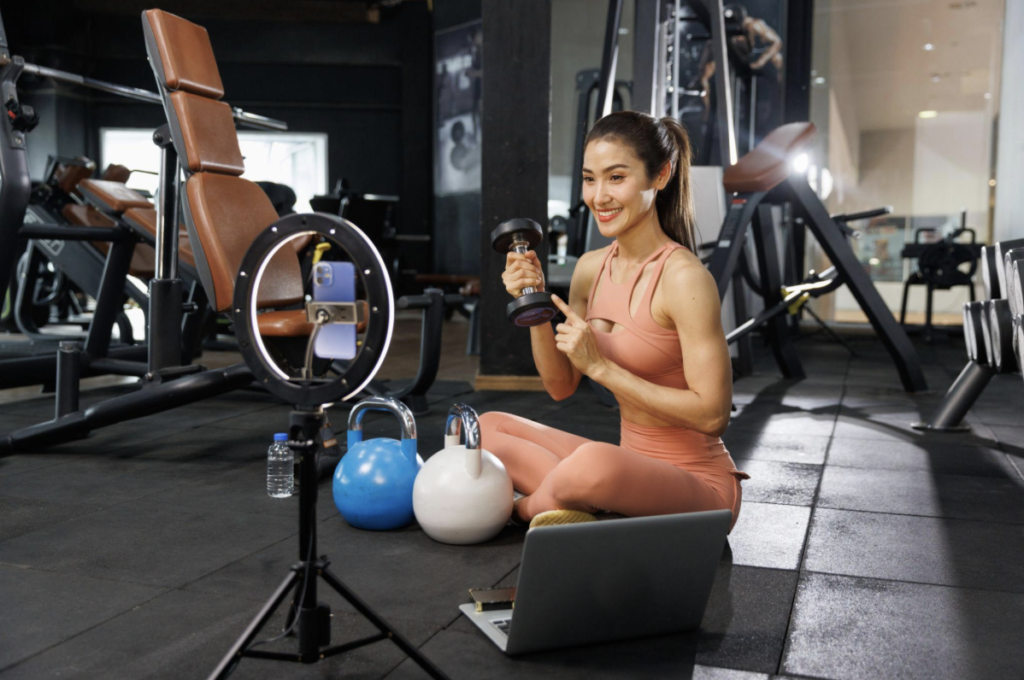
Fitness professionals should also build a library of original video footage. You can then reuse that footage across multiple posts.
Set aside one training session to record exercise demonstrations. Film movements such as squats, lunges, rows, presses, hinges, carries, mobility exercises, and common technique corrections. Record several variations while you are already dressed and in the training environment.
You can also record short explanations.
For example, instead of filming one long video called “Everything You Need to Know About Squats,” record individual clips covering knee position, depth, bracing, stance, common mistakes, and beginner modifications.
Those clips can become separate pieces of content.
AI can then help create hooks, captions, subtitles, descriptions, and alternative versions without requiring you to record yourself repeatedly.
Give AI Your Professional Voice
Your content should sound like you.
This requires more than asking an AI tool to “write naturally.”
Give it examples of your existing captions, explanations, emails, or articles. Tell it how technical you want to be and what types of claims you avoid.
For example:
- Audience: Adults 30–50 who are returning to resistance training
- Tone: Professional, direct, encouraging
- Avoid: Extreme claims, fear-based language, fitness clichés
- Teaching style: Explain the reason behind each recommendation
- CTA: Encourage readers to save the post or ask a question
This gives AI boundaries.
After generating the copy, you can use an AI Humanizer when you want to identify sections that feel overly formulaic or unlike your normal writing style. The final edit should still come from you, especially when the post includes professional training advice.
Add the Details AI Cannot Know
Generic advice is easy to produce. Useful coaching advice requires context. Suppose AI writes, “Train three times per week for the best results.”
That statement may be reasonable for some people, but it is not a complete coaching explanation. Your audience needs to understand why three sessions might work, when two sessions may be sufficient, and what factors should influence training frequency.
This is where you add your expertise. Explain the trade-offs. Give an example. Mention the beginner who has never lifted before, the parent with limited recovery time, or the experienced client preparing for a specific goal.
Specific examples make educational content stronger. They also help potential clients understand how you think as a coach.
Spend One Afternoon Building the System
You can divide your content in the afternoon into four stages.
First 45 minutes: Identify client questions and choose your monthly topics.
Next 60 minutes: Use AI to develop outlines, hooks, scripts, captions, and content variations.
Next 60 minutes: Record exercise demonstrations and talking-head videos.
Final 45 minutes: Review, edit, add personal examples, create graphics, and schedule the content.
That gives you a four-hour production block.
The exact timing is less important than the sequence.
You first decide what your audience needs, then create the material, then produce the supporting visuals, and finally schedule everything.
Before publishing, check grammar errors and review the wording manually. Grammar is only one part of quality control, so also verify exercise terminology, statistics, research references, and any claims that could affect how a reader approaches training.
Review Every Fitness Claim Before Publishing
AI can make incorrect information sound extremely confident.
That creates a particular problem for fitness professionals.
Never publish an exercise, nutrition, recovery, or health claim simply because an AI tool produced it. Check statistics, research references, exercise recommendations, and statements that could be interpreted as medical advice.
You should also remove exaggerated promises.
“Build 10 pounds of muscle in four weeks” may attract attention, but it can damage your credibility. A technically accurate explanation of what influences muscle growth is far more valuable for building a professional reputation.
Your content represents your coaching business.
Treat it with the same level of care you would give a client program.
Measure Content Like a Business Asset
Creating content is not the final step. After several weeks, review what happened.
Look beyond likes. Track saves, shares, comments, profile visits, website traffic, consultation requests, and new leads.
Suppose your exercise demonstration videos receive fewer likes than motivational posts but generate more profile visits and consultation requests.
The motivational posts may look better in your dashboard, but the instructional videos are producing more business value.
That distinction matters. Your next month’s content should be based partly on those results.
If beginner strength content consistently performs well, create more advanced posts around the same subject. If certain topics receive little response, either improve the angle or stop spending time on them.
The Goal Is Consistency With Expertise
AI does not eliminate the need for a personal trainer’s expertise. It eliminates some of the repetitive work around expressing that expertise.
The most effective system is simple: identify real client problems, build a monthly topic structure, use AI to repurpose your knowledge, record original footage in batches, review every claim, and measure what produces meaningful results.
One afternoon can then create the foundation for an entire month of content. You are no longer asking, “What should I post today?”
You are building a repeatable content system that turns your everyday coaching experience into educational material that attracts, informs, and builds trust with potential clients.

Eddie Lester
Read more from the category

How Personal Trainers Can Help Older Clients Consider a Medical Alert Device

A Practical Guide to Understanding Anxiety Disorders - A Personal Trainers Perspective