ACE vs NASM: What’s the Best CPT for You?

ACE vs NASM: What’s the Best CPT for You?
You’ve made the wise decision to pursue a career in personal training. Fantastic!

Now, on to the next major decision. Which certification should I pursue, ACE or NASM?

I’ll detail some very important factors regarding ACE vs NASM, and by the end of this post you’ll be able to determine which CPT is right for you. It should also preface that I have a certification in both, so I can provide realistic views of which cert may be better for who.

NASM vs ACE Video Review

ACE VS NASM VS CPT Overview

Before you make a decision on your CPT, it pays to know a little bit about what makes each organization unique.

The American Council on Exercise (ACE) was founded in 1985 under the name IDEA Foundation, with the goal of becoming one of the first major fitness education bodies with national credibility. ACE places a strong commitment to create global impact and “facilitate partnerships with policymakers, fitness industry leaders, community organizations and the Healthcare Industry.”

The National Academy of Sports Medicine (NASM), the younger of the two at its 30th year, is a global leader in fitness certifications with recognition all over the world. NASM certification is built on evidence-based science. They focus their health and fitness solutions on evidence and research that they use to craft their training and knowledge programs. NASM boasts that their certifications “require the most comprehensive knowledge of human movement science, functional anatomy, physiology and kinesiology, as well as functional assessment and program design.”

Both organizations are NCCA-certified, the gold standard for fitness certifications.

ACE vs NASM: An Objective Look into Other CPT Considerations

Price of ACE & NASM Study Packages and Exam

We did some research into the cost of the cheapest study package and test. Here’s what we found:

ACE is the cheaper of the two CPTs, coming in at $599*. (Click here for 30% Off) Their most basic package includes:

  • ACE Personal Trainer Manual
  • ACE Personal Trainer Manual Study Companion
  • ACE’s Essentials of Exercise Science for Fitness Professionals
  • ACE Academy Elite 2018 (Interactive Study Platform)
  • Access to Personal Trainer Resources
  • ACE certification exam
  • ACE Personal Trainer Manual eBook

NASM comes in at $799 (Click here for 30% Off) and is the most expensive of all CPTs that we evaluated in our initial best personal trainer certification analysis. This cost includes:

  • NCCA Accredited Exam
  • Textbook (hard copy and PDF)
  • Lectures Videos
  • Exercise Library
  • Cueing Library
  • Practice Exams
  • Quizzes
  • Study Guide

*Note: these prices are subject to change and sale prices may reflect different numbers.

WinnerACE

Pass Rate of ACE & NASM Exam

Both ACE and NASM are known for having somewhat difficult exams that require extensive study, as well as knowledge, on challenging topics such as anatomy, physiology and biomechanics. While there are tests with significantly higher pass rates in the industry (ISSA’s pass rate is 89.9%), these certification bodies ensure you obtain the knowledge necessary to become a stellar trainer.

The focus of education:

  • ACE: Program Design, Implementation, and Modification
  • NASM: Exercise technique and training instruction

NASM Exam Pass Rate: 64.3%

ACE Exam Pass Rate: 65%

Winner: Tie

Number of Test Questions on the ACE & NASM Exam

NASM has the fewest test questions in the industry as a whole, whereas ACE has amongst the most. If you are the type of test taker who’s mind goes blank due to testing anxiety, you may want to consider a shorter test.

BelowNumber of test questions / total test time / minimum passing score

NASM: 120 questions / 120 minutes/ 70% or higher is passing

ACE: 150 questions / 180 minutes / 62.5% or higher is passing. 800 points available based on scaled questions 500 points needed to pass

Winner: NASM

CEU Requirements for ACE & NASM

Maintaining your certification via continuing education is required by both ACE and NASM as well as all other personal trainer certification bodies. The more CEU hours you need to get within a certification period, the more time and money you have to spend.

Fortunately, both ACE and NASM have similar recertification requirements as well as similar costs.

NASM: 20 hours of CEUs and $99 to recertify every 2 years

ACE: 20 hours of CEUs and $129 to recertify every 2 years

Winner: Tie

Certification Popularity for ACE & NASM

This factor is based on the number of trainers with a given certification, something to consider if you are looking for evidence as to what other trainers are doing in the industry.

Unfortunately, when we called NASM they said they don’t publish numbers on how many trainers have earned their CPT. They did, however, mention that they have twice as many as their competitors combined. We do have data on ACE that showcases they have about 45,000 trainers certified.

Without throwing out some unverifiable number, let’s just say NASM has 50,000 trainers with their CPT.

WinnerNASM

Average Income of ACE or NASM Personal Trainers

How much will I make as an ACE trainer? How much will I make as a NASM trainer?

These are common answers that I get that I have an answer for! While ACE and NASM don’t publish this information I was able to extrapolate it from self-reported data on reputable websites such as payscale.com. These incomes are averages of 30+ different people holding the same certification currently working as fitness professionals.

To me, this consideration may outweigh some of the others study materials cost, pass rate, CEUs, etc. because an upfront investment can pay dividends down the road.

Unsurprisingly, NASM and ACE are at the top tiers of average incomes for personal trainers.

NASM average income: $41,598

ACE average income: $41,546

Winner: Tie

It should be noted that the mere acquisition of a NASM or ACE CPT doesn’t mean you’ll make $41k, nor does it mean you’ll be limited by that income amount. Your success as a personal trainer is dependent on a lot of other factors including your business acumen, how you market yourself as a trainer, and other factors like geography and approach.
slider Female PT1

Which CPT is Better ACE or NASM?

Now you have some objective (and subjective) data for which to make a decision about moving forward with an ACE or NASM CPT. Based on the above data, NASM gets a slight nod based on the popularity of the certification. However, this factor can be considered subjective, and is unlikely to affect your ability to get a job or train.

That said, these certifications are both fairly even in the areas of exam difficulty, CEU requirements, and average income.

The bottom line is that you need to identify which factors are the most important to you and determine how the career path you want to follow necessitates one CPT over the other.

ACE vs NASM: Thoughts from a trainer with both certifications

When considering either certification it is first important that you check with the employer you’d like to work for to ensure they accept one or both of the certifications, as that can provide the direction you need.

As stated above, both certifications are nationally accredited which will get your foot in the door almost anywhere. What truly matters is what elements from above have the biggest impact on you? Cost, test-length, income, popularity/reputation? They both require abundant study time and are difficult to pass. (If it’s grasping the material is a concern we have you covered as we provide the best study tools to help you easily pass either test and become a successful personal trainer.)

My final thought would be that NASM provides an easier to use programming model (the OPT Model) that is great for new trainers, while ACE focuses their education on working to assist clients in optimizing their behaviors. If you feel you would struggle with the coaching of clients and want to improve in that area, go with ACE. If you feel you want to have more knowledge of how to design an effective workout program, go with NASM. For more information on how to become a personal trainer, check out our post on that topic.

Feel free to give us a call and we can always help point you in the right direction (424) 675-0476.

Reviews of our ACE & NASM Study Materials

Personal Trainer Career Roadmap

Featured Posts
Subscribe
To Our Blog

ACE CPT Review 2026 | Pass Rates, Study Guides & More

ACE Personal Trainer Certification Review

Considering getting your CPT with the American Council on Exercise (ACE)? Here’s an ACE CPT review to help you decide if this certification is right for you.

First and foremost, ACE is NCCA accredited, meaning the National Commission for Certifying Agencies has identified their coursework as reputable and meets the criteria for what is considered a high-quality program within the personal training industry. This also means that this CPT gives you a high likelihood of getting you a job within a gym.

It is also one of the most popular of the personal trainer certifications, with our research indicating that there are over 13,100 tests taken each year, second only to NASM. Like NASM, the cost of ACE’s study materials and test are a bit higher than most. The cheapest study package and test sits at $599, whereas some of the other CPTs fall around the $500 range.

While slightly more expensive up front, ACE looks to be a good investment as the average income of an ACE personal trainer is amongst the best in the industry. ACE personal trainers, on average, make $41,546 per year, second to only NASM trainers. Of course, there are a lot of other factors that allow a trainer to earn more, and we recommend this online course for learning many of them.

ACE also has modest continuing education (CEU) requirements. Trainers are required to take 20 hours of CEUs and the current cost is $129 to recertify every 2 years.

The exam is comprised of 150 questions, and a 62.5% or higher gets you an ACE CPT. The focus of ACE’s education is Program Design, Implementation, and Modification, meaning you’ll learn how to design programs for your clients, help them achieve success within them, and modify them as necessary as their skillsets improve.

General Consensus on Difficulty of the ACE CPT Exam

In our analysis of personal trainer exam pass rates we found that ACE was sort of middle of the road at 65%. The exam with the highest pass rate is ISSA at 89.9%, but that exam is open book.

The consensus we have heard about the exam from actual test takers is that the questions are subjective and there always seems to be more than one right answer. Another thing we frequently hear is that the ACE study materials are somewhat inconsistent with the information that is provided on the exam, making some feel inadequately prepared after solely relying on these.

This is why we recommend learning how to study for the ACE CPT but also what to study to ensure you pass the first time. The Fitness Mentors’ free ACE Study Guide will help you along your path. If you really want to get serious, check out our Premium Study Guide that focuses on the subjects that are most important to pass the ACE CPT.

circles@2x 1
cross 1

Five Secrets to Passing your ACE-CPT Exam

Featured Posts

Subscribe
To Our Blog

Personal Trainer Stats 2026

Personal Trainer Stats 2018

Personal Trainer Statistics 2026: Salary, Job Growth & Career Outlook

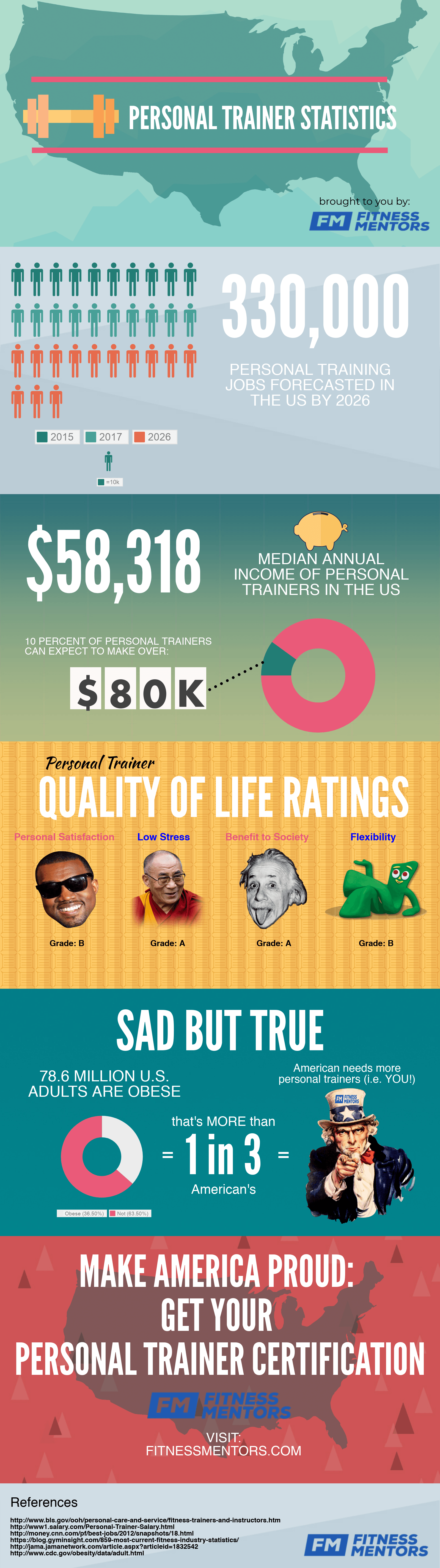
Now is one of the best times in recent history to pursue a career as a personal trainer in the United States. The fitness industry has demonstrated remarkable resilience and continued expansion, fueled by growing public awareness of preventable chronic diseases, surging demand for personalized wellness programs, and a post-pandemic fitness boom that has kept gym memberships and one-on-one coaching in high demand.

Many personal trainers are drawn to the profession because it offers a rare combination: a career with genuine purpose helping clients transform their health, confidence, and quality of life alongside a flexible, active work environment. Whether you prefer working on the gym floor, training clients outdoors, running virtual sessions, or building a private practice, few careers offer this level of variety.

With the right credentials particularly a nationally accredited personal training certification you can capitalize on strong projected job growth, competitive salaries, and a field that genuinely needs skilled professionals. Below, we break down the key personal trainer statistics you need to know before starting your career.

Personal Trainer Job Growth: 330,000+ Jobs Forecasted

According to the U.S. Bureau of Labor Statistics (BLS), employment of fitness trainers and instructors is projected to grow approximately 14 percent through 2032 significantly faster than the average for all occupations. This translates to tens of thousands of new personal training jobs entering the market each year, with the total number of active positions expected to surpass 330,000 nationwide.

The BLS identifies a broad range of work settings where personal trainers find employment, including:

  •   Health clubs, fitness centers, and commercial gyms
  •   Hospitals and rehabilitation centers
  •   Corporate wellness programs
  •   Country clubs and resort spas
  •   Group fitness studios and boutique gyms
  •   Private in-home training
  •   Online and virtual coaching platforms

The diversification of training environments especially the rise of remote and hybrid fitness coaching accelerated by the COVID-19 pandemic means that today’s personal trainers have more pathways to build a sustainable career than ever before. Virtual training alone has opened up a national (and even international) client base for trainers willing to work online.

Personal Trainer Salary: What You Can Realistically Earn

Median Annual Income: $58,000–$62,000

According to salary data aggregators including Salary.com, the national average annual salary for a full-time personal trainer in the United States currently sits between $58,000 and $62,000. Roughly half of all personal trainers in the U.S. earn within this range, while the upper quartile typically those with several years of experience, specialty certifications, or high-demand clientele can earn $75,000 to $83,000 or more per year.

It is worth noting that the Bureau of Labor Statistics still publishes an older median pay figure closer to $40,000 for fitness trainers and instructors as a broad category. This figure includes part-time workers and group fitness instructors, which significantly drags down the average. Full-time personal trainers working in premium settings or running independent businesses tend to earn considerably more.

Salary by Experience Level

Experience is one of the strongest predictors of earning potential in personal training. Here is a general breakdown of what trainers can expect at different career stages:

  • Entry-level (0–2 years): $35,000–$45,000 per year often working at gyms on an hourly basis while building a client base
  • Mid-level (3–5 years): $53,000–$62,000 per year established clientele, potentially supplemented by group fitness or small group training
  • Senior/Specialist (5+ years): $65,000–$85,000+ per year typically hold advanced certifications, run independent businesses, or work in clinical or corporate settings

Geography also plays a major role in personal trainer compensation. Trainers working in high cost-of-living metros such as New York City, San Francisco, Los Angeles, Boston, and Seattle routinely command higher session rates and annual salaries than the national median. Using salary lookup tools filtered by zip code is a recommended step when evaluating the income potential in your local market.

How Specialty Certifications Increase Earning Potential

One of the most effective strategies for increasing your income as a personal trainer is to pursue additional specialty certifications beyond your initial CPT credential. Specialty certifications signal expertise to clients and employers, justify higher session rates, and open doors to niche markets that are often underserved and willing to pay a premium.

High-value specialty areas include:

  •   Pain Management and Corrective Exercise
  •   Special Populations (seniors, prenatal/postnatal clients, clients with chronic illness)
  •   Sports Performance and Athletic Conditioning
  •   Nutrition Coaching
  •   Group Fitness and HIIT

Online Training and Digital Program Design

circles@2x 1
cross 1

Personal Trainer Quality of Life and Job Satisfaction

Personal training consistently ranks among the highest-rated careers for overall quality of life. In an assessment by CNN Money and PayScale, personal training was ranked among the top 20 best jobs in America with strong marks across multiple quality-of-life dimensions:

  •   Personal Satisfaction: B — Trainers consistently report a high sense of fulfillment from helping clients reach meaningful health goals
  •   Stress Level: A — Compared to most professional fields, personal training is considered low-stress, particularly for self-employed trainers who control their own schedule
  •   Benefit to Society: A — With chronic disease, obesity, and mental health challenges on the rise, personal trainers are increasingly recognized as essential health professionals
  •   Flexibility: B — Personal trainers can often set their own hours, choose their clients, and determine where and how they work

Beyond the numerical rankings, personal training offers intangible rewards that are hard to quantify: watching a previously sedentary client complete their first 5K, helping an older adult regain mobility after surgery, or supporting someone through a complete lifestyle transformation. For many trainers, these moments are the real return on their professional investment.

The active nature of the job also means personal trainers are rarely sitting at a desk. Most trainers maintain a high level of physical activity themselves, are immersed in a health-positive environment daily, and frequently report better physical and mental health outcomes compared to sedentary desk-based careers.

The Obesity Crisis in America: Why Personal Trainers Are More Essential Than Ever

According to the Centers for Disease Control and Prevention (CDC), more than 40 percent of American adults are currently classified as obese a figure that has continued to rise steadily over the past two decades. When overweight adults are included, the proportion climbs to over 70 percent of the adult population.

Obesity is directly linked to an increased risk of type 2 diabetes, cardiovascular disease, hypertension, certain cancers, and mental health conditions including depression and anxiety. The economic cost to the U.S. healthcare system is estimated in the hundreds of billions of dollars annually.

Personal trainers occupy a uniquely powerful position in the fight against this public health crisis. Unlike physicians, who typically have only minutes to spend with patients, personal trainers spend hours each week with clients building trust, educating them on movement and nutrition, and providing the accountability and motivation that makes long-term behavior change possible. As trainers continue to expand their knowledge into evidence-based nutrition and lifestyle coaching, their role in preventive health care becomes increasingly significant.

For aspiring trainers, this public health context provides both a moral mandate and a commercial opportunity: the population that most needs help is large, growing, and increasingly aware that professional guidance is a key ingredient in sustainable weight management and lifestyle improvement.

How to Start Your Personal Training Career: Get Certified

The first step toward a career in personal training is earning a nationally accredited certification from a recognized certifying body. The most respected and widely accepted personal training certifications in the United States include:

  • NASM-CPT (National Academy of Sports Medicine Certified Personal Trainer) widely regarded as the gold standard for corrective exercise and functional training methodology
  • ACE-CPT (American Council on Exercise Certified Personal Trainer) known for its well-rounded, science-based curriculum and emphasis on behavior change
  • FM-CPT (Fitness Mentors Certified Personal Trainer) a competitively priced, comprehensive option with strong study support resources

These credentials are recognized by employers, health clubs, and clients nationwide. Holding a certification from one of these bodies demonstrates that you have met a baseline standard of knowledge in exercise science, program design, anatomy, nutrition basics, and client communication.

Once certified, the most ambitious trainers do not stop there. Pursuing continuing education units (CEUs) and specialty credentials throughout your career keeps your knowledge current, expands the client populations you can serve, and provides a concrete competitive advantage in an increasingly credentialed field

circles@2x 1
cross 1

The 5 Hardest NASM CPT Test Questions (and Answers)

The NASM CPT exam is notorious for being one of the most difficult fitness certification exams out there. They purposely try to make it difficult in many ways, like reaching into the depths of the text book to locate the one sentence where that test question can be found [take our free NASM CPT Exam Study Course and we’ll show you each sentence]. They also have many questions that you must truly understand the concept to get right. Regardless of the reason for these questions being hard, let us help you by explaining the top 5 hardest questions from the NASM CPT Exam. (This has been updated to reflect the newest version of the exam: Version 6). If you are preparing, using a NASM CPT practice exam can give you a realistic sense of what to expect.

BONUS!

Try our free NASM Practice Test below to see how you’d fair on the real exam:

circles@2x 1
cross 1

1. Which of the following is released into the synaptic terminal to stimulate muscular contraction?

  1. Calcium
  2. Troponin
  3. Acetylcholine
  4. Actin

To immediately analyze this question, it is a science-based and from chapter two, which they do point out in their study guide. Specifically, they tell you to memorized Figure 2.38. When memorizing this chart, the answer is only 1 of the 10 steps in initiating a muscular contraction. All of the above answers are also located in this chart, making it that much more difficult. Thirdly, the actual answer is abbreviated in the text, making you second guess yourself. All of these answers participate in muscular contraction, but the key words you must look at in the question is the ‘synaptic terminal’, as this will tell you which part of the muscular contraction they are focusing on.

Answer:  C : Acetylcholine

Many students prepare by reviewing NASM exam questions in addition to the book for extra clarity.

2. Get ready for the exam by using practice questions and mock tests that closely reflect the actual format and content

To vent a smidge, they don’t tell you what these topics are when you are reading in the book. They discuss the Length Tension Relationship and Force Couple, but never define what an altered version of either actually is. Yes, you could say its common sense, but the way they ask the questions leaves a little room for argument as to what the correct answer is. For example, “When the feet turn out due to tightness in the calves, which of the following has occurred? A. Altered Reciprocal Inhibition B. Altered Length Tension Relationship C. Altered Force Couple Relationship D. Muscle Imbalance”. Well we definitely know that this is an example of a muscle imbalance. But by definition, which they do not have in the book, misaligned joints or poor posture is an Altered Length Tension Relationship. This is your correct answer. My guess is they are trying to get you to use the principles they discuss as opposed to just saying it is a muscle imbalance. Tough stuff, but you just got it right for reading this. A CPT practice test is an excellent way to sharpen your ability to recognize subtle differences in phrasing.

3. Which muscle can internally rotate the hip when the foot is in the planted position touching the floor?

  1. Gluteus Maximus
  2. Adductor Longus
  3. TFL
  4. Vastus Medialis

Overall just a tough question as this would require you to memorize all the concentric actions of most the muscles in Appendix D. Luckily they don’t ask many muscle action questions, so don’t waste too much time, but knowing the basics to the larger muscles can help. In the back of the book the TFL does perform internal rotation, but adding, “when the foot is in the planted position touching the floor” throws most people off. The others are going to be external rotators of the hip or perform no rotation of the hip at all. The TFL is also associated with many muscle imbalances, so be aware this is not the only place that the TFL makes an appearance on the NASM CPT Test. While fewer questions ask about muscle actions, knowing the basics helps. Reviewing a NASM study guide can simplify these challenging sections.

4. Which exercise follows the Half Foam Roll in the lower extremity proprioceptive progression continuum?

  1. Bosu Ball
  2. Balance Beam
  3. Foam Pad
  4. Balance Disc

This question is one of the questions that point to a very specific section of the book that you would not think to memorize. Most of us have some basic training sense that would give us a good guess, but the answer can be found in table 10.1 in Balance Training Program Design section. The correct answer is the Foam Pad, but noting the asterisk at the bottom, “theses modalities come in many shapes and sizes that will dictate proper progression”. This tricks many test takers as the balance disk and foam pad are tough to choose from when thinking of the next progression logically. Studying the right material is sometimes better than relying on logic, (insert shameless plug here) and that’s why we highly encourage checking out Free Fitness Mentors Study Guide for the NASM CPT Exam. Some students even search for a NASM CPT exam answers PDF to cross-check their knowledge, but structured practice materials are far more effective.

5. Which of the following supplements have the greatest potential for excess dosage in adults?

  1. Selenium, Magnesium, Vitamin D and Thiamin
  2. Vitamin A, Vitamin D, Iron and Zinc
  3. Vitamin A, Iodine, Potassium, Vitamin K
  4. Vitamin E, Vitamin B12, Biotin and Manganese

Uggghhhh. Pure agony. Of course you studied this, right? Well you know a few that might be considered toxic in excess amounts, but you can’t recall all of them can you? I know the feeling and this one gets most all test takers. Looking to Chapter 18 – Nutrition and Supplementation. You’re going to find this in the first two paragraphs after Table 18.3 – Comparison of Dietary Reference Intake Values (for adult men and women) and Daily Values for Micronutrients with the Tolerable Upper Intake Levels, Safe Upper Levels, and Guidance Levels; they couldn’t have named that chart any better. Every supplement has the potential for excess dosage when taken in extreme amounts, but NASM is looking to make sure you know the ones that are most common for our society, eating the American diet. Looking at the paragraph below Table 18.3, they list 3 vitamins and 2 minerals that specifically that can cause serious adverse effects, which are Vitamins A, D, B6, Iron and Zinc. For preparation, resources like NASM CPT Quizlet can be useful for quick review, but be sure to rely on official materials for accuracy.

These questions will now be a ton easier once they show up on the test. 5 questions down, 115 to go. NASM can pull questions from any sentence in the book which makes the 600+ pages daunting for the unmotivated reader (Our Free Audio Lectures take you page by page through the text and explain everything to make this process easier). Check out more of our tips and tricks to passing the exam by signing up to receive the “5 Secrets to Passing Your NASM CPT Exam”. Also if you need more help we have some great premium materials, like our Practice Tests for the NASM CPT Exam that make this test a breeze. Check them out here. (If you can score above a 108 out of 120 on all three of our practice final exams you are ready to test.)

circles@2x 1
cross 1

Five Secrets to Passing your NASM-CPT Exam

Featured Posts

Subscribe
To Our Blog

8 Ways to Jumpstart Your Personal Training Career in 2026

Fitness Mentors 8 Ways to Jumpstart Your Personal raining Career

Use this simple guide to jumpstart your personal training career in 2026. Here are the steps needed to go from personal training weakling to personal training career beast mode in no time:

  1. Start at the Beginning

First things first, know that before you get into personal training you need to be 18 or older, have a high school diploma or GED and be CPR certified.

  1. Get Credentials

There are many personal training accreditation bodies. Find one that works for you and study for the test. Our personal favorite is the NASM. Study for the NASM-CPT.

  1. Extra Credentials

Extra credentials will set you apart from the pack and allow you hone in on the areas of personal fitness that you are most interested in.

  1. Build on Your Foundation

Most really successful personal trainers find a niche that they excel at. This can be yoga, buy xenical online discount power lifting or martial arts. Whatever yours is, become the best at it.

  1. Your Fitness Theory

This is what really defines you as a personal trainer. Your thoughts and feelings about health, how you promote it, the exercises you recommend and your nutritional habits all define your fitness theory.

  1. Personal Branding

You are a reflection of your product. Make sure your personal brand reflects someone who is strong, healthy and fit.

  1. Product Branding

This is where you tell your story and show the world what being a client of yours will bring to the table. It also incorporates branded exercises or fitness strategies unique to your name.

  1. Business Registration

While not necessarily the last item you should tick off this list, registering your business and making it all legal is a top priority.

circles@2x 1
cross 1

Personal Trainer Career Guide: Beyond Your CPT

Earned your CPT now what? Whether you’re training clients at a commercial gym, running outdoor boot camps, coaching at a CrossFit box, or building a private studio from scratch, one thing is certain: getting certified is just the starting line.

The real challenge and the real opportunity is what comes after the cert. How do you market yourself in a crowded fitness industry? How do you stand out, build a loyal client base, and actually grow a career you love?

This guide was built for that exact moment. Whatever your environment, your goals, or your training style, you’ll find actionable strategies here to help you evolve from certified trainer to thriving fitness professional. Feel free to jump to the sections most relevant to where you are right now.

Beyond the PT Certification

Your CPT gets you in the door. But here’s the hard truth: no client has ever chosen a trainer based on which certification body issued their card. Think about it when was the last time a prospect asked, “So, are you NASM or ACE certified?” It just doesn’t happen.

What does move the needle? Specialized credentials that signal expertise, build trust, and make you the obvious choice for the clients you actually want to work with.

Why Stacking Credentials Within One Authority Makes Strategic Sense

When we work with trainers advancing beyond their initial CPT, we typically recommend staying within the same certification authority NASM being a prime example for two practical reasons:

  1. You’re already fluent in their methodology, so the learning curve is lower.
  2. Add-on certifications count toward your Continuing Education Credits (CEUs), making recertification smoother and more cost-effective.

This logic applies no matter which body you’re certified through not just NASM.

Choosing the Right Add-On Certifications

The best additional credentials aren’t the most prestigious ones they’re the ones that make you most valuable to your ideal client. Ask yourself: Who do I want to serve, and what problems do they need solved?

  • Corrective Exercise Specialist (CES) — ideal if you want to help clients move better, recover from injury, or train around chronic pain. This is a massive differentiator as more clients deal with desk-job posture issues and past injuries.
  • Fitness Nutrition Specialist (FNS) — perfect if your clients want a complete transformation, not just a workout plan. Being able to guide nutrition puts you miles ahead of trainers who can only touch one side of the equation.
  • Performance Enhancement Specialist (PES) — the go-to if you’re working with athletes or clients chasing peak performance. Speed, power, agility this cert speaks the language serious athletes respect.
  • Mixed Martial Arts Specialist (MMAS) — a standout niche credential for trainers working with combat sports athletes or clients who want high-intensity, functional conditioning with real-world application.

Your extra certifications are your competitive edge. Choose them intentionally, align them with the clients you want to attract, and watch how they transform both your confidence and your reputation.

What Exactly Is a "Fitness Theory"- and Why Does It Matter?

Your fitness theory is your core belief about what true health really is. It’s your why the philosophy that drives every workout you program, every habit you recommend, and every conversation you have with a client.

Think about how Coca-Cola operates. They’re not selling carbonated sugar water they’re selling happiness, nostalgia, and connection. The product is just the vehicle.

As a personal trainer, the same principle applies. You’re not selling sweat, sore muscles, or early morning wake-up calls. You’re selling confidence. You’re selling the feeling of walking into a room and owning it. You’re selling the version of your client they’ve always wanted to become. Your fitness theory is what makes that transformation feel real and it’s also your most powerful sales tool.

Why Most New Trainers Get This Wrong

Here’s something most trainer education programs won’t tell you: when you’re just starting out, it’s easy to borrow someone else’s philosophy and run with it. That’s exactly what I did early in my career. I was selling a theory I didn’t fully believe in piggybacking off respected trainers, going through the motions, and wondering why my sessions felt hollow.

The turning point came when I stopped performing someone else’s playbook and started building my own. The moment I began training clients through the lens of my beliefs about health, everything shifted my confidence, my client relationships, and my results.

The lesson? If you don’t believe what you’re selling, your clients won’t either. Authenticity isn’t a nice-to-have it’s your foundation.

5 Questions to Help You Define Your Fitness Theory

Set aside 10 minutes and write down your honest answers to these:

  1. What does health truly mean to me? Beyond aesthetics — physical, mental, emotional?
  2. What does my daily routine look like to actively promote health? Be specific.
  3. What types of training have delivered the best results in my own body? What worked, and why?
  4. What do I eat — and what’s the reasoning behind those choices?
  5. How do I believe lasting habits and behavior change are created?

Don’t rush this. These answers are the raw material of your brand, your messaging, and your client experience.

You Are Your Own Best Case Study

Once you’ve written your answers do you believe them? You should. Because your clients are watching you far more closely than you realize. You are the living proof that your theory works.

If you believe health is the alignment of physical strength, mental clarity, and nutritional balance does your lifestyle reflect that? If you preach whole foods, consistent training, and recovery are you walking that talk?

Unlike the overweight physician advising patients to “eat better,” you have the rare opportunity to be the embodiment of your message. Your body, your energy, your daily habits they are your most persuasive marketing asset. Own them

Why Documenting Your Fitness Theory Is a Game-Changer

Why Documenting Your Fitness Theory Is a Game-Changer

You’ve done the hard work of defining what you believe about health and fitness. Now it’s time to turn those beliefs into tangible assets your clients can hold, follow, and refer back to long after your session ends.

There’s a significant difference between telling a client what to eat and handing them a personalized nutrition document that lays it all out clearly. One is forgotten by Tuesday. The other becomes a reference they return to again and again. Documentation transforms your expertise from a conversation into a system and systems build trust, consistency, and results.

What to Create and Why

Start building a library of core documents that bring your fitness theory to life:

  • Fitness Programs — structured, progressive training plans tailored to your methodology. These aren’t generic templates; they should reflect your training philosophy and the specific goals of your client base.
  • Meal Plans — practical, realistic nutrition guides aligned with your dietary beliefs. Whether you advocate for whole foods, flexible dieting, or performance-based nutrition, your meal plans should feel like an extension of your brand.
  • Behavioral Change Strategies — this is where most trainers fall short. Physical transformation is 20% exercise and 80% mindset and habit. Documenting strategies for building consistency, overcoming setbacks, and rewiring daily routines sets you apart as a coach, not just a trainer.
  • Exercise Charts & Reference Guides — visual, easy-to-follow resources clients can use independently. These build confidence between sessions and reinforce your value even when you’re not in the room.

Your Documents Are Also a Revenue Stream

Here’s something worth sitting with: the documents you create to serve your clients can also become products you sell. A well-crafted 4-week meal plan, a beginner strength training program, or a habit-building workbook can be packaged and sold to clients, online audiences, or the general public generating income that doesn’t require you to be physically present.

You’re in the business of transforming lives and building a sustainable career. Your intellectual property has real value treat it that way.

Build for Consistency, Not Perfection

Ground every document in research, your own expertise, and real client outcomes. The goal isn’t to create a perfect masterpiece on the first try it’s to build replicable systems that deliver consistent results across every client you work with.

Think of it like a great restaurant chain: whether a customer walks into a location in New York or Dubai, the experience should feel identical. Your documentation is what makes that level of consistency possible and consistency is what builds an undeniable reputation.

Personal and Product Branding

Remember when you answered the question above “What is my daily routine to promote health?” This is essentially your own personal version of branding. 

Personal branding is a fairly easy concept to grasp but one that you should be conscious of and evoke in your day-to-day life. For example, people in your local community that see you at the grocery or health foods market will see the food choices you make. 

They’ll notice that you make healthy food choices and that McD’s isn’t part of your diet. They’ll also notice, if you’re anything like 90 percent of the personal trainers out there, that you are always wearing fitness clothes, probably because you just got out of the gym or engaged in some type of training. With all this healthy eating and training you are doing you are probably looking pretty good. 

You know what, people who look good get a lot of attention and your attractiveness has a lot to do with your personal brand. Extend your personal brand to your clients and encourage them to eat like you, workout like you and let their friends know what they are doing to live this great life of health and fitness.

Product Branding

Product branding is equally as important to personal branding but will take a bit more consideration and implementation. Above we mentioned that you’re selling the confidence, self-esteem and attractiveness that comes with being in shape in your personal brand. 

Let’s think about some ways that can translate into selling your product.

First, let’s consider what a personal trainer’s product could look like. Again, keeping in mind that what you are really selling is a lifestyle change, let’s look at what the tangible objects are that will get you there. What better place to look than what the 10 highest paid personal trainers are selling. 

Here’s some examples of what a few of these personal trainers “sell” to get the reputation they have (based on an article from WeightTraining.com).

Bernardo Coppola– along with training celebrities, Coppola is known for challenging his clients to eat less sugar, processed foods, avoid caffeine, alcohol and sodium and has even developed a catering company and restaurant around this product.

Tracy Anderson– creator of the “Tracy Anderson Method,” a Pilates-style program that introduces members to new exercises, stretches and lots of reps.

David Buer– often recognized for selling his story of being bullied for being fat as a boy, Buer now has his own fitness blog in the Huffington Post. He is also known for helping clients with injuries and post-surgical rehab.

Can you see how these famous personal trainers sell not only their personal brands but also their own product based on their beliefs and expertise? How can you incorporate your interests, certifications and desires of your clients into a product brand that is targeted and desirable? 

Here are some tips to help you get started:

  • Define Your Brand
    • Use your fitness theory to clearly define what it is that can help make a difference in people’s fitness and health. Above, Coppola’s brand involved a clearly defined way of eating or put another way, not eating.
  • Define Your Audience
    • Who are the types of people who would benefit from your fitness theory? What demographic research can you find on them that is quantifiable? Address specific ages, incomes, occupations, personality types and any other data you can get your hands on to learn about who you will be appealing to.
  • Create Your Brand Name
    • Will it be like the “Tracy Anderson Method,” the “Booty Fit Club,” “Five Minute Abs” or some other type or personal name? Keep it simple and use your fitness theory as a basis.
  • Tell Your Story
    • Were you once a chubby little kid with an accent that got picked on like Buer? What is it that motivated you to create your product?
  • Create a Logo and Tagline
    • Keep it simple here too. Hire a professional graphic designer and pay attention to color schemes and psychology.
  • Create Your Image
    • Your branding should be consistent across all mediums so that you become instantly recognizable. Use the same color schemes, fonts and layouts whenever possible. In the design world this is called a “style guide.” Use a graphic designer who understands this.
 

Your Certification Was the Starting Line - Not the Finish Line

Getting certified as a personal trainer is an achievement worth celebrating. But in a market full of certified trainers, your CPT alone won’t make clients choose you over the competition. It simply makes you eligible to play the game.

What separates the trainers who struggle to fill their schedule from those who build thriving, in-demand careers comes down to three things and they’re exactly what this guide has been building toward.

1. Strategic Credentials That Signal Real Expertise

Advanced certifications aren’t just boxes to check for CEU requirements. They’re a declaration of who you serve and how well you serve them. Every specialized credential you earn whether in corrective exercise, nutrition, performance, or a specific population tells your ideal client: “I was built for exactly what you need.” Choose them with intention, and they become one of your most powerful marketing tools.

2. A Fitness Theory That Makes You Unforgettable

Your fitness theory is the heartbeat of your brand. It’s what clients feel when they work with you, talk about when they refer their friends, and come back to when life gets hard and they need a reason to stay consistent. The trainers who build lasting careers aren’t just knowledgeable they’re believable. They live their philosophy out loud, and their clients feel the difference.

3. A Brand – Personal and Product – That Works for You 24/7

Your personal brand is how you show up in the world: the choices you make, the physique you maintain, the energy you bring. Your product brand is the specific transformation you promise and deliver. Together, they tell a story that no certification can tell for you.

Look at the trainers who have built recognizable names in this industry. They didn’t get there by being the most certified person in the room. They got there by being crystal clear on their story, their audience, and their unique value and then showing up consistently until the world took notice.

The Road Ahead

Building a personal training career you’re proud of won’t happen overnight. Like the transformation you create in your clients taking someone from the couch to genuinely chiseled it requires patience, persistence, and an unshakeable belief in the process.

You now have the roadmap. The credentials to pursue, the philosophy to develop, and the brand to build. The only variable left is your commitment to seeing it through.

The fitness industry needs more trainers who are truly great at what they do. Go be one of them

circles@2x 1
cross 1

Kickboxing Certification: How to Get It and Become an Instructor

kickboxing certification post image

Kickboxing Certification: How to Get It and Become an Instructor

Are you passionate about kickboxing and dream of turning that energy into a rewarding career? Imagine stepping into a class full of eager students, guiding them through dynamic routines, and helping them build strength, confidence, and discipline all while doing what you love. Earning a kickboxing certification is your first step toward making that vision a reality. Certification not only validates your skills and knowledge but also ensures the safety of your students, enhances your professional credibility, and opens doors to a variety of teaching opportunities.

Whether your goal is to instruct at fitness centers, martial arts studios, community programs, or even launch your own classes, becoming certified gives you the tools and recognition you need to stand out in the competitive fitness and martial arts industry. With so many options available, from fully online programs to hands-on in-person courses, it can be overwhelming to know where to start.

In this comprehensive guide, we’ll break down everything you need to know about kickboxing certification: program types, costs, prerequisites, advanced certifications, and potential career paths. You’ll learn how to evaluate programs, choose the one that best fits your goals, and gain actionable steps to launch a fulfilling career as a certified kickboxing instructor. By the end, you’ll have a clear roadmap to not only earn your certification but also inspire and empower others through the art of kickboxing.

If you’ve ever dreamed of turning your passion for kickboxing into a professional adventure, this guide is your ultimate starting point.

Why Kickboxing Certification is Essential

A kickboxing instructor certification is more than just a piece of paper; it represents a commitment to professional standards, student safety, and effective teaching practices. In today’s fitness and martial arts industry, both clients and employers prioritize working with certified professionals who have proven their expertise and knowledge.

Earning certification ensures that you fully understand the mechanics of strikes, proper form, injury prevention, and class structure, while also equipping you with the skills to motivate and engage your students effectively. This foundation not only enhances the quality of your instruction but also builds trust and confidence among those you train, positioning you as a credible and reliable authority in kickboxing and fitness.

For instructors looking to broaden their professional horizons, recognized certifications such as ISSA Kickboxing Certification or ACE Kickboxing Certification can be transformative. These credentials open doors to a variety of opportunities, including teaching at gyms, martial arts studios, specialized fitness programs, corporate wellness initiatives, or even launching online coaching platforms. In short, kickboxing certification is an investment in your knowledge, credibility, and career growth, providing the tools to lead others safely and confidently while advancing your professional journey.

Understanding the Different Types of Kickboxing Certifications

Kickboxing certifications vary in format, intensity, and focus. Understanding the differences can help you choose the program that best aligns with your personal and professional goals.

Kickboxing Certification Online

Online programs have revolutionized the fitness certification landscape. A kickboxing certification online offers the flexibility to learn at your own pace while accessing extensive resources, including video tutorials, exercise demonstrations, and interactive learning modules.

These programs are ideal for: busy professionals who need schedule flexibility, fitness enthusiasts who prefer self-paced learning, and instructors aiming to earn a recognized certification without relocating. Advanced online programs also integrate theoretical knowledge with practical guidance, ensuring that students gain not only technique but also effective class management and instructional skills.

In-Person Kickboxing Certification

For those who prefer hands-on experience, in-person kickboxing certifications provide an immersive learning environment. Practicing techniques under the guidance of an experienced instructor allows for immediate feedback, correction of form, and enhanced understanding of body mechanics.

In-person certification is especially beneficial for beginners, those seeking to teach physically intensive classes, or individuals who want to build strong professional networks. Many programs also offer hybrid approaches, combining online theoretical modules with live workshops for practical skills.

Top Kickboxing Certification Programs

Choosing the best kickboxing certification requires evaluating reputation, curriculum depth, format, and career impact. Here’s a detailed breakdown of leading programs:

ISSA Kickboxing Certification

The International Sports Sciences Association (ISSA) offers a highly regarded online kickboxing instructor program. The curriculum covers:

  • Striking techniques, defensive moves, and class flow
  • Safety and injury prevention strategies for diverse student groups
  • Program design, motivational strategies, and fitness integration

ISSA’s certification is globally recognized, making it ideal for instructors seeking international credibility. Its online format allows for flexible study schedules while ensuring comprehensive knowledge acquisition.

ACE Kickboxing Certification

The American Council on Exercise (ACE) offers a certification focused on cardio kickboxing. The program emphasizes teaching methodology, practical class management, and evidence-based training. Students learn to:

  • Integrate kickboxing with cardiovascular fitness
  • Adapt exercises to different skill levels and populations
  • Design structured, high-energy classes that maximize results

ACE is widely respected in the US fitness industry, making it an excellent option for instructors looking to enhance credibility and career opportunities.

NCCPT Kickboxing Instructor Certification

The National Council for Certified Personal Trainers (NCCPT) offers a challenging, in-depth program. The curriculum focuses on both theoretical knowledge and practical application, covering:

  • Advanced kickboxing techniques and strategies
  • Class planning, progression, and modification for safety
  • Networking and career placement support

This program is ideal for individuals seeking a rigorous certification that emphasizes skill mastery, professional recognition, and career advancement.

Kickboxing Certification NASM

While NASM does not offer a dedicated kickboxing certification, its personal trainer programs support specialty CEUs that complement kickboxing instruction. For certified NASM trainers, these credits can enhance credibility, provide continuing education opportunities, and allow instructors to integrate kickboxing into broader fitness programs.

Prerequisites and Educational Requirements

Most kickboxing certification programs are designed to be accessible, requiring minimal formal prerequisites while emphasizing dedication and a genuine interest in teaching. Typical requirements include a minimum age of 18, a high school diploma or equivalent, and a passion for fitness and helping others achieve their health goals. These basic standards ensure that candidates are ready to engage fully in both the physical and educational components of the program.

While prior martial arts or kickboxing experience can be an advantage, it is not strictly necessary. Many certification programs are structured to provide comprehensive foundational training, guiding beginners through the essential techniques, class management skills, and safety practices needed to become confident and effective instructors. This approach allows aspiring instructors to build strong technical knowledge and teaching proficiency from the ground up.

In addition to initial certification, many programs offer advanced modules and continuing education opportunities. These are designed to help instructors stay up to date with the latest trends in fitness, safety protocols, and motivational strategies, ensuring that your teaching remains effective and relevant. By meeting these prerequisites and engaging with ongoing education, certified instructors not only demonstrate professionalism and competence but also gain the tools needed to lead successful classes, inspire students, and advance their careers in the dynamic field of kickboxing instruction.

Understanding Kickboxing Certification Costs

Now, let’s talk about the certification costs that come with being a kickboxing instructor. While cost can vary based on factors such as location, experience, and the type of facility you work in, the average salary for kickboxing instructors in the United States ranges from $30,000 to $60,000 per year. According to Glassdoor, the average salary for a kickboxing instructor is $47,749.

Moreover, the job outlook for fitness professionals is projected to grow steadily in the coming years. So, pursuing this certification can lead to a stable and fulfilling career.

Factors That Affect Certification Costs

The cost of kickboxing certification depends on the program provider, curriculum depth, and training format (online vs. in-person). Programs range from affordable entry-level courses to comprehensive certifications that require a larger investment.

  • Entry-level or free courses: Provide basic fundamentals but may not qualify instructors for professional positions.

  • Mid-range programs: Examples include ACE Kickboxing Certification, which focuses on cardio and fitness integration and typically costs around $169.

  • Comprehensive programs: Certifications like ISSA Kickboxing Certification offer international recognition, extensive coursework, and in-depth instruction, costing $399 or more.

  • Moderate programs: NCCPT certifications balance theoretical knowledge with practical training and usually cost around $239.

Choosing the Right Program

Selecting the best program depends on your budget, career goals, and preference for online or in-person training. While costs vary, the investment often pays off through enhanced credibility, broader career opportunities, and the ability to offer specialized and high-quality kickboxing classes.

Step-by-Step Process to Get Certified

Earning your kickboxing certification involves a structured and purposeful pathway designed to prepare you for a successful career as an instructor.

1. Research and Select a Program

Begin by evaluating available certification providers. Consider factors such as curriculum content, cost, delivery format (online vs. in-person), and overall reputation. Look for programs that align with your career goals, whether you aim to teach at gyms, martial arts studios, community centers, or launch your own classes. Reading reviews and comparing options can help you make an informed decision.

2. Complete Training

Once enrolled, engage fully with the program’s training modules. This includes mastering techniques, learning proper form, understanding injury prevention, and developing class management strategies. Many programs now feature video demonstrations, interactive assessments, and practice exercises to ensure hands-on competency. This stage builds both your technical skills and teaching confidence.

3. Pass the Exam

Certification typically requires passing a written and practical exam to demonstrate both theoretical knowledge and applied proficiency. These assessments ensure you are prepared to teach safely and effectively while meeting industry standards.

4. Receive Certification and Start Teaching

After successful completion, you receive your credential, officially qualifying you to teach kickboxing in gyms, studios, fitness centers, or independently. From here, you can continue professional growth through advanced courses, specializations, or ongoing education to stay current with trends and best practices.

Following this process ensures you gain more than just a certificate you acquire the knowledge, skills, and confidence needed to lead engaging, safe, and effective kickboxing classes.

Career Opportunities and Salary Outlook

A certified kickboxing instructor has a wide range of career opportunities across different environments. You can work in gyms, fitness centers, martial arts schools, corporate wellness programs, community recreation centers, or even offer private coaching. This flexibility allows instructors to tailor their careers to their interests, whether focusing on cardio kickboxing, self-defense training, youth programs, or specialized fitness classes for adults. Many instructors also have the option to launch their own classes or studios, creating entrepreneurial opportunities in addition to traditional employment.

The average salary for kickboxing instructors in the United States ranges from $30,000 to $60,000 annually, with potential for higher earnings in premium gyms, boutique studios, specialized programs, or through private coaching. Instructors who gain additional certifications, teach advanced classes, or build a strong client base can further increase their income.

The career outlook for fitness professionals, including kickboxing instructors, is promising. As health, wellness, and fitness awareness continues to grow, the demand for qualified instructors is projected to rise steadily. This makes kickboxing certification not just an investment in skills but also a pathway to a stable and fulfilling career. Beyond financial rewards, the profession offers the satisfaction of helping others improve their health, build confidence, and achieve their fitness goals, making it a truly rewarding career choice.

Table of Contents

NASM CPT Review: Costs, Exam, Salary, How to Become a CPT & More

The cover of the NASM CPT Personal Trainer Textbook

As an aspiring personal trainer, there is a good chance you’ve considered a NASM CPT training certification to add to your list of professional accolades. There’s good reason too, NASM is considered to be a global leader in credentialing fitness professionals, and their wealth of certifications will prepare you for a promising career in personal training or one of their other areas of specialization.

Below is a NASM certification review from an actual certified NASM CPT (me), and an overview of the NASM company, the NASM CPT Below is a NASM  and other certifications, some notes on the ever popular NASM OPT model, and lots of other important information on NASM curriculum, costs, reviews, salaries, and your next steps should you choose to pursue a career with NASM.

If you are interested in becoming an Online Personal Trainer, check out our How to Become an Online Personal Trainer blog.

BONUS!

If you want our NASM CPT Study Course completely free click here.

Screen-Shot-2022-10-25-at-2.31.22-PM

Why I am Qualified to recommend top personal trainer certifications

The Best Personal Trainer Certification Programs

Hi, I’m Eddie Lester, the founder and CEO of Fitness Mentors. I’ve been a personal trainer for nearly two decades and have eight personal training certifications. In addition, I teach the NASM at a local college and helped develop NASM’s 900 credit hour university curriculum, making me highly familiar with the educational materials and learning styles NASM provides.

Myself and the team at Fitness Mentors have focused our careers on educating students to pass the NASM CPT Exam so I hope this blog helps you make the best decision for your career.

circles@2x 1
cross 1

What Does NASM CPT Stand For?

NASM stands for the National Academy of Sports Medicine, a 30-year-old company best known for its Certified Personal Trainer (CPT) program. Within the last 10 years, NASM has certified and recertified more personal trainers than any other personal training company, helping nearly 200,000 obtain or maintain their NASM credentials all across the globe. 

NASM is also NCCA-accredited, meaning they have the National Commission for Certifying Agencies credentials, the first standards ever developed to ensure a fitness certification body has the essential elements of a high-quality program.

As a personal trainer, the global recognition and the NCCA-certification are important factors in choosing NASM as a potential candidate for your fitness education, along with utilizing the best NASM Study Tools.


NASM Reviews CPT, CES, PES, CNC

NASM Programs

Like other fitness certification bodies, NASM is best-known for its Certified Personal Trainer program. However, they also provide a number of other specializations that are worth mentioning.

The NASM CPT is based on an evidence-based training model preparing students for real-life situations. The CPT program emphasizes the NASM core content. In addition to learning and understanding complex scientific principles, students will use NASM’s proprietary Optimum Performance Training™ (OPT™) model, a systematic system that helps you train in various areas including: Flexibility, Cardiorespiratory, Core, Balance, Power, and Strength.

NASM CPT cost: $849 (Fitness Mentors exclusive pricing for the entry-level package).

The Certified Nutrition Coach Certification is their newest program that helps trainers explain to clients the true nutritional content of what they are eating and help them understand why they should, or shouldn’t, be eating it. A popular choice for trainers seeking a nutrition-focused credential, often referenced in NASM nutrition certification reviews. This course will allow your clients to understand how to interpret food labels, select appropriate portion sizes, and eat healthy. This course also goes into detail around effective strategies to create and help your clients adhere to a nutrition program.

Course Cost: $899

The NASM CES is a specialization that can be applied to reduce muscular dysfunction and help you correct common movement issues. The corrective exercise continuum includes four areas, including: Inhibit, Lengthen, Activate, and Integrate. 

Exam Cost: $449 (includes course materials)

The NASM PES is designed to make athletes stronger, faster, and tougher. It uses approaches that are common in professional sports as well as exercise techniques and programs that are designed to maximize performance and minimize sports-related injury. 

Exam Cost: $449

The Behavior Change Specialization goes beyond the training elements and takes a deeper dive into motivational strategies. After completing this program, you’ll have the skill sets needed to determine your clients’ barriers to change, and design programs around their specific personalities.

Course Cost: $499 (Includes course materials and exam)

The Group Personal Training Specialization is a course that helps trainers design, develop, and deliver successful group fitness training programs. In addition to the physical fitness elements of this course, trainers will also learn how to develop strategic business plans around group fitness.

Course Cost: $499

The Weight Loss Specialization uses NASM’s OPT Model to help you design weight loss programs and develop strategies to assist clients in implementing a healthier lifestyle.

Course Cost: $499

The Women’s Fitness Specialization helps trainers become more effective at training women of all body types and ages. In addition to specific nutrition recommendations, it also involves exercise and small group training coursework.

Course Cost: $299

For trainers who want to capitalize on the growing exercise demand for people aged 6 to 19, the Youth Exercise Specialization helps kids focus on sports, increase their physical fitness levels, and lose weight.

The Senior Fitness Specialization is designed to help trainers focus their exercise programs on the specific needs of seniors. This coursework includes helping seniors reduce risk, preserve independence, helps you to understand the aging process, and helps you understand the limitations of an older group of clients.

Course Cost: $199

The Golf Fitness Specialization is designed for the trainer who wants to help golfers be fit with corrective exercise strategies. While much of the focus is on injury-prevention, it also involves helping clients improve driving distance, how to increase head speed, and how to lower scores from a fitness perspective.

Course Cost: $199

The MMA Conditioning Specialization caters to the growing group of mixed martial artists who want to better condition their bodies to the rigors of MMA. It involves system design around individuals as well as group courses, and also includes nutritional and supplement guidance.

Course Cost: $299

If you want to learn more about the various specializations and my personal thoughts on them, refer to this guide on  NASM Personal Trainer Certifications.

The NASM OPT Model

The NASM curriculum has pioneered what is called the Optimum Performance Training (OPT™) model, a comprehensive training system that is heavily versed in scientific, evidence-based research. According to NASM, the emphasis on science makes OPT ideal for program design and delivering consistent results.

Through the improvement of functional abilities, including

  • Strength
  • Balance
  • Power
  • Flexibility
  • Core stabilization
  • Cardio endurance

This program helps clients from a wide variety of body types and ages increase muscle mass, reduce body fat, and improve overall health.

OPT takes into account the individual and their needs, but also the environment in which they are performing. The program is not just for athletes, but also for seniors, the clinically obese, or those populations with special needs.

It starts with an assessment of goals, needs and abilities, and takes a look at a client from the front, back, and side to evaluate the kinetic chain to make sure they are moving how they should be moving. With this information, trainers can then determine what exercises they should be doing to help clients’ reach their goals.

The program is made of five phases split into three levels stabilization, strength, and power:

  • Phase 1: Stabilization Endurance
  • Phase 2: Strength Endurance
  • Phase 3: Hypertrophy
  • Phase 4: Maximal Strength
  • Phase 5: Power

Trainers should know that they don’t need a background in kinesiology or exercise science; they will learn all of this in their CPT and touch on it in additional certifications.

NASM Certification Cost

NASM has multiple study options for aspiring trainers and they really boil down to choosing the one that is right for you. The main NASM certification that people want to know about is the NASM Certified Personal Trainer (CPT) certification. For the others, you can see the costs above.

The NASM cost varies depending on the study package selected. NASM, at the time of this writing, has four study options to choose from:

  1. Self-Study $849 (Click here for 30% Off)
  2. Premium Self-Study $1149 (Click here for 30% Off)
  3. All-Inclusive $1799 (Click here for 30% Off)

The NASM Self-Study is best for those studying directly from a textbook.

Each option offers progressively more study assistance and assets that will help you pass the test. If you want the best NASM study materials, created by college-level NASM instructors who take the exam every year, check out our Free NASM CPT Study Course

These guides are the best on the internet and will help you save a considerable amount of time compared to NASM’s study packages. Fitness Mentors also provides specialized NASM exam prep and study materials designed by instructors who regularly take the test, with a 99% student pass rate.

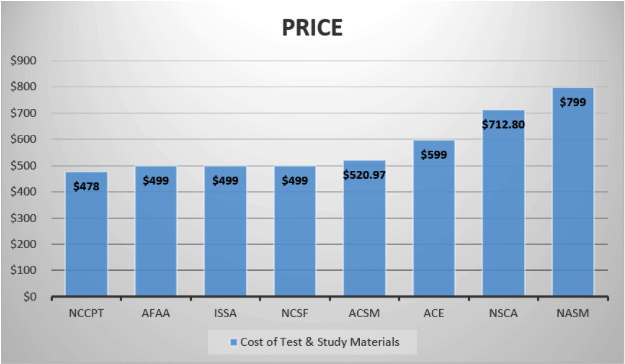
Wondering how the NASM CPT stacks up against other CPTs in terms of cost? We put together an in-depth look at the best personal trainer certifications and did cost comparisons. Here’s how it compares to the other major personal trainer certification bodies:

 
Price Graph

As you can see, the NASM CPT is the most expensive (considering exam and study materials) of all the major certification bodies. NASM is also considered to be the most popular of these brands, and there is a certain amount of prestige that goes along with their certification.

At the same time, there are other options you should be weighing in addition to cost. For example, you should also take into consideration CEU requirements, the primary focus of education, and perhaps most importantly, if the place you want to work accepts the certification you are leaning towards.

circles@2x 1
path-6-1.png
path 6@2x 1

NASM Certification Reviews

The NASM Facebook page shows that NASM has an average review rating of 8.2 out of 10. While this is a generally favorable average, I’d encourage you to speak with some NASM trainers to gauge their experience with the test, their studies, and how a NASM CPT played into their careers. However, some NASM reviews complaints mention higher costs compared to other CPT options and a challenging exam.

Fintess Mentors Soft Back 1

NASM CPT Salary

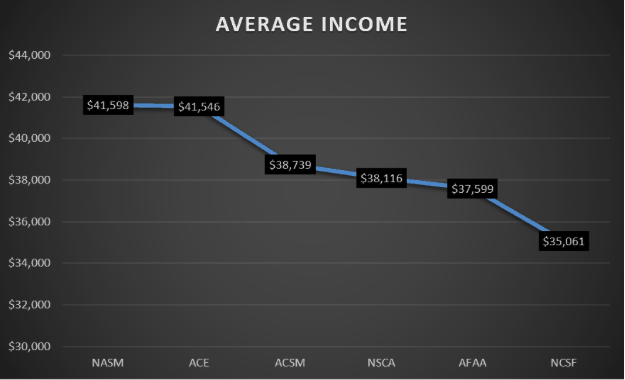
In the aforementioned blog post we did on the Best Personal Trainer Certification, we evaluated the average income of NASM, ACE, ACSM, NSCA, AFAA, and NCSF personal trainers. This data was pulled from reputable websites where registered users self-report their income.

The top tier of these incomes was with NASM, at $41,598 annually. It was followed closely by ACE at $41,546. The others were below the $40k a year annual salary. The important thing to note is that these are just averages; your ability to be successful greatly depends on your business acumen and less about the words after your name. Regardless, it is interesting to note that on average, NASM trainers make the most.

CPT Average Income

How to Get a NASM Certification

The NASM website claims that you can get your NASM CPT in as little as 10 to 12 weeks. To be eligible, you need to meet the following criteria:

  • Be at least 18 years of age 
  • Hold a current cardiopulmonary resuscitation (CPR) and an automated external defibrillator (AED) certification

From there, you simply sign up for one the aforementioned study programs on the NASM website and begin studying, then schedule a time to take the exam once you feel prepared. How do you know if you’ll be prepared? The Fitness Mentors Online Course for the NASM CPT Exam comes with a pass guarantee, so that is a good place to start.

If you have any questions, please leave them in the comments below and I will get to them as soon as possible.

circles@2x 1
cross 1

Survey Results: The Best In Personal Training & Fitness Industry Trends for 2026

It comes as no surprise that the fitness industry’s personal training is rapidly growing, especially during COVID times, where at-home and virtual workouts have exploded. As a whole, the personal training industry is growing at a rate of 8.7% per year, with the demand for personal trainers expected to grow 13% between now and 2028.

For CPTs within this highly dynamic and steadily expanding industry, fitness trends change annually. Fitness Mentors surveyed nearly 500 personal trainers to determine their preferences for the best fitness-related brands, technologies, workout strategies, services, education, client acquisition tactics, and more. 

The categories and topics we’ll touch on include:

  • Personal trainer client acquisition: Where are clients coming from?
  • The best fitness apps, software, and technology
  • The best personal training workouts
  • Best personal trainer certification.
  • Fitness Trend Projections For 2026

Some of the survey results were even a bit unexpected! Read on to see what we found.

circles@2x 1
cross 1

Personal Trainer Client Acquisition

Let’s start at the beginning. Where are we getting our clients? There’s not much sense in knowing the best workout strategies if we don’t have the clientele.

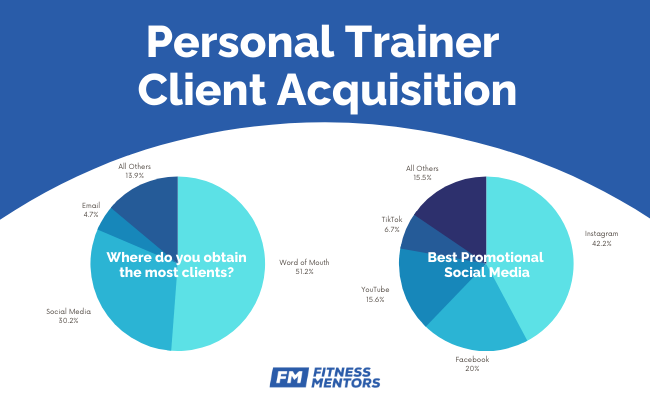
Over 50% of those surveyed by Fitness Mentors said their primary way to obtain clients is by word of mouth and referrals. Whether it’s a current client that recommended their services to someone else, or they just let members of their community know what they offer, most of their clients came this way. 

Second to that was social media, where 30.2% of those surveyed said they obtain the most clients. So what’s the best social media platform for personal trainers to use? According to 42.2% of the personal trainers we asked, Instagram is the best place to promote their personal training business, followed by 20% that suggested Facebook is best and 15.6% that prefer YouTube. 

Why did the majority choose Instagram? Likely because Instagram’s heavy reliance on photos makes for a great way to promote a business whose results are highly visual.

Personal-Trainer-Client-Acquisition-1

Fitness Apps, Software And Technology

Once we have our clients, what are the best ways to record their data and manage them? 

Best CMS

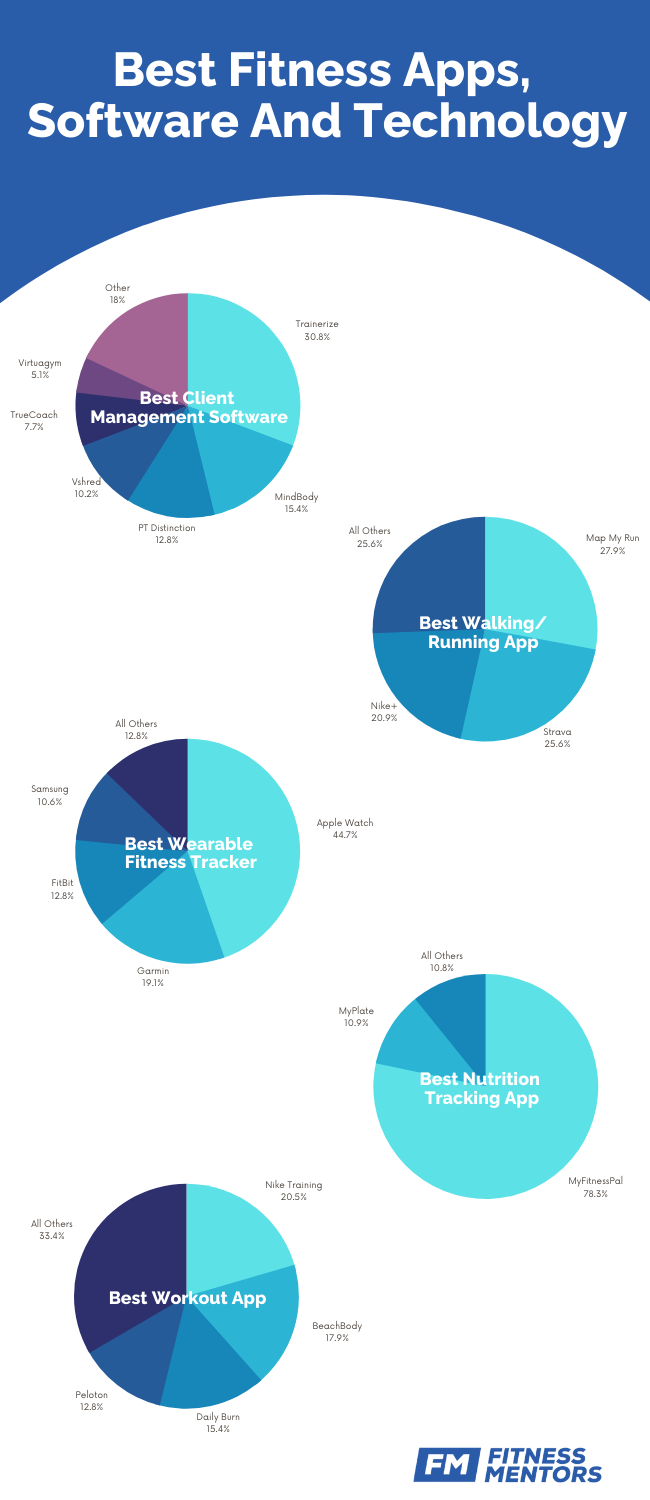
We asked our survey respondents what their choice is for the best client management software. The results were not unanimous, but nearly 31% of personal trainers said Trainerize is the best software, followed by MindBody at 15.4% and PT Distinction at 12.8%.

When we asked why Trainerize is their favorite, they talked about the many features like the ability to build customized training programs for their clients, track their progress, and even accept payments from them using the software.

So what about fitness and nutrition apps that personal trainers recommend for their own use and for their clients?

Best Nutrition App

Let’s start with nutrition – a big part of any personal trainer’s programs. The best nutrition tracking app that CPTs suggest their clients use is MyFitnessPal, which came in at 78.3%! Their many reasons involved the ease of use and the especially comprehensive database of foods and exercises.

Best Walking And Running Apps

When it came to walking and running apps to track your routes and progress, results were fairly close between three: Map My Run came in at 27.9%, Strava at 25.6%, and Nike+ at 20.9%. While it was a close call, the preference for Map My Run came because of the ability to track other activities besides just running. The app tracks cycling, interval training, walking, and more.

Best Fitness Training Apps

For virtual classes and training session apps, 20.5% of our surveyed trainers recommended Nike Training, while 17.9% preferred Beach Body. Both options allow the CPT’s clients to supplement their workouts with digital training that boasts anywhere-you-need-it accessibility.

Best Wearable Fitness Tracker

When it came to the best wearable fitness trackers, 44.7% of personal trainers answered their favorite was the Apple Watch. This was followed by 19.10% choosing Garmin, 12.8% who selected FitBit, and 10.6% who preferred Samsung.

With Apple and Garmin being two of the biggest names when it comes to wearable fitness trackers, you may wonder why CPTs lean more towards Apple. When we asked some of our voters, they said they prefer the Apple Watch because of the advanced features, such as the ECG and pulse oximeter sensors in the newer models.

Fitness industry Trends: Best Fitness apps

The Personal Training Workouts

On to the single-handed most important aspect of personal training: the workouts themselves. With so many new trends and fitness strategies, it’s no surprise that personal trainers may differ on what they feel is the best. We surveyed to find out what the majority prefer, and here’s what we found.

Best Workout For Weight Loss

When we asked personal trainers what they think the best workout for weight loss is, the majority, 51.10%, said interval training. 13.3% answered that CrossFit is their preferred method, and 8/9% answered running.

The trainers who chose interval training said they did so because it helps your body continue to burn fat even after the workout is over.

Best Cardio Equipment

For those trainers working in gyms or studios, or recommending equipment to their clients, we asked what the best is for cardio. 31.9% chose a rowing machine, compared to 23.4% who said a treadmill. Ellipticals and steppers tied up at around 15%.

Rowing machines were a top choice because of their workout efficiency. They target 85% of your body’s muscles, which makes them the perfect workout if you had to choose just one piece of equipment.

Home Fitness Brand

So which equipment brand is a favorite amongst our surveyed personal trainers? 36.6% chose Peloton, while 24.4% chose Total Gym. 

Peloton, which was once known solely for its stationary bikes, now offers treadmills as well. When we asked why the preference towards the brand, many responders told us it’s about the quality and technology within the fitness equipment. Since Peloton integrates with its app to allow motivation and tracking, it’s often a choice for those looking for that extra support.

Transportable Strength Training

One of the beautiful things about being a personal trainer is the ability to provide your services anywhere. We asked our group of personal trainers what their favorite transportable strength training is. 46.8% answered resistance bands, while 27.7% preferred dumbbells.

The trainers who preferred resistance bands did so because of their lightweight functionality, making them effective at muscle building, yet easier to travel with.

Workout Delivery

COVID-19 put a huge emphasis on at-home workouts, which includes virtual personal training. When we asked our surveyors what their preference was for delivering their sessions to their clients, 58.7% chose a hybrid combination of in-person and virtual to obtain the most success. 32.6% preferred completely in person, while 8.7% said purely remote.

The combination of virtual and in-person training was a clear winner. 

Workout Recovery

Personal trainers have preferences for how they recommend their clients recover from a workout, as well. While resting is certainly one option, as far as other tools and techniques go, a foam roller was the highest recommended at 42.2%. This was followed by massage at 17.8% and percussion therapy at 11.1%.

The trainers said they preferred foam rollers because of their self-myofascial release that assists with tightness and soreness. They’re also easy to carry around and don’t take up a lot of space.

Fitness industry Trends: The Personal Training Workouts

Personal Training Certification

No two personal training certifications are exactly the same, and each has its own set of pros and cons that may make it better for one person over another. We asked our pool of personal trainers what their preference was for certification and CEUs. 46.8% answered NASM, while 23.4% said ACE, and 12.8% responded Fitness Mentors own certification.

You can read more about each certification here to mak the best choice for you.

Personal-Training-Certification

Fitness Industry Trend Projections For 2026

If you’ve been wondering which fitness trends in 2026 are worth your time and which ones are just hype you’re in the right place.

Whether you’re a personal trainer trying to stay ahead of the curve, or someone who wants to make smarter choices about your health routine, I’ve broken down the top fitness industry trends projected to dominate 2026 so you can make informed decisions fast.

Let’s get into it.

Why Fitness Trends Matter More in 2026 Than Ever Before

The fitness industry isn’t slowing down. Consumer expectations are higher, technology is smarter, and the way people define “working out” has fundamentally shifted since the pandemic. If I’m being honest with you, the trainers and health-focused individuals who pay attention to these shifts will build better habits, better businesses, and better results.

Here are the 10 trends I believe you need to know about.

1. Move-to-Earn: Getting Paid to Break a Sweat

What it is: Move-to-earn apps reward users with cryptocurrency for meeting physical fitness goals. The more you move, the more you earn.

I know what you’re thinking, is this actually real? Yes, and it’s growing fast. These platforms combine blockchain technology with daily movement tracking to give users a financial incentive to stay active. Different apps use different earning models, but the core idea is simple: your steps, runs, and workouts translate into real rewards.

Why it matters for you: If you’ve struggled with motivation in the past, a financial stake in your fitness can change the game entirely. Gamification meets accountability.

2. Wearable Technology: The Fitness Tracker I Think Everyone Should Own

What it is: Smartwatches and fitness trackers that monitor heart rate, GPS, sleep, steps, calories, blood pressure, and more all from your wrist.

I can’t overstate how much wearable technology has evolved. What used to be a basic step counter is now a comprehensive health dashboard. Today’s devices give you insights that were once only available through clinical testing.

What I look for in a wearable:

  • Real-time heart rate monitoring
  • GPS for outdoor workouts
  • Sleep quality tracking
  • Blood pressure and heart rhythm alerts

Why it matters for you: If I want to improve my performance or my clients’ results, I need data. Wearables make tracking effortless and keep accountability at an all-time high.

3. At-Home Fitness: The Billion-Dollar Trend That Isn't Going Away

What it is: Structured home workouts supported by streaming platforms, on-demand classes, and digital coaching tools.

I find it fascinating that what started as a pandemic necessity has evolved into a genuine lifestyle preference. The at-home fitness market is expected to reach $14.74 billion by 2028 and that tells me everything about where consumer behavior is heading.

Platforms like Peloton have proven that you don’t need a gym to build a serious fitness routine. With live classes, on-demand workouts, and community features built right in, the home gym is now more capable than ever.

Why it matters for you: Lower barrier to consistency. When the gym is your living room, you eliminate excuses.

4. Virtual Personal Training: I Can Coach You From Anywhere

What it is: Live, one-on-one or group personal training delivered via video conferencing platforms like Zoom, Google Meet, or Skype or asynchronously through recorded sessions.

This trend changed my entire view on what “local” means in fitness. Virtual training removes geography as a limiting factor. As a trainer, I can serve clients around the world. As a client, I can work with the best trainer for my goals, not just the nearest one.

Why it matters for you: Flexibility, accessibility, and cost-effectiveness. Virtual training consistently delivers real results when the programming is solid.

5. Mindfulness in Fitness: The Mental Side I Used to Overlook

What it is: The intentional integration of meditation, breathwork, yoga nidra, and mindfulness practices into physical training routines.

I used to think mindfulness was separate from fitness. I was wrong. The data is clear mental resilience, focus, and stress management directly impact physical performance and recovery. Top athletes and trainers are now treating mental training with the same seriousness as physical conditioning.

What mindfulness in fitness looks like:

  • Guided breathing between sets
  • Post-workout meditation sessions
  • Yoga nidra for active recovery and sleep optimization
  • Body scan practices to build kinesthetic awareness

Why it matters for you: You can have the best program in the world, but if your mind isn’t in it, your body won’t follow.

6. Functional Fitness: Training for Real Life, Not Just the Mirror

What it is: Exercise programming that improves the movement patterns you use every day bending, lifting, pushing, pulling, twisting, and carrying.

This is a principle I stand behind completely. Functional fitness doesn’t isolate a single muscle in a vacuum. Instead, it trains your body as an integrated system. It actually is improving balance, coordination, mobility, and joint stability so you move better outside the gym.

Why it matters for you: Whether you’re 25 or 65, functional movement directly reduces injury risk and improves quality of life. That’s a return on investment no bicep curl can match alone.

7. HIIT Workouts: High Intensity, Maximum ROI on Your Time

What it is: High-Intensity Interval Training alternating short bursts of maximum effort with brief recovery periods.

I recommend HIIT to almost every client who tells me they’re short on time. It’s efficient, it’s proven, and it works. Research consistently shows HIIT burns more calories per minute than steady-state cardio, improves cardiovascular fitness faster, and continues burning calories post-workout through the afterburn effect (EPOC).

Why it matters for you: If I only have 20–30 minutes, HIIT is how I make every second count.

8. Outdoor Workouts: Why I Think Fresh Air Is Underrated

What it is: Taking training outside running trails, park workouts, outdoor bootcamps, cycling, swimming, hiking, and bodyweight circuits in natural environments.

There’s something about training outdoors that I genuinely believe makes you work harder without feeling like it. Studies support it too; outdoor exercise is linked to improved mood, reduced cortisol, and higher workout enjoyment compared to indoor training.

And the options go far beyond a jog. I’ve seen trainers use park benches for step-ups, trees for suspension training, and hills for sprint work. Get creative.

Why it matters for you: Variety breaks plateaus. Nature lowers stress hormones. Vitamin D supports recovery. Outdoor training checks all three boxes.

9. Smart Gym Equipment: AI-Powered Feedback in Real Time

What it is: Exercise machines and tools embedded with sensors and AI that analyze your form, count reps, track load, and deliver real-time performance feedback.

I’ve tested several smart gym devices, and what impresses me most isn’t the data, it’s the actionable insight. Instead of just knowing I did 10 reps, I know whether my form was compromised on reps 7 through 10. That kind of granular feedback accelerates improvement dramatically.

Why it matters for you: Smart equipment bridges the gap between training with a coach and training alone. It’s accountability, built into the machine itself.

10. Competitive Fitness: The Community-Driven Trend I See Everywhere

What it is: Organized competitive fitness events including CrossFit competitions, obstacle course races, and team-based fitness challenges.

Competitive fitness has something that solo training often lacks: community and external motivation. When I sign up for a race or competition, my training has a deadline, a goal, and often a team behind it. That changes everything about consistency and effort.

Why it matters for you: If you’ve ever struggled to stay motivated training alone, competition gives you a reason to show up. The community you build in the process is a bonus that keeps most people coming back.

A Final Word

These aren’t just trends I’m reporting on; these are signals about where the fitness industry is heading and what real people are responding to. Whether you’re a trainer building your programming for the year ahead, or an individual designing your own health journey, leaning into these trends gives you a structural advantage.

My recommendation? Don’t try to adopt all ten at once. Pick two or three that align with your goals or your clients’ goals, go deep on them, and build from there.

The fitness industry rewards people who stay curious and adapt. In 2026, that advantage has never been more available to you.

Top Strength And Conditioning Certifications for 2026, Compared

With this comes the increasing need for personal trainers and coaches, including certified strength and conditioning specialists. There is no better time than now to pursue your coaching dreams and make money along the way with the strength training certification.

Here, we’ll walk you through our top strength and conditioning certifications and compare each. We’ll include the eligibility of each Strength and Conditioning Coach course topic, exam information, costs, and career paths you can take with whichever certification you choose.

The strength and conditioning certifications we’ll compare include:

circles@2x 1
cross 1

Eligibilities for Each Strength And Conditioning Certification

Each association’s certification has different suggested or mandatory requirements for obtaining and keeping your accreditation.

SCC from ISSA 

To obtain your SSC, per the ISSA, they mandate you:

  • Are at least 18 years of age
  • High school graduate or equivalent
  • Hold a CPR/AED certification

PES from NASM

NASM recommends that you have at least one of the following to obtain your PES:

  • NASM-CPT certification
  • Licensed Massage Therapist
  • 4-year College Degree
  • REPs Level 3 or higher
  • NCCA, NBFE, or DETC Accredited Health/Fitness Certification

CSCS from NSCA 

NSCA requires that you possess the following to be a CSCS certification candidate:

  • A Bachelor’s or higher degree or currently enrolled as a college senior at an accredited institution – Candidates in the US and Canada must provide proof in the form of an official transcript or a terminal degree. Candidates outside of the US and Canada can provide a copy of the transcript that shows they obtained a Bachelor’s degree equivalent.
  • A current CPR/AED certification – if you do not yet have this certification, you can still take the exam, but you have to supply proof of certification within one year of your exam date.

CSC from NCSF

NCSF requires that you have one or more of the following for their Certified Strength Coach certification:

  • Bachelor’s degree
  • Associates Degree
  • NCCA accredited fitness certification (such as a CPT)

While each has different requirements for being certified, they also cover their own sets of topics that set them apart. Also, if your certification is expired, make sure to renew your cpr certificate before you complete your chose course. 

Best strength and conditioning certifications 2026

The topics covered in each course reflect what the exam will entail as well. While each gives you a different subset of topics, all will give you the framework to succeed in your career.

PES from NASM

NASM divides the PES course into four sections:

  • Section 1: Anatomy and Physiology for Sport
  • Section 2: Sport Performance Testing, Integrated Training certification, and Programming: 
  • Section 3: Olympic Lifting & Injury Prevention
  • Section 4: Sport Nutrition & Psychology

CSCS from NSCA 

The textbook is laid out into 24 chapters. Some of the topics include:

  • Structure and function of body systems
  • Anaerobic and Aerobic training programs
  • Nutrition
  • Flexibility
  • Weight and Resistance Training
  • Speed & Agility Training
  • Rehabilitation and Reconditioning

SCC from ISSA 

The course contents for the SSC are divided into 23 chapters. Some of the topics include:

  • The nervous, muscular, skeletal, and cardiorespiratory systems
  • Biomechanics
  • General and performance assessments
  • Program design
  • Flexibility
  • Core, Lower-Body, Plyometric, Upper Body and Weight Lifting Exercises
  • Periodization
  • Injury Recovery
  • Nutrition & Supplements

CSC from NCSF

Topics covered in becoming an NCSF certified Strength and Conditioning coach include:

  • Athletic Analyses
  • Advanced program construction
  • Athletic-based training
  • Over 300 exercises and drills

Costs Associated With Strength And Conditioning Certifications

Each certification option offers various study courses before a final exam. Below is the cost you can expect from each (pricing and components subject to change):

PES from NASM

NASM offers three packages for their 100% online certification. 

The self-study option is regularly $699. It includes:

  • CEU Value 1.9
  • NASM-PES Digital Textbook with 16 in-depth chapters
  • Online PES Exam
  • 2 Online Practice Exams
  • Syllabus and Study Guide
  • Exercise Library with 64 videos
  • 35 lecture videos, 34 demo videos
  • Exercise Libraries
  • Module Quizzes
  • Certificate of Completion

The Premium Self-Study option is regularly $849. It includes all of the above, plus the addition of bonus content like weight room maintenance and sports lecture videos, as well as a programming toolkit.

The All-Inclusive option is regularly $999 and includes everything the premium version includes with the addition of a hard copy textbook and a live workshop.

The exam itself is not available as an a la carte purchase; you must purchase one of the above courses. The typical completion time is around 8-10 weeks, but you’ll have one full year to complete the course once you enroll. 

Once you pass NASM’s PES exam, your certification never expires.

Fitness Mentors also offers an efficient study guide featuring the best educational materials for the exam. We’ll give you all the test-specific topics that will guide you to read the book’s most pertinent sections. For more information and to purchase, click here.

CSCS from NSCA 

NSCA breaks down the CSCS study packages into three choices, but customizable options are available too.

The CSCS Digital Package starts at $162 and includes:

  • CSCS Study Guide
  • Over 200 practice questions

The CSCS Essential Package starts at $250 and adds in the physical textbook, Essentials of Strength Training. For a starting price of $465, the CSCS Essential Plus Package also offers an online study course and an Exercise Technique manual.

SCC from ISSA

The ISSA offers one online course option, and the course is not required to purchase and take the exam. Regularly priced at $639, the online course allows you to study at your own pace and take the exam at home.

The completely online course includes:

  • Study guide and workbook
  • Online and home study exam
  • Exercise lab
  • Practice exam and section quizzes
  • “Take home” strength and conditioning certification exam
  • NCCPT accredited exam (proctoring fee not included)
  • A free professional website
  • Ongoing educational support

With just 1-2 hours a day, you can expect to finish the course in 8-10 weeks – but the pace is entirely up to you. You have up to 12 months to complete the program.

CSC from NCSF

According to the NCSF site, they offer various packages as well as the a la carte exam. Packages range in price from $299 for the exam alone, or up to $999 for the most in-depth package. They offer two home-study packages.

The first is regularly $799 and includes:

  • Digital textbook: Advanced Concepts of Strength & Conditioning
  • Instructional videos
  • Lesson notes
  • Q&A
  • Review quizzes
  • Online Certified Strength Coach practice exam
  • 8 NCSF CEUs (meets ethics requirement)
  • One year membership to NCSF
  • NCSF Certified Strength Coach Exam

For an additional $100, you receive a physical textbook with the Home-Study Plus package. 

Candidates have 6 months after enrollment to schedule and take the exam. On average, NCSF suggests taking 2-4 months to study the material. The exam may be taken online or at a testing center.

Exam Information for Each Strength And Conditioning Certification

Each certification exam has a different number of questions, time limits, passing scores and allowed attempts. Here is the breakdown:

PES from NASM

  • Questions: 100 multiple-choice
  • Time Limit: 90 Minutes
  • Passing score: 70% or higher
  • Attempts allowed: 3

CSCS from NSCA 

  • Questions: 220 multiple-choice
  • Time Limit: 4 Hours; split into 1.5 hours for Scientific Foundations and 2.5 hours for the Practical/Applied section
  • Passing score: 70 in both sections
  • Attempts allowed: No limit, but you must wait 90 days between retakes. If you fail only one section, you may retake just the section you failed within one year.

SCC from ISSA 

  • Questions: 140 multiple-choice, 15 field items (unscored)
  • Time Limit: Unlimited, Open book (the NCCPT accredited exam is not open book)
  • Passing score: 75% or higher
  • Attempts allowed: Unlimited within six months with fees and a 72 hour waiting period between attempts.

CSC from NCSF 

  • Questions: 150 multiple-choice
  • Time Limit: 3 hours
  • Passing score: 70 or higher
  • Attempts allowed: Unlimited within six months with fees and a 30-day waiting period between attempts.

FAQs of Strength and conditioning certifications for beginners

How Do I Get Certified In Strength and Conditioning?

Choose the training you wish to receive and from what organization. Be sure to have all of the prerequisites covered for the course and exam you choose.

How Long Does It Take To Become a Certified Strength And Training Specialist?

Most programs allow the flexibility to work at your own pace, within a specified time frame. Many recommend taking at least 8-12 weeks to allow for material comprehension, but you generally have longer if needed. For example, the ISSA-SSC requires you to complete your course and exam within 12 months from enrollment.

How Much Does CSCS Certification Cost?

While some programs allow you to get the exam a la carte, taking a course will help you to better your chances of passing. For a course and exam, you should plan to spend around $500 minimum. According to industry surveys, the Certified Strength and Conditioning Specialist salary typically ranges between $55,000–$75,000 annually, depending on experience, location, and level of employment (collegiate, professional, or private sector).

Where Does a Strength And Conditioning Specialist Work? What CSCCA Jobs Will I Have An Opportunity For?

A Strength and Conditioning Certification, regardless of which one, has the potential to open the door to many career opportunities. These may include personal trainer, strength and conditioning coach, sports coach, physical therapist, teacher/researcher/professor, athletic trainer, and more!

Which Strength and Conditioning Certification is Best?

It’s important to note that an SCCC (Strength and Conditioning Coach Certified) certification from the Collegiate Strength & Conditioning Coaches Association is one of the most highly regarded in the industry.

However, you must already be a full-time practicing strength and conditioning coach or a student preparing to be, and the exam is only once per year with no course materials.

If you wish to coach on a collegiate or professional level otherwise, NSCA-CSCS and NASM-PES are two of the best options. For flexible, fully strength and conditioning certifications online, ISSA and NCSF offer excellent study-at-home options.

All four courses with certifications are similar in cost in relation to what you receive in each package for budget concerns.

Ultimately, which certification you choose depends on your personal preferences and what your goals are post-certification. If you’d like to work for a specific organization, it’s best to check with the potential employer to determine which certification they prefer. 

A Strength traning Certification is highly lucrative and can open many doors to advance your career and put you on the path to financial freedom.

Everything You Should Know About TRX Training Certifications

Why TRX Certification Might Be the Game-Changer Your Fitness Career Needs

circles@2x 1
cross 1

Walk into almost any gym today and you’ll likely see straps dangling from a rack, door, or ceiling beam. Suspension training has exploded in popularity over the last few years, and for good reason. It’s different, it’s challenging, and it’s fun both for clients and trainers.

But here’s the thing: while fitness trends come and go, TRX has stayed strong. As a master personal trainer with over 20 years of experience, multiple certifications, and a background in kinesiology, I’ve watched countless fads fade. TRX hasn’t. Why? Because when it’s used correctly, it delivers real, measurable results.

If you’ve been thinking about adding suspension training to your skill set, this guide is for you. Whether you’re:

  • A personal trainer wanting to stand out from the crowd
  • A gym owner looking to offer group classes that sell
  • A kinesiology student exploring new certifications
  • Or simply researching TRX courses before committing

In this guide, you’ll discover:

  • The types of TRX certifications available
  • The differences between online and in-person courses
  • What you can expect to pay
  • Options for group training and class formats
  • And most importantly whether certification is truly worth your time and money

Here’s the Real Question
With so many certification options out there, how do you know which TRX course aligns with your goals and whether it will actually advance your career? This guide breaks it all down so you can make an informed decision with confidence.

TRX training allows you to:

  • Modify classic exercises like planks, pushups, and squats for greater challenge.
  • Create workouts tailored to all fitness levels.
  • Suspension training reduces pressure on articulations for a low-impact workout.
Everything-You-Should-Know-About-TRX-Training-Certifications​

What Is TRX and Why Has It Become So Popular?

Resistance training has several benefits, from helping you lose close to four pounds of body fat in only ten weeks to increasing bone density.

However, there are risks involved with resistance-based workouts. Studies show that these risks increase due to a lack of clear instructions or supervision.

Besides providing you with the knowledge needed to get the most out of this workout method, TRX training certifications ensure that

  • You teach safe TRX exercises, learn how to
  • Use TRX straps effectively
  • Develop workouts adapted to the goals and levels of each client.

The TRX Certification Process

The TRX company offers different classes you can take to become a certified instructor. You can sign up for in-person or virtual TRX education classes.

In-person classes are available regularly in major US cities. Virtual classes can be a better option if you don’t want to travel or prefer completing the class at your own pace.

You’ll get started by completing the TRX Suspension Training Course or TRX Suspension Training Course: Virtual Edition 2.0. This class includes an introduction to the TRX workout method where you’ll also learn how to set up the equipment.

At the end of this class, you’ll be familiar with the key moves you can use with the suspension equipment and know enough to create personalized TRX workouts.

You’ll get a certificate of completion after taking this eight-hour class and will become a TRX Qualified Trainer.

If you want to take things further, you can sign up for an advanced class. TRX offers classes that focus on yoga, kettlebell training, or sports medicine. You can also sign up for a group TRX certification class.

The Benefits of TRX Certification

The TRX community includes over 300,000 fitness professionals. As TRX becomes more popular, taking a TRX suspension training course can help you stand out.

The fitness industry is going through some significant changes. There is a projected job outlook of 19%, and with less than 25% of adults meeting the CDC’s recommended guidelines for aerobic and muscle-strengthening activities, there is a strong market for growth.

As more Americans take steps to achieve a healthier lifestyle, fitness trends emerge. People want to have several options to choose from so they can try different workout methods and find something they enjoy doing.

With TRX, you can diversify your offering while presenting your clients with a workout method that yields results.

Obtaining a certification will help you create a safe environment where clients can explore this new way of working out. It will inspire trust and provide you with the tools you need to help your clients get the best results possible.

TRX instructor training is more appealing than other certifications since few other workout methods are as versatile. You can use TRX to offer full-body workouts or focus on strength, resistance, flexibility, cardio, and more.

Who Should Consider TRX Certifications?

There are no prerequisites for taking a TRX class. However, you should keep in mind that obtaining a TRX certification isn’t sufficient to offer your services as a certified fitness trainer. You’ll need to obtain a certification from a reputable organization like Fitness Mentors.

Read more: How To Become A Personal Trainer

Taking the entry-level TRX class can be a good option if you’re studying sports medicine and plan on becoming a fitness trainer.

It’s also a great option if you’re currently a fitness trainer and want to branch out by offering a new way of working out.

If you own a gym or work at one, you should consider taking the TRX group certification so you can offer a new class.

What Are TRX Training Certifications?

If you want to teach suspension training the right way, you need more than just watching a few workout videos. That’s where TRX training certifications come in.

These programs are designed to teach you how to properly set up the equipment, coach exercises safely, and adjust movements for different fitness levels. You learn how to cue clients, fix common mistakes, and build smart workouts using the straps.

Not a Full Personal Training Certification

It’s important to understand something clearly.

A TRX certification is not the same as becoming a certified personal trainer (CPT). It does not replace certifications from major organizations like NASM or ACE.

Instead, it’s a specialty course focused only on suspension training. Think of it as an extra skill that adds value to your main certification.

If you’re already a trainer, this can help you stand out. If you’re new to fitness, you’ll still need a full CPT before training clients professionally.

Who Offers These Certifications?

Official TRX courses are offered directly through TRX Training. They provide both in-person workshops and a TRX certification online option, which allows you to complete the course at your own pace.

Most programs include:

  • Video lessons


  • Exercise breakdowns


  • Coaching demonstrations


  • Practical programming guidance


  • A final assessment


Once completed, you become a TRX Qualified Trainer or Coach.

Are There Free TRX Certification Courses?

This is a common question.

You might see searches for TRX certification courses online free or TRX training certifications free, but here’s the honest answer:

There is no fully accredited, official TRX certification that is completely free.

Sometimes TRX offers:

  • Free sample workouts


  • Trial access to their app


  • Introductory educational content


But to receive an official certificate of completion, you must enroll in a paid course.

Be cautious of websites offering “free certification” downloads that are not officially connected to TRX.

Is There a TRX Training Certifications PDF?

Many courses provide downloadable materials. After registering, you typically receive digital study guides or manuals. These often come in PDF format so you can review the exercises, principles, and coaching cues offline.

However, there isn’t a public trx training certifications pdf that gives you full certification without enrolling. The PDF materials are part of the paid education program.

In simple terms, TRX training certifications are specialty courses that teach you how to safely and effectively coach suspension training. They add to your skills but they don’t replace a full personal training credential.

Types of TRX Certification Courses Available

Not all TRX courses are the same. Some are made for beginners. Others are designed for experienced trainers who want to specialize.

Let’s break them down in a simple way.

TRX Suspension Training Course (STC)

The TRX Suspension Training Course (STC) is the main entry-level course. This is where most trainers begin.

It usually takes about 6–8 hours to complete, depending on whether you take it live or online.

In this course, you’ll learn:

  • How to properly set up the straps
  • Safety guidelines and anchoring methods
  • Foundational TRX exercises
  • How to progress and regress movements
  • How to coach and cue clients correctly
  • Basic workout design using suspension training

By the end of the course, you’ll understand how to build full-body workouts using TRX safely and effectively.

Once you pass, you receive a certificate of completion and become a TRX Qualified Trainer. This shows that you have formal training in suspension coaching.

For most trainers, this is the first and most important step.

TRX Group Training Course

If you plan to teach classes instead of one-on-one sessions, the TRX group training course is worth considering.

Training one person is very different from managing 8–15 people at the same time. This course focuses on:

  • Class structure and flow
  • Managing different fitness levels in one room
  • Keeping sessions safe and organized
  • Creating timed circuits and stations
  • Coaching clearly in a group setting

You’ll learn how to design sessions that keep energy high while still maintaining good form and safety.

This course is ideal for:

  • Gym owners
  • Studio instructors
  • Trainers who teach boot camps
  • Coaches running small group sessions

If group fitness is part of your business model, this adds real value.

Advanced TRX Courses (Level 2 Options)

Once you complete a Level 1 course, you can move into more advanced training.

These Level 2 options focus on specific goals or populations.

Some examples include:

Sports Medicine Focus
This course teaches how to use TRX for corrective work and muscular imbalances. It’s helpful for trainers working with post-rehab clients or people returning from injury.

Force or Performance Training
This option is designed for high-intensity training styles. It’s great for athletic performance, boot camps, and military-style conditioning.

Specialized Populations
Certain advanced courses focus on working with athletes, older adults, or specific sports like tennis. These teach you how to adjust exercises safely and effectively for different needs.

If you already have strong experience as a trainer, these advanced courses can help you specialize and offer something unique in your market.

Online vs In-Person TRX Training Certifications

When choosing between formats, it really comes down to your schedule, budget, and learning style. Both options teach the same core material, but the experience feels different.

Flexibility

If you have a busy schedule, trx training certifications online are often the easiest option. You can learn at your own pace, pause videos, rewatch lessons, and complete the course when it fits your time.

In-person workshops follow a fixed schedule. You must attend on a specific date and complete the training in one session.

Travel

If you search for trx certification classes near me, you might find a workshop in your city. That’s great if you prefer hands-on instruction.

But if there are no local events, you may need to travel. That adds time and extra cost.

Online courses remove that problem completely. You can learn from home, your studio, or even while traveling.

Cost

Online courses are often slightly more affordable because there are no venue costs. You also save money on travel, hotels, and transportation.

In-person workshops may cost more, but they give you live coaching feedback and direct interaction.

Learning Style

Some people learn best by doing and asking questions face to face. In-person training gives you immediate corrections and hands-on experience.

Others prefer to move at their own speed. Online learning lets you replay sections, take notes, and study comfortably.

There is no “better” option just the one that fits you best.

Are There Free TRX Certification Options?

This is one of the most common questions people ask.

You may see searches for trx training certifications free or trx certification courses online free, but here’s the honest truth:

There is no fully accredited, official TRX certification that is completely free.

To receive a recognized certificate of completion, you must enroll in a paid course.

What Free Options Actually Exist?

Even though there isn’t a free certification, you may find:

  • Trial memberships to the TRX app

  • Free sample workouts

  • Short educational videos

  • Introductory webinars

  • Limited study materials

These are helpful for learning the basics and deciding if TRX is right for you. But they do not make you certified.

If you’re serious about adding suspension training to your services, investing in a proper course is the safest and most professional route.

In fitness, credibility matters. A real certification shows clients and employers that you’ve taken the time to learn the system correctly.

Do You Get Continuing Education Credits (CECs)?

One big advantage of completing a TRX training certification is that it can count toward continuing education credits (CECs) for certified personal trainers (CPTs). These credits help you maintain your main certifications with organizations like ACE, NASM, or ISSA.

Which Organizations Recognize TRX CECs?

  • ACE (American Council on Exercise) – Many TRX courses offer approved CEC hours to keep your ACE certification current.
  • NASM (National Academy of Sports Medicine) – TRX education can count toward NASM’s required continuing education.
  • ISSA (International Sports Sciences Association) – Courses are recognized for CECs for trainers looking to stay certified and expand their knowledge.

How Many CE Credits Can You Earn?

Typically, a TRX certification course provides 6–8 continuing education hours, depending on the program. Online courses and in-person workshops usually offer the same credit value.

Why CECs Matter for CPTs

As a certified personal trainer, you need to complete continuing education regularly to maintain your main certification. By taking TRX courses:

  • You earn credits while learning a specialized skill
  • You stay compliant with certification requirements
  • You enhance your resume and professional credibility
  • You gain knowledge to safely and effectively train clients using suspension equipment

In short, TRX certifications are not just about learning suspension training they also help trainers keep their credentials current while building practical skills that clients love.

Who Should Get TRX Certified?

TRX training certifications aren’t just for one type of fitness professional they can benefit anyone who wants to add functional, versatile training to their toolkit.

Personal Trainers

If you already work as a personal trainer, TRX can help you stand out. You’ll be able to offer unique workouts that improve strength, balance, and core stability in every client. Whether you train beginners or advanced athletes, suspension training adds variety and effectiveness to your sessions.

Gym Owners

Owning a gym comes with the challenge of keeping classes fresh and members engaged. Offering TRX group classes or adding suspension equipment to your gym gives your clients a new way to train while increasing your offerings.

Rehab Specialists

Physical therapists and rehab coaches can use TRX to help clients recover from injuries safely. The ability to adjust resistance using body weight makes it perfect for controlled, low-impact training.

Athletes

Athletes looking to improve performance benefit from TRX because it builds functional strength, balance, and stability skills that translate directly to sports movements.

Students Studying Kinesiology

If you’re studying kinesiology or planning to become a fitness professional, TRX certifications provide practical, hands-on experience. You’ll learn how to apply principles of biomechanics and movement in real-world training.

Eddie Lester’s Perspective

As a master personal trainer with over 20 years of experience and 10 specialized certifications, I’ve seen firsthand how adding a TRX certification can elevate your career.

I recommend specializing in TRX because:

  • It’s versatile for all client levels


  • It teaches functional movement you can apply immediately


  • It opens opportunities to teach one-on-one or group classes


  • It adds credibility to your profile and shows commitment to ongoing learning

In practice, I’ve used TRX with both beginners and advanced clients. It’s a tool that allows me to regress movements for safety or progress exercises for challenge, making it a staple in any trainer’s toolbox.

Whether you’re a trainer, gym owner, rehab professional, athlete, or student, a TRX certification can provide skills and confidence to apply suspension training effectively.

TRX Certification vs Personal Training Certification

It’s important to understand the difference between a TRX training certification and a general personal training certification (CPT).

A TRX certification focuses specifically on suspension training. You’ll learn how to safely set up the straps, coach exercises, and design workouts for individual clients or groups. It teaches practical skills for a specialty area, but it does not cover all aspects of personal training, like nutrition, anatomy, exercise science, or program design for every client.

On the other hand, a CPT certification from organizations like NASM, ACE, or ISSA provides a full foundation to train clients safely across all exercise modalities. You still need a CPT to work as a professional personal trainer.

That’s where Fitness Mentors comes in. Their programs allow you to get fully certified as a CPT while also offering specialized courses like TRX. This combination ensures you’re fully prepared to train clients professionally while also having the added skills of suspension training.

In short: TRX certification adds value and specialty knowledge, but it complements rather than replaces your personal training credentials.

How Much Do TRX Training Certifications Cost?

The cost of TRX training certifications depends on the course type and format.

General Price Range

  • Entry-level TRX Suspension Training Course (STC): $300–$400


  • TRX Group Training Course: $400–$500


  • Advanced Level 2 Courses: $500–$700


Prices may vary slightly depending on location or if you take the course online.

Online vs In-Person

  • Online TRX certification: Often slightly cheaper because there are no travel or venue costs. You can complete it from home at your own pace.


  • In-person workshops: Typically cost more due to venue, equipment, and instructor time. But you get hands-on coaching and live feedback.


Value vs Return on Investment

Investing in TRX training certifications is not just about the price tag it’s about what you gain:

  • Add a valuable skill to your resume


  • Offer clients unique workouts


  • Expand career opportunities (group classes, rehab, sports performance)


  • Earn continuing education credits for your CPT

Considering the skills, credibility, and versatility you gain, TRX certification is a worthwhile investment for trainers serious about growing their careers.

exercising-with-trx-straps-gym-club

FAQ

Read on to learn more about TRX training.

Your TRX certification will not expire. However, we recommend keeping up with new classes released by TRX.

You can obtain a TRX certification by completing the eight-hour TRX Suspension Training course. However, you’ll also need a national certification from an organization like ACE or NASM to become a certified fitness trainer.

TRX is a proven method that is gaining in popularity. It’s a fun and low-impact way to take your workouts up a notch. It’s an option worth considering if you want to diversify what you offer to your clients.

How To Get Zumba Certified: Everything You Need To Know

Like TRX, yoga, and other group exercise techniques, you need certification to legally and effectively run a class or studio. 

As personal trainers ourselves, we know the drill. Let’s walk through how to get Zumba Certification, including the costs and due process. et’s explore the process of Zumba instructor training, including requirements, costs, and how to position yourself for long-term success.

Zumba
circles@2x 1
cross 1

Walk into almost any gym across the globe and you’ll hear it before you see it: high-energy Latin beats, cheering participants, and an instructor leading what looks more like a dance party than a workout. That atmosphere is exactly why Zumba has become one of the most recognized group fitness programs in the world.

The program was created in the late 1990s by Alberto “Beto” Pérez, a Colombian dancer and choreographer who accidentally forgot his traditional aerobics music and improvised a class using Latin rhythms instead. That spontaneous moment turned into a global fitness movement now taught in more than 180 countries.

How Zumba Works: The Interval Formula Behind the Fun

At its core, Zumba is an interval-style cardio workout. It alternates between high-intensity dance sequences and lower-intensity recovery movements. This format keeps the heart rate elevated while preventing early fatigue which is one reason participants can sustain energy throughout the session.

As I’ve seen in the fitness industry, programs that blend structure with enjoyment tend to outperform rigid workout models. Zumba’s formula allows beginners to follow along while still challenging more experienced participants.

How Many Calories Does Zumba Burn?

Because of its interval design, Zumba can be a highly effective calorie-burning workout. Research has shown participants may burn between 300 and 900 calories per hour depending on intensity, body weight, and fitness level.

The combination of aerobic conditioning, coordination work, and muscular endurance makes it more than just dancing; it becomes a total-body cardiovascular session.

Why Participants Keep Coming Back

The reason Zumba remains globally popular isn’t just calories, it’s psychology.

Participants love it because:

  • It feels inclusive and welcoming

  • No advanced dance experience is required

  • The music boosts mood and reduces stress

  • Classes create a sense of community

From an instructor’s perspective, that emotional connection matters. When people associate exercise with enjoyment instead of obligation, attendance improves, referrals increase, and retention grows.

As someone deeply involved in trainer development, I’ve noticed that group programs rooted in music and community tend to generate stronger loyalty than purely performance-based workouts. That loyalty is what helped Zumba scale worldwide and it’s what continues to make it attractive for aspiring instructors.

Why I Recommend Zumba as a Smart Entry Into the Fitness Industry

Breaking into the fitness industry can feel overwhelming. Between advanced certifications, specialty niches, and business logistics, many aspiring trainers delay getting started. But not every path requires years of preparation. In my experience mentoring fitness professionals, Zumba offers one of the most accessible entry points into the industry.

Eddie Lester often tells new trainers that momentum matters more than perfection. Starting with a format that allows you to teach quickly while building confidence can accelerate long-term success.

Low Barrier to Entry

Unlike many advanced fitness credentials, Zumba does not require prior certification or a formal fitness background. You must be at least 18 years old to enroll, but there are no mandatory prerequisites.

While a dance or group exercise background can be helpful, it’s not required. This accessibility removes a major psychological barrier for individuals who love movement but may not yet feel ready to pursue a full personal training certification.

Fast Certification Process

One of the biggest advantages is speed. The Basic Level 1 training can be completed in as little as one day (around 8–10 hours depending on format). After completing the training, you receive your license to begin teaching.

As I’ve seen in the fitness industry, faster certification pathways allow new instructors to gain real-world experience quickly. Teaching early builds confidence, stage presence, and leadership skills that no textbook can replicate.

Strong Community Appeal

Zumba classes naturally create community. The music-driven format, synchronized movement, and upbeat atmosphere encourage interaction and consistency. Participants don’t just attend for exercise, they return for the experience.

From a business standpoint, this is powerful. Programs that foster connection typically retain members longer and generate word-of-mouth referrals more effectively than solo training models.

Eddie Lester often reminds trainers that community-based formats can reduce marketing costs because your students become your promoters.

Scalable Income Potential

Zumba also provides scalable earning opportunities. Instructors can begin part-time teaching a few weekly classes and gradually expand into:

  • Hosting special events
  • Running themed workshops
  • Offering private sessions
  • Adding additional class formats

Because classes are group-based, income is not capped the same way one-on-one training can be. With consistent attendance, revenue grows alongside class size.

Flexibility Across Teaching Environments

Another reason I recommend Zumba as a starting point is flexibility. Instructors can teach in multiple settings:

  • Commercial gyms
  • Private studios
  • Community centers
  • Schools
  • Corporate wellness programs
  • Virtual platforms

This versatility allows instructors to test different environments before committing to a long-term business model. Whether you prefer structured employment at a gym or entrepreneurial independence, Zumba fits both paths.

For those exploring their place in the fitness industry, beginning with a format that blends accessibility, community, and earning potential can create both confidence and clarity about your long-term direction.

How to Become a Zumba Instructor (Step-by-Step Breakdown)

Starting a career in group fitness doesn’t have to be complicated. One reason I often suggest Zumba to aspiring instructors is because the pathway is clearly structured and beginner-friendly. Below is the practical roadmap to getting licensed and ready to teach.

Step 1 – Meet the Basic Requirements

Before enrolling in training, you’ll need to confirm a few simple eligibility standards.

Age Requirement (18+)
You must be at least 18 years old to register for instructor training. There are no advanced academic or fitness prerequisites required.

No Formal Prerequisites
Unlike many personal training certifications, you do not need prior credentials to begin. You don’t have to hold a CPT license or complete a degree in kinesiology.

Dance Background (Helpful but Not Required)
While rhythm and coordination can make the transition smoother, they are not mandatory. As I’ve seen in the fitness industry, enthusiasm and willingness to learn often matter more than technical dance experience.

Eddie Lester often reminds trainers that confidence develops through repetition not perfection on day one.

Step 2 – Complete Basic Level 1 Instructor Training

The official entry point into teaching is the Basic Level 1 Instructor Training, offered through the program’s authorized platform.

What You Learn

During this training, instructors are taught:

  • The four core rhythms (salsa, merengue, cumbia, reggaeton)

  • Foundational step patterns

  • How to structure a full class

  • Cueing techniques and stage presence

  • The Zumba interval formula

This training focuses on practical application so you can lead classes confidently.

Duration

The Basic Level 1 course can typically be completed in a single day, usually around 8–10 hours depending on format. This makes it one of the faster entry points into group fitness instruction.

Training Formats

You can choose the format that fits your schedule and learning style:

  • In-person workshops

  • Live virtual training sessions

  • Self-paced online modules (when available)

This flexibility allows you to begin regardless of location.

Step 3 – Earn Your Zumba License

After successfully completing Basic Level 1 training, you receive a license that permits you to begin teaching official classes.

What the License Allows

With your license, you are permitted to:

  • Teach official Zumba classes

  • Use branded choreography frameworks

  • Promote yourself as a licensed instructor

This license is typically valid for six months following training.

Certification vs. License – What’s the Difference?

Many people use these terms interchangeably, but there is a distinction:

  • Certification refers to completing the training program.

  • License grants you the legal right to teach under the brand name.

Understanding this difference is important for clarity and compliance.

Step 4 – Join the ZIN™ Network (Optional but Powerful)

After becoming licensed, many instructors choose to join the ZIN™ (Zumba Instructor Network) membership program.

While technically optional, it offers significant advantages.

Key Benefits

  • Extended teaching rights while membership remains active

  • Access to ongoing education

  • Community networking with instructors worldwide

Monthly Music & Choreography Access

Members receive new music and ready-to-use choreography each month. This helps keep classes fresh without requiring instructors to constantly create new routines from scratch.

From a business standpoint, updated material improves retention and client satisfaction.

Marketing Materials

ZIN members gain access to branded promotional tools, instructor listings, and marketing support to help attract students.

Eddie Lester often emphasizes that marketing support is what separates hobby instructors from long-term professionals.

Ongoing Support

The network provides community access, event invitations, and additional specialty training opportunities. For new instructors, that guidance can significantly reduce the learning curve.

zumba_dance-class

Let’s Dance - Start Your Zumba Instructor Training Journey

A successful Zumba class and Zumba business require plenty of certification, patience, and initiative, but the result is rewarding. Motivated teachers rake in over $60,000 per year, turning a craft they love into a full-time position. Zumba.com is the best place to st
art on your journey toward your unique class or studio.

And if you want to become a world-class personal trainer, look no further than Fitness Mentors. We have everything you need to become a certified personal trainer or exercise coach. Get started today and turn your love of exercise into a profitable career. 

Check out our latest: How to Become an Exercise Physiologist

Zumba Certification Cost (Full Breakdown & What to Expect)

  • Basic Level 1 cost range


  • Advanced format pricing


  • Early registration discounts


  • ZIN membership cost


  • Renewal options

How I Suggest New Zumba Instructors Find Clients Faster

One of the biggest challenges new Zumba instructors face is building a student base. In my experience mentoring fitness professionals, the fastest way to grow your classes is a combination of strategy, visibility, and consistency. Eddie Lester often emphasizes that a structured approach to client acquisition separates hobbyists from career instructors.

NCCA Certifications for the Fitness Industry

NCCA Certifications for the Fitness Industry

Do you aspire to become an NCCA personal trainer but aren’t sure which certification aligns with your career goals?

Or maybe curious about the different NCCA personal training certification programs and their prerequisites?

Getting certified through the NCCA-accredited personal training certification pathway can give you a strong advantage in the fitness industry. Accreditation not only builds client trust but also increases your chances of employment with top gyms and health organizations.

Before choosing the right certification, it’s essential to understand what the NCCA is, why it matters, and which certifying bodies are included in the NCCA accredited certification list. This guide simplifies the options and highlights the most popular programs on NCCA certifications for the fitness industry.

circles@2x 1
cross 1

What Does NCCA Stand for in Fitness?

NCCA is short for National Commission for Certifying Agencies and is the gold standard of accreditation for health, fitness, and wellness certifications. Most employers prefer hiring professionals who hold an NCCA personal trainer certification because it guarantees a high level of credibility and competency.

Accredited programs are popular as they are the gold standard. NCCA grants prestigious certifications that broaden your scope for employment.

Established in 1989, NCCA is an independent, non-governmental agency responsible for setting standards for the fitness and health industry. NCCA is one of the top accreditations around the world that sets the benchmark for certification programs.

What Does It Mean to Hold an NCCA Accredited Personal Training Certification?

The NCCA-accredited CPT programs test your written knowledge and practical skills through a comprehensive personal trainer program and examination.

Getting an NCCA accreditation sets you apart as a professional personal trainer. Since NCCA is the leading standard in the accreditation of certification, it boosts the trust in the certification program while ensuring that the competence and skills of the trainer are on par with the industry requirements. 

NCCA certification also ensures employers that you have the highest level of skills and ability for the fitness industry.

NCCA Requirements For Personal Trainer Certifications

The agencies accredited by NCCA need to meet a specific set of standards before they can issue the NCCA personal training certification. The NCCA analyzes the programs and systems of the certifying agencies and investigates the curriculum set by them to get a clearer picture and understanding of the following:

  • To check whether the agency conducts examinations in an unbiased manner.
  • To ensure that the program assesses the minimum proficiency level of the candidate.
  • To ensure enough support and guidance from the certifying agencies to their certified professionals.
  • To make sure that the agency protects its clients from incompetent trainers.

The National Commission for Certifying Agencies makes sure that the certifying agencies work in a regulated manner to extend utmost support to the candidates and ensure complete protection for the people by determining the skill level of the personal trainers.

NCCA Accredited Certification List

Here are the certifying bodies currently offering NCCA-accredited personal trainer certification programs:

Every program has its own set of guidelines and prerequisites. You can choose the best according to your career requirements and your knowledge level. 

Top Four NCCA Personal Trainer Certification Options

While the NCCA accredited fifteen personal trainer certifications, our top four choices include the National Academy of Sports Medicine (NASM), National Council on Strength and Fitness (NCSF), American Council on Exercise (ACE), and International Sports Sciences Association (ISSA). The ISSA recently acquired NCCPT, making their CPT program NCCA certified as well.

Let’s dive in deeper to these four:

1. National Academy of Sports Medicine (NASM)

Opened in 1987, the National Academy of Sports Medicine is a premier certifying agency, regarded as the best certification program by many professionals.  Its NCCA personal training certification is highly regarded by gyms and employers.

NASM is known for its Optimum Performance Training (OPT) model. This model enables trainers to advance their clients using secure, safe, and effective methods. As a prestigious agency, NASM primarily focuses on training instructions and exercise techniques.

There are four available study options – self-study, premium self-study, guided study, and the all-inclusive package. The examination consists of 120 questions you need to complete in two hours. To pass the exam, you need a score of 70% or above.

2. International Sports Sciences Association (ISSA)

Founded in 1988, ISSA is a 100% online certification program, and it is an entry-level personal trainer program. It offers five NCCA accredited certifications that are well-recognized in the fitness industry. 

ISSA offers extensive study material and various specializations for aspiring personal trainers. ISSA strongly emphasizes business-oriented personal training in its study materials.

The ISSA exam follows a unique pattern. It is an open-book test consisting of 200 questions, with a pass rate of 90%. You need to score 75% or above to pass the test. 

3. National Council on Strength and Fitness (NCSF)

Founded in 1996, National Council on Strength and Fitness is a community-driven fitness and health initiative. This certification aims to elevate the standards of the personal trainers and their inclusion in the same professional bracket as therapists and doctors. 

NCSF offers four packages – home study, home study plus, workshop, and workshop plus.

The NCSF exam consists of 150 questions that you need to complete in three hours. You require a score of at least 70% to pass the test.

4. American Council on Exercise (ACE)

American Council on exercise is the most popular non-profit certifying agency and considered one of the top-most personal trainer certifications. 

ACE follows an integrated fitness training model and offers a primary study package and a plus study package.

The exam consists of 150 multiple-choice questions divided into three sections. The pass rate for the examination is 65%.

Final Notes From A Certified Personal Trainer

Choosing the best personal trainer program depends on your personal preferences and passion. You can select an appropriate program from the available NCCA certifications that can help you become a successful personal trainer and excel in the fitness industry. There are even programs that focus on personal training your clients online.

No matter which certification you choose, a career in personal training can be incredibly enriching!

Read more: How To Start A Personal Training Business: The Ultimate Guide

And for added momentum in your personal training certification, don’t forget that Fitness Mentors offers in-depth, proven study guides to help you reach your career goals!

Featured Posts
Subscribe
To Our Blog
Your subscription could not be saved. Please try again.
Your subscription has been successful.