Kickboxing Certification: How to Get It and Become an Instructor

kickboxing certification post image

Kickboxing Certification: How to Get It and Become an Instructor

Are you passionate about kickboxing and dream of turning that energy into a rewarding career? Imagine stepping into a class full of eager students, guiding them through dynamic routines, and helping them build strength, confidence, and discipline all while doing what you love. Earning a kickboxing certification is your first step toward making that vision a reality. Certification not only validates your skills and knowledge but also ensures the safety of your students, enhances your professional credibility, and opens doors to a variety of teaching opportunities.

Whether your goal is to instruct at fitness centers, martial arts studios, community programs, or even launch your own classes, becoming certified gives you the tools and recognition you need to stand out in the competitive fitness and martial arts industry. With so many options available, from fully online programs to hands-on in-person courses, it can be overwhelming to know where to start.

In this comprehensive guide, we’ll break down everything you need to know about kickboxing certification: program types, costs, prerequisites, advanced certifications, and potential career paths. You’ll learn how to evaluate programs, choose the one that best fits your goals, and gain actionable steps to launch a fulfilling career as a certified kickboxing instructor. By the end, you’ll have a clear roadmap to not only earn your certification but also inspire and empower others through the art of kickboxing.

If you’ve ever dreamed of turning your passion for kickboxing into a professional adventure, this guide is your ultimate starting point.

Why Kickboxing Certification is Essential

A kickboxing instructor certification is more than just a piece of paper; it represents a commitment to professional standards, student safety, and effective teaching practices. In today’s fitness and martial arts industry, both clients and employers prioritize working with certified professionals who have proven their expertise and knowledge.

Earning certification ensures that you fully understand the mechanics of strikes, proper form, injury prevention, and class structure, while also equipping you with the skills to motivate and engage your students effectively. This foundation not only enhances the quality of your instruction but also builds trust and confidence among those you train, positioning you as a credible and reliable authority in kickboxing and fitness.

For instructors looking to broaden their professional horizons, recognized certifications such as ISSA Kickboxing Certification or ACE Kickboxing Certification can be transformative. These credentials open doors to a variety of opportunities, including teaching at gyms, martial arts studios, specialized fitness programs, corporate wellness initiatives, or even launching online coaching platforms. In short, kickboxing certification is an investment in your knowledge, credibility, and career growth, providing the tools to lead others safely and confidently while advancing your professional journey.

Understanding the Different Types of Kickboxing Certifications

Kickboxing certifications vary in format, intensity, and focus. Understanding the differences can help you choose the program that best aligns with your personal and professional goals.

Kickboxing Certification Online

Online programs have revolutionized the fitness certification landscape. A kickboxing certification online offers the flexibility to learn at your own pace while accessing extensive resources, including video tutorials, exercise demonstrations, and interactive learning modules.

These programs are ideal for: busy professionals who need schedule flexibility, fitness enthusiasts who prefer self-paced learning, and instructors aiming to earn a recognized certification without relocating. Advanced online programs also integrate theoretical knowledge with practical guidance, ensuring that students gain not only technique but also effective class management and instructional skills.

In-Person Kickboxing Certification

For those who prefer hands-on experience, in-person kickboxing certifications provide an immersive learning environment. Practicing techniques under the guidance of an experienced instructor allows for immediate feedback, correction of form, and enhanced understanding of body mechanics.

In-person certification is especially beneficial for beginners, those seeking to teach physically intensive classes, or individuals who want to build strong professional networks. Many programs also offer hybrid approaches, combining online theoretical modules with live workshops for practical skills.

Top Kickboxing Certification Programs

Choosing the best kickboxing certification requires evaluating reputation, curriculum depth, format, and career impact. Here’s a detailed breakdown of leading programs:

ISSA Kickboxing Certification

The International Sports Sciences Association (ISSA) offers a highly regarded online kickboxing instructor program. The curriculum covers:

  • Striking techniques, defensive moves, and class flow
  • Safety and injury prevention strategies for diverse student groups
  • Program design, motivational strategies, and fitness integration

ISSA’s certification is globally recognized, making it ideal for instructors seeking international credibility. Its online format allows for flexible study schedules while ensuring comprehensive knowledge acquisition.

ACE Kickboxing Certification

The American Council on Exercise (ACE) offers a certification focused on cardio kickboxing. The program emphasizes teaching methodology, practical class management, and evidence-based training. Students learn to:

  • Integrate kickboxing with cardiovascular fitness
  • Adapt exercises to different skill levels and populations
  • Design structured, high-energy classes that maximize results

ACE is widely respected in the US fitness industry, making it an excellent option for instructors looking to enhance credibility and career opportunities.

NCCPT Kickboxing Instructor Certification

The National Council for Certified Personal Trainers (NCCPT) offers a challenging, in-depth program. The curriculum focuses on both theoretical knowledge and practical application, covering:

  • Advanced kickboxing techniques and strategies
  • Class planning, progression, and modification for safety
  • Networking and career placement support

This program is ideal for individuals seeking a rigorous certification that emphasizes skill mastery, professional recognition, and career advancement.

Kickboxing Certification NASM

While NASM does not offer a dedicated kickboxing certification, its personal trainer programs support specialty CEUs that complement kickboxing instruction. For certified NASM trainers, these credits can enhance credibility, provide continuing education opportunities, and allow instructors to integrate kickboxing into broader fitness programs.

Prerequisites and Educational Requirements

Most kickboxing certification programs are designed to be accessible, requiring minimal formal prerequisites while emphasizing dedication and a genuine interest in teaching. Typical requirements include a minimum age of 18, a high school diploma or equivalent, and a passion for fitness and helping others achieve their health goals. These basic standards ensure that candidates are ready to engage fully in both the physical and educational components of the program.

While prior martial arts or kickboxing experience can be an advantage, it is not strictly necessary. Many certification programs are structured to provide comprehensive foundational training, guiding beginners through the essential techniques, class management skills, and safety practices needed to become confident and effective instructors. This approach allows aspiring instructors to build strong technical knowledge and teaching proficiency from the ground up.

In addition to initial certification, many programs offer advanced modules and continuing education opportunities. These are designed to help instructors stay up to date with the latest trends in fitness, safety protocols, and motivational strategies, ensuring that your teaching remains effective and relevant. By meeting these prerequisites and engaging with ongoing education, certified instructors not only demonstrate professionalism and competence but also gain the tools needed to lead successful classes, inspire students, and advance their careers in the dynamic field of kickboxing instruction.

Understanding Kickboxing Certification Costs

Now, let’s talk about the certification costs that come with being a kickboxing instructor. While cost can vary based on factors such as location, experience, and the type of facility you work in, the average salary for kickboxing instructors in the United States ranges from $30,000 to $60,000 per year. According to Glassdoor, the average salary for a kickboxing instructor is $47,749.

Moreover, the job outlook for fitness professionals is projected to grow steadily in the coming years. So, pursuing this certification can lead to a stable and fulfilling career.

Factors That Affect Certification Costs

The cost of kickboxing certification depends on the program provider, curriculum depth, and training format (online vs. in-person). Programs range from affordable entry-level courses to comprehensive certifications that require a larger investment.

  • Entry-level or free courses: Provide basic fundamentals but may not qualify instructors for professional positions.

  • Mid-range programs: Examples include ACE Kickboxing Certification, which focuses on cardio and fitness integration and typically costs around $169.

  • Comprehensive programs: Certifications like ISSA Kickboxing Certification offer international recognition, extensive coursework, and in-depth instruction, costing $399 or more.

  • Moderate programs: NCCPT certifications balance theoretical knowledge with practical training and usually cost around $239.

Choosing the Right Program

Selecting the best program depends on your budget, career goals, and preference for online or in-person training. While costs vary, the investment often pays off through enhanced credibility, broader career opportunities, and the ability to offer specialized and high-quality kickboxing classes.

Step-by-Step Process to Get Certified

Earning your kickboxing certification involves a structured and purposeful pathway designed to prepare you for a successful career as an instructor.

1. Research and Select a Program

Begin by evaluating available certification providers. Consider factors such as curriculum content, cost, delivery format (online vs. in-person), and overall reputation. Look for programs that align with your career goals, whether you aim to teach at gyms, martial arts studios, community centers, or launch your own classes. Reading reviews and comparing options can help you make an informed decision.

2. Complete Training

Once enrolled, engage fully with the program’s training modules. This includes mastering techniques, learning proper form, understanding injury prevention, and developing class management strategies. Many programs now feature video demonstrations, interactive assessments, and practice exercises to ensure hands-on competency. This stage builds both your technical skills and teaching confidence.

3. Pass the Exam

Certification typically requires passing a written and practical exam to demonstrate both theoretical knowledge and applied proficiency. These assessments ensure you are prepared to teach safely and effectively while meeting industry standards.

4. Receive Certification and Start Teaching

After successful completion, you receive your credential, officially qualifying you to teach kickboxing in gyms, studios, fitness centers, or independently. From here, you can continue professional growth through advanced courses, specializations, or ongoing education to stay current with trends and best practices.

Following this process ensures you gain more than just a certificate you acquire the knowledge, skills, and confidence needed to lead engaging, safe, and effective kickboxing classes.

Career Opportunities and Salary Outlook

A certified kickboxing instructor has a wide range of career opportunities across different environments. You can work in gyms, fitness centers, martial arts schools, corporate wellness programs, community recreation centers, or even offer private coaching. This flexibility allows instructors to tailor their careers to their interests, whether focusing on cardio kickboxing, self-defense training, youth programs, or specialized fitness classes for adults. Many instructors also have the option to launch their own classes or studios, creating entrepreneurial opportunities in addition to traditional employment.

The average salary for kickboxing instructors in the United States ranges from $30,000 to $60,000 annually, with potential for higher earnings in premium gyms, boutique studios, specialized programs, or through private coaching. Instructors who gain additional certifications, teach advanced classes, or build a strong client base can further increase their income.

The career outlook for fitness professionals, including kickboxing instructors, is promising. As health, wellness, and fitness awareness continues to grow, the demand for qualified instructors is projected to rise steadily. This makes kickboxing certification not just an investment in skills but also a pathway to a stable and fulfilling career. Beyond financial rewards, the profession offers the satisfaction of helping others improve their health, build confidence, and achieve their fitness goals, making it a truly rewarding career choice.


Table of Contents

NASM CPT Review: Costs, Exam, Salary, How to Become a CPT & More

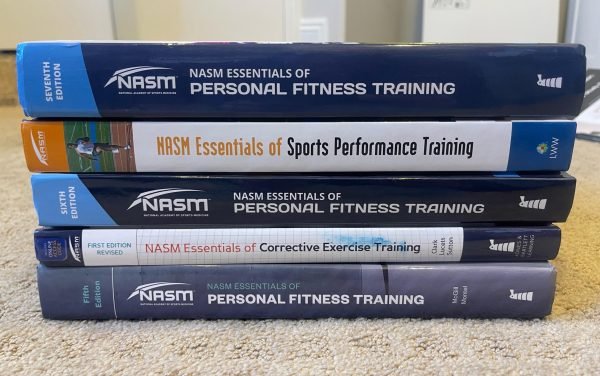
The cover of the NASM CPT Personal Trainer Textbook

As an aspiring personal trainer, there is a good chance you’ve considered a NASM CPT training certification to add to your list of professional accolades. There’s good reason too, NASM is considered to be a global leader in credentialing fitness professionals, and their wealth of certifications will prepare you for a promising career in personal training or one of their other areas of specialization.

Below is a NASM certification review from an actual certified NASM CPT (me), and an overview of the NASM company, the NASM CPT Below is a NASM  and other certifications, some notes on the ever popular NASM OPT model, and lots of other important information on NASM curriculum, costs, reviews, salaries, and your next steps should you choose to pursue a career with NASM.

If you are interested in becoming an Online Personal Trainer, check out our How to Become an Online Personal Trainer blog.

BONUS!

If you want our NASM CPT Study Course completely free click here.

Screen-Shot-2022-10-25-at-2.31.22-PM

Why I am Qualified to recommend top personal trainer certifications

The Best Personal Trainer Certification Programs

Hi, I’m Eddie Lester, the founder and CEO of Fitness Mentors. I’ve been a personal trainer for nearly two decades and have eight personal training certifications. In addition, I teach the NASM at a local college and helped develop NASM’s 900 credit hour university curriculum, making me highly familiar with the educational materials and learning styles NASM provides.

Myself and the team at Fitness Mentors have focused our careers on educating students to pass the NASM CPT Exam so I hope this blog helps you make the best decision for your career.

circles@2x 1
cross 1

What Does NASM CPT Stand For?

NASM stands for the National Academy of Sports Medicine, a 30-year-old company best known for its Certified Personal Trainer (CPT) program. Within the last 10 years, NASM has certified and recertified more personal trainers than any other personal training company, helping nearly 200,000 obtain or maintain their NASM credentials all across the globe. 

NASM is also NCCA-accredited, meaning they have the National Commission for Certifying Agencies credentials, the first standards ever developed to ensure a fitness certification body has the essential elements of a high-quality program.

As a personal trainer, the global recognition and the NCCA-certification are important factors in choosing NASM as a potential candidate for your fitness education, along with utilizing the best NASM Study Tools.


NASM Reviews CPT, CES, PES, CNC

NASM Programs

Like other fitness certification bodies, NASM is best-known for its Certified Personal Trainer program. However, they also provide a number of other specializations that are worth mentioning.

The NASM CPT is based on an evidence-based training model preparing students for real-life situations. The CPT program emphasizes the NASM core content. In addition to learning and understanding complex scientific principles, students will use NASM’s proprietary Optimum Performance Training™ (OPT™) model, a systematic system that helps you train in various areas including: Flexibility, Cardiorespiratory, Core, Balance, Power, and Strength.

NASM CPT cost: $849 (Fitness Mentors exclusive pricing for the entry-level package).

The Certified Nutrition Coach Certification is their newest program that helps trainers explain to clients the true nutritional content of what they are eating and help them understand why they should, or shouldn’t, be eating it. A popular choice for trainers seeking a nutrition-focused credential, often referenced in NASM nutrition certification reviews. This course will allow your clients to understand how to interpret food labels, select appropriate portion sizes, and eat healthy. This course also goes into detail around effective strategies to create and help your clients adhere to a nutrition program.

Course Cost: $899

The NASM CES is a specialization that can be applied to reduce muscular dysfunction and help you correct common movement issues. The corrective exercise continuum includes four areas, including: Inhibit, Lengthen, Activate, and Integrate. 

Exam Cost: $449 (includes course materials)

The NASM PES is designed to make athletes stronger, faster, and tougher. It uses approaches that are common in professional sports as well as exercise techniques and programs that are designed to maximize performance and minimize sports-related injury. 

Exam Cost: $449

The Behavior Change Specialization goes beyond the training elements and takes a deeper dive into motivational strategies. After completing this program, you’ll have the skill sets needed to determine your clients’ barriers to change, and design programs around their specific personalities.

Course Cost: $499 (Includes course materials and exam)

The Group Personal Training Specialization is a course that helps trainers design, develop, and deliver successful group fitness training programs. In addition to the physical fitness elements of this course, trainers will also learn how to develop strategic business plans around group fitness.

Course Cost: $499

The Weight Loss Specialization uses NASM’s OPT Model to help you design weight loss programs and develop strategies to assist clients in implementing a healthier lifestyle.

Course Cost: $499

The Women’s Fitness Specialization helps trainers become more effective at training women of all body types and ages. In addition to specific nutrition recommendations, it also involves exercise and small group training coursework.

Course Cost: $299

For trainers who want to capitalize on the growing exercise demand for people aged 6 to 19, the Youth Exercise Specialization helps kids focus on sports, increase their physical fitness levels, and lose weight.

The Senior Fitness Specialization is designed to help trainers focus their exercise programs on the specific needs of seniors. This coursework includes helping seniors reduce risk, preserve independence, helps you to understand the aging process, and helps you understand the limitations of an older group of clients.

Course Cost: $199

The Golf Fitness Specialization is designed for the trainer who wants to help golfers be fit with corrective exercise strategies. While much of the focus is on injury-prevention, it also involves helping clients improve driving distance, how to increase head speed, and how to lower scores from a fitness perspective.

Course Cost: $199

The MMA Conditioning Specialization caters to the growing group of mixed martial artists who want to better condition their bodies to the rigors of MMA. It involves system design around individuals as well as group courses, and also includes nutritional and supplement guidance.

Course Cost: $299

If you want to learn more about the various specializations and my personal thoughts on them, refer to this guide on  NASM Personal Trainer Certifications.

The NASM OPT Model

The NASM curriculum has pioneered what is called the Optimum Performance Training (OPT™) model, a comprehensive training system that is heavily versed in scientific, evidence-based research. According to NASM, the emphasis on science makes OPT ideal for program design and delivering consistent results.

Through the improvement of functional abilities, including

  • Strength
  • Balance
  • Power
  • Flexibility
  • Core stabilization
  • Cardio endurance

This program helps clients from a wide variety of body types and ages increase muscle mass, reduce body fat, and improve overall health.

OPT takes into account the individual and their needs, but also the environment in which they are performing. The program is not just for athletes, but also for seniors, the clinically obese, or those populations with special needs.

It starts with an assessment of goals, needs and abilities, and takes a look at a client from the front, back, and side to evaluate the kinetic chain to make sure they are moving how they should be moving. With this information, trainers can then determine what exercises they should be doing to help clients’ reach their goals.

The program is made of five phases split into three levels stabilization, strength, and power:

  • Phase 1: Stabilization Endurance
  • Phase 2: Strength Endurance
  • Phase 3: Hypertrophy
  • Phase 4: Maximal Strength
  • Phase 5: Power

Trainers should know that they don’t need a background in kinesiology or exercise science; they will learn all of this in their CPT and touch on it in additional certifications.

NASM Certification Cost

NASM has multiple study options for aspiring trainers and they really boil down to choosing the one that is right for you. The main NASM certification that people want to know about is the NASM Certified Personal Trainer (CPT) certification. For the others, you can see the costs above.

The NASM cost varies depending on the study package selected. NASM, at the time of this writing, has four study options to choose from:

  1. Self-Study $849 (Click here for 30% Off)
  2. Premium Self-Study $1149 (Click here for 30% Off)
  3. All-Inclusive $1799 (Click here for 30% Off)

The NASM Self-Study is best for those studying directly from a textbook.

Each option offers progressively more study assistance and assets that will help you pass the test. If you want the best NASM study materials, created by college-level NASM instructors who take the exam every year, check out our Free NASM CPT Study Course

These guides are the best on the internet and will help you save a considerable amount of time compared to NASM’s study packages. Fitness Mentors also provides specialized NASM exam prep and study materials designed by instructors who regularly take the test, with a 99% student pass rate.

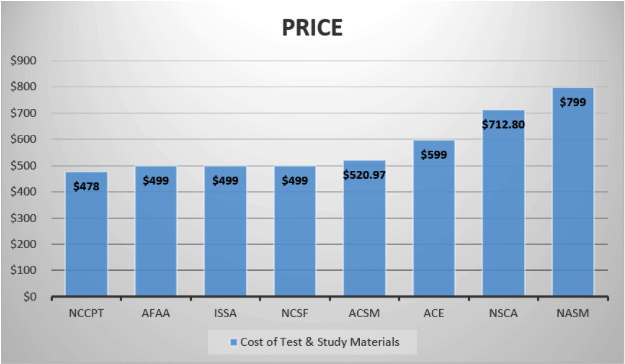
Wondering how the NASM CPT stacks up against other CPTs in terms of cost? We put together an in-depth look at the best personal trainer certifications and did cost comparisons. Here’s how it compares to the other major personal trainer certification bodies:

 
Price Graph

As you can see, the NASM CPT is the most expensive (considering exam and study materials) of all the major certification bodies. NASM is also considered to be the most popular of these brands, and there is a certain amount of prestige that goes along with their certification.

At the same time, there are other options you should be weighing in addition to cost. For example, you should also take into consideration CEU requirements, the primary focus of education, and perhaps most importantly, if the place you want to work accepts the certification you are leaning towards.

circles@2x 1
path-6-1.png
path 6@2x 1

NASM Certification Reviews

The NASM Facebook page shows that NASM has an average review rating of 8.2 out of 10. While this is a generally favorable average, I’d encourage you to speak with some NASM trainers to gauge their experience with the test, their studies, and how a NASM CPT played into their careers. However, some NASM reviews complaints mention higher costs compared to other CPT options and a challenging exam.

Fintess Mentors Soft Back 1

NASM CPT Salary

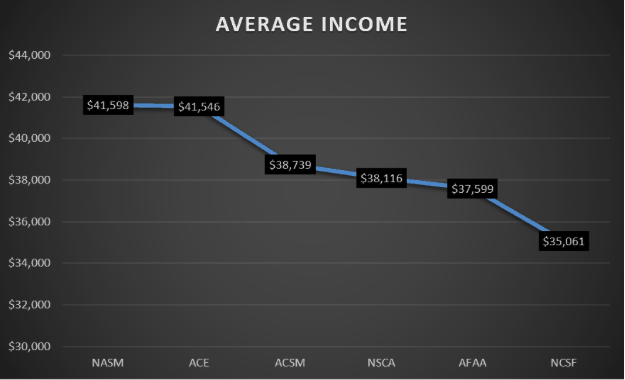
In the aforementioned blog post we did on the Best Personal Trainer Certification, we evaluated the average income of NASM, ACE, ACSM, NSCA, AFAA, and NCSF personal trainers. This data was pulled from reputable websites where registered users self-report their income.

The top tier of these incomes was with NASM, at $41,598 annually. It was followed closely by ACE at $41,546. The others were below the $40k a year annual salary. The important thing to note is that these are just averages; your ability to be successful greatly depends on your business acumen and less about the words after your name. Regardless, it is interesting to note that on average, NASM trainers make the most.

CPT Average Income

How to Get a NASM Certification

The NASM website claims that you can get your NASM CPT in as little as 10 to 12 weeks. To be eligible, you need to meet the following criteria:

  • Be at least 18 years of age 
  • Hold a current cardiopulmonary resuscitation (CPR) and an automated external defibrillator (AED) certification

From there, you simply sign up for one the aforementioned study programs on the NASM website and begin studying, then schedule a time to take the exam once you feel prepared. How do you know if you’ll be prepared? The Fitness Mentors Online Course for the NASM CPT Exam comes with a pass guarantee, so that is a good place to start.

If you have any questions, please leave them in the comments below and I will get to them as soon as possible.

circles@2x 1
cross 1

Survey Results: The Best In Personal Training & Fitness Industry Trends for 2026

It comes as no surprise that the fitness industry’s personal training is rapidly growing, especially during COVID times, where at-home and virtual workouts have exploded. As a whole, the personal training industry is growing at a rate of 8.7% per year, with the demand for personal trainers expected to grow 13% between now and 2028.

For CPTs within this highly dynamic and steadily expanding industry, fitness trends change annually. Fitness Mentors surveyed nearly 500 personal trainers to determine their preferences for the best fitness-related brands, technologies, workout strategies, services, education, client acquisition tactics, and more. 

The categories and topics we’ll touch on include:

  • Personal trainer client acquisition: Where are clients coming from?
  • The best fitness apps, software, and technology
  • The best personal training workouts
  • Best personal trainer certification.
  • Fitness Trend Projections For 2026

Some of the survey results were even a bit unexpected! Read on to see what we found.

circles@2x 1
cross 1

Personal Trainer Client Acquisition

Let’s start at the beginning. Where are we getting our clients? There’s not much sense in knowing the best workout strategies if we don’t have the clientele.

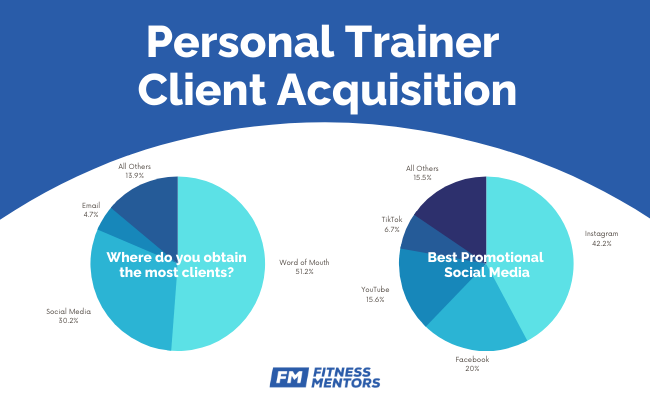
Over 50% of those surveyed by Fitness Mentors said their primary way to obtain clients is by word of mouth and referrals. Whether it’s a current client that recommended their services to someone else, or they just let members of their community know what they offer, most of their clients came this way. 

Second to that was social media, where 30.2% of those surveyed said they obtain the most clients. So what’s the best social media platform for personal trainers to use? According to 42.2% of the personal trainers we asked, Instagram is the best place to promote their personal training business, followed by 20% that suggested Facebook is best and 15.6% that prefer YouTube. 

Why did the majority choose Instagram? Likely because Instagram’s heavy reliance on photos makes for a great way to promote a business whose results are highly visual.

Personal-Trainer-Client-Acquisition-1

Fitness Apps, Software And Technology

Once we have our clients, what are the best ways to record their data and manage them? 

Best CMS

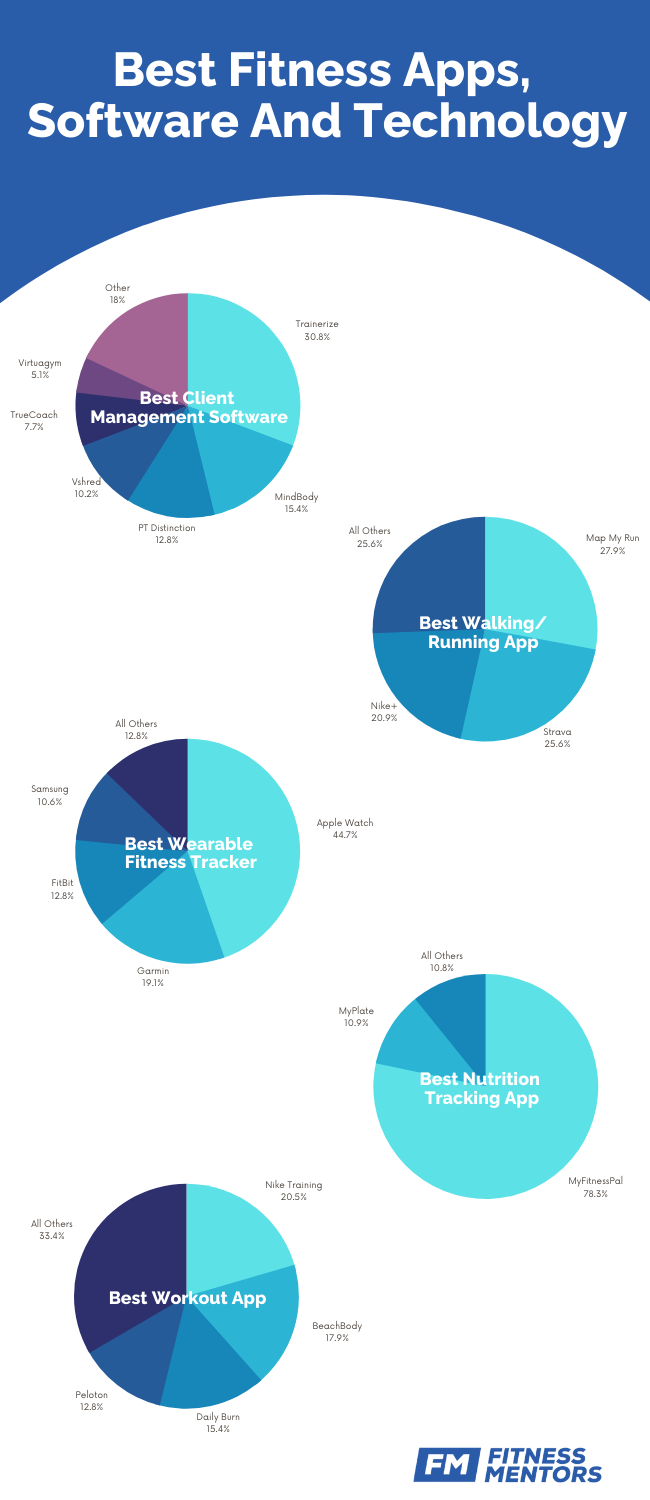
We asked our survey respondents what their choice is for the best client management software. The results were not unanimous, but nearly 31% of personal trainers said Trainerize is the best software, followed by MindBody at 15.4% and PT Distinction at 12.8%.

When we asked why Trainerize is their favorite, they talked about the many features like the ability to build customized training programs for their clients, track their progress, and even accept payments from them using the software.

So what about fitness and nutrition apps that personal trainers recommend for their own use and for their clients?

Best Nutrition App

Let’s start with nutrition – a big part of any personal trainer’s programs. The best nutrition tracking app that CPTs suggest their clients use is MyFitnessPal, which came in at 78.3%! Their many reasons involved the ease of use and the especially comprehensive database of foods and exercises.

Best Walking And Running Apps

When it came to walking and running apps to track your routes and progress, results were fairly close between three: Map My Run came in at 27.9%, Strava at 25.6%, and Nike+ at 20.9%. While it was a close call, the preference for Map My Run came because of the ability to track other activities besides just running. The app tracks cycling, interval training, walking, and more.

Best Fitness Training Apps

For virtual classes and training session apps, 20.5% of our surveyed trainers recommended Nike Training, while 17.9% preferred Beach Body. Both options allow the CPT’s clients to supplement their workouts with digital training that boasts anywhere-you-need-it accessibility.

Best Wearable Fitness Tracker

When it came to the best wearable fitness trackers, 44.7% of personal trainers answered their favorite was the Apple Watch. This was followed by 19.10% choosing Garmin, 12.8% who selected FitBit, and 10.6% who preferred Samsung.

With Apple and Garmin being two of the biggest names when it comes to wearable fitness trackers, you may wonder why CPTs lean more towards Apple. When we asked some of our voters, they said they prefer the Apple Watch because of the advanced features, such as the ECG and pulse oximeter sensors in the newer models.

Fitness industry Trends: Best Fitness apps

The Personal Training Workouts

On to the single-handed most important aspect of personal training: the workouts themselves. With so many new trends and fitness strategies, it’s no surprise that personal trainers may differ on what they feel is the best. We surveyed to find out what the majority prefer, and here’s what we found.

Best Workout For Weight Loss

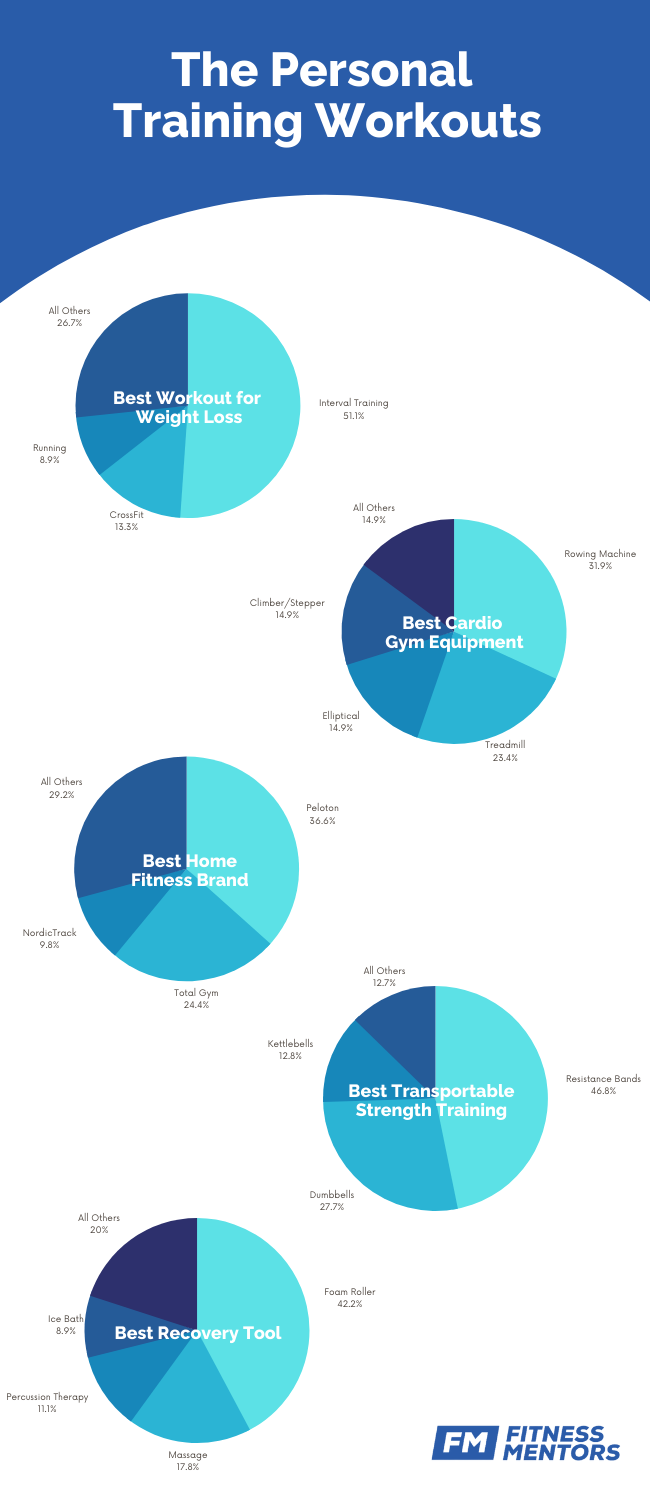
When we asked personal trainers what they think the best workout for weight loss is, the majority, 51.10%, said interval training. 13.3% answered that CrossFit is their preferred method, and 8/9% answered running.

The trainers who chose interval training said they did so because it helps your body continue to burn fat even after the workout is over.

Best Cardio Equipment

For those trainers working in gyms or studios, or recommending equipment to their clients, we asked what the best is for cardio. 31.9% chose a rowing machine, compared to 23.4% who said a treadmill. Ellipticals and steppers tied up at around 15%.

Rowing machines were a top choice because of their workout efficiency. They target 85% of your body’s muscles, which makes them the perfect workout if you had to choose just one piece of equipment.

Home Fitness Brand

So which equipment brand is a favorite amongst our surveyed personal trainers? 36.6% chose Peloton, while 24.4% chose Total Gym. 

Peloton, which was once known solely for its stationary bikes, now offers treadmills as well. When we asked why the preference towards the brand, many responders told us it’s about the quality and technology within the fitness equipment. Since Peloton integrates with its app to allow motivation and tracking, it’s often a choice for those looking for that extra support.

Transportable Strength Training

One of the beautiful things about being a personal trainer is the ability to provide your services anywhere. We asked our group of personal trainers what their favorite transportable strength training is. 46.8% answered resistance bands, while 27.7% preferred dumbbells.

The trainers who preferred resistance bands did so because of their lightweight functionality, making them effective at muscle building, yet easier to travel with.

Workout Delivery

COVID-19 put a huge emphasis on at-home workouts, which includes virtual personal training. When we asked our surveyors what their preference was for delivering their sessions to their clients, 58.7% chose a hybrid combination of in-person and virtual to obtain the most success. 32.6% preferred completely in person, while 8.7% said purely remote.

The combination of virtual and in-person training was a clear winner. 

Workout Recovery

Personal trainers have preferences for how they recommend their clients recover from a workout, as well. While resting is certainly one option, as far as other tools and techniques go, a foam roller was the highest recommended at 42.2%. This was followed by massage at 17.8% and percussion therapy at 11.1%.

The trainers said they preferred foam rollers because of their self-myofascial release that assists with tightness and soreness. They’re also easy to carry around and don’t take up a lot of space.

Fitness industry Trends: The Personal Training Workouts

Personal Training Certification

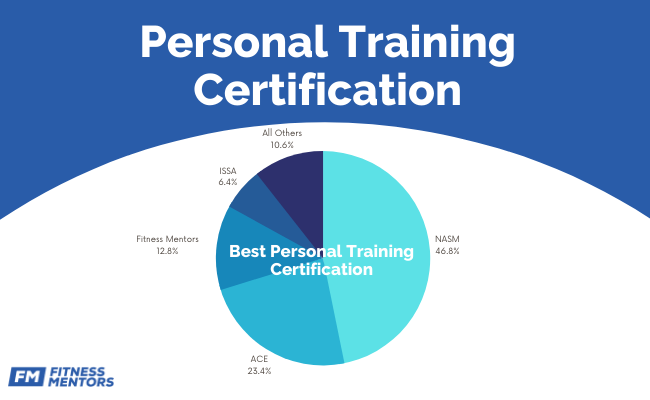
No two personal training certifications are exactly the same, and each has its own set of pros and cons that may make it better for one person over another. We asked our pool of personal trainers what their preference was for certification and CEUs. 46.8% answered NASM, while 23.4% said ACE, and 12.8% responded Fitness Mentors own certification.

You can read more about each certification here to mak the best choice for you.

Personal-Training-Certification

Fitness Industry Trend Projections For 2026

If you’ve been wondering which fitness trends in 2026 are worth your time and which ones are just hype you’re in the right place.

Whether you’re a personal trainer trying to stay ahead of the curve, or someone who wants to make smarter choices about your health routine, I’ve broken down the top fitness industry trends projected to dominate 2026 so you can make informed decisions fast.

Let’s get into it.

Why Fitness Trends Matter More in 2026 Than Ever Before

The fitness industry isn’t slowing down. Consumer expectations are higher, technology is smarter, and the way people define “working out” has fundamentally shifted since the pandemic. If I’m being honest with you, the trainers and health-focused individuals who pay attention to these shifts will build better habits, better businesses, and better results.

Here are the 10 trends I believe you need to know about.

1. Move-to-Earn: Getting Paid to Break a Sweat

What it is: Move-to-earn apps reward users with cryptocurrency for meeting physical fitness goals. The more you move, the more you earn.

I know what you’re thinking, is this actually real? Yes, and it’s growing fast. These platforms combine blockchain technology with daily movement tracking to give users a financial incentive to stay active. Different apps use different earning models, but the core idea is simple: your steps, runs, and workouts translate into real rewards.

Why it matters for you: If you’ve struggled with motivation in the past, a financial stake in your fitness can change the game entirely. Gamification meets accountability.

2. Wearable Technology: The Fitness Tracker I Think Everyone Should Own

What it is: Smartwatches and fitness trackers that monitor heart rate, GPS, sleep, steps, calories, blood pressure, and more all from your wrist.

I can’t overstate how much wearable technology has evolved. What used to be a basic step counter is now a comprehensive health dashboard. Today’s devices give you insights that were once only available through clinical testing.

What I look for in a wearable:

  • Real-time heart rate monitoring
  • GPS for outdoor workouts
  • Sleep quality tracking
  • Blood pressure and heart rhythm alerts

Why it matters for you: If I want to improve my performance or my clients’ results, I need data. Wearables make tracking effortless and keep accountability at an all-time high.

3. At-Home Fitness: The Billion-Dollar Trend That Isn't Going Away

What it is: Structured home workouts supported by streaming platforms, on-demand classes, and digital coaching tools.

I find it fascinating that what started as a pandemic necessity has evolved into a genuine lifestyle preference. The at-home fitness market is expected to reach $14.74 billion by 2028 and that tells me everything about where consumer behavior is heading.

Platforms like Peloton have proven that you don’t need a gym to build a serious fitness routine. With live classes, on-demand workouts, and community features built right in, the home gym is now more capable than ever.

Why it matters for you: Lower barrier to consistency. When the gym is your living room, you eliminate excuses.

4. Virtual Personal Training: I Can Coach You From Anywhere

What it is: Live, one-on-one or group personal training delivered via video conferencing platforms like Zoom, Google Meet, or Skype or asynchronously through recorded sessions.

This trend changed my entire view on what “local” means in fitness. Virtual training removes geography as a limiting factor. As a trainer, I can serve clients around the world. As a client, I can work with the best trainer for my goals, not just the nearest one.

Why it matters for you: Flexibility, accessibility, and cost-effectiveness. Virtual training consistently delivers real results when the programming is solid.

5. Mindfulness in Fitness: The Mental Side I Used to Overlook

What it is: The intentional integration of meditation, breathwork, yoga nidra, and mindfulness practices into physical training routines.

I used to think mindfulness was separate from fitness. I was wrong. The data is clear mental resilience, focus, and stress management directly impact physical performance and recovery. Top athletes and trainers are now treating mental training with the same seriousness as physical conditioning.

What mindfulness in fitness looks like:

  • Guided breathing between sets
  • Post-workout meditation sessions
  • Yoga nidra for active recovery and sleep optimization
  • Body scan practices to build kinesthetic awareness

Why it matters for you: You can have the best program in the world, but if your mind isn’t in it, your body won’t follow.

6. Functional Fitness: Training for Real Life, Not Just the Mirror

What it is: Exercise programming that improves the movement patterns you use every day bending, lifting, pushing, pulling, twisting, and carrying.

This is a principle I stand behind completely. Functional fitness doesn’t isolate a single muscle in a vacuum. Instead, it trains your body as an integrated system. It actually is improving balance, coordination, mobility, and joint stability so you move better outside the gym.

Why it matters for you: Whether you’re 25 or 65, functional movement directly reduces injury risk and improves quality of life. That’s a return on investment no bicep curl can match alone.

7. HIIT Workouts: High Intensity, Maximum ROI on Your Time

What it is: High-Intensity Interval Training alternating short bursts of maximum effort with brief recovery periods.

I recommend HIIT to almost every client who tells me they’re short on time. It’s efficient, it’s proven, and it works. Research consistently shows HIIT burns more calories per minute than steady-state cardio, improves cardiovascular fitness faster, and continues burning calories post-workout through the afterburn effect (EPOC).

Why it matters for you: If I only have 20–30 minutes, HIIT is how I make every second count.

8. Outdoor Workouts: Why I Think Fresh Air Is Underrated

What it is: Taking training outside running trails, park workouts, outdoor bootcamps, cycling, swimming, hiking, and bodyweight circuits in natural environments.

There’s something about training outdoors that I genuinely believe makes you work harder without feeling like it. Studies support it too; outdoor exercise is linked to improved mood, reduced cortisol, and higher workout enjoyment compared to indoor training.

And the options go far beyond a jog. I’ve seen trainers use park benches for step-ups, trees for suspension training, and hills for sprint work. Get creative.

Why it matters for you: Variety breaks plateaus. Nature lowers stress hormones. Vitamin D supports recovery. Outdoor training checks all three boxes.

9. Smart Gym Equipment: AI-Powered Feedback in Real Time

What it is: Exercise machines and tools embedded with sensors and AI that analyze your form, count reps, track load, and deliver real-time performance feedback.

I’ve tested several smart gym devices, and what impresses me most isn’t the data, it’s the actionable insight. Instead of just knowing I did 10 reps, I know whether my form was compromised on reps 7 through 10. That kind of granular feedback accelerates improvement dramatically.

Why it matters for you: Smart equipment bridges the gap between training with a coach and training alone. It’s accountability, built into the machine itself.

10. Competitive Fitness: The Community-Driven Trend I See Everywhere

What it is: Organized competitive fitness events including CrossFit competitions, obstacle course races, and team-based fitness challenges.

Competitive fitness has something that solo training often lacks: community and external motivation. When I sign up for a race or competition, my training has a deadline, a goal, and often a team behind it. That changes everything about consistency and effort.

Why it matters for you: If you’ve ever struggled to stay motivated training alone, competition gives you a reason to show up. The community you build in the process is a bonus that keeps most people coming back.

A Final Word

These aren’t just trends I’m reporting on; these are signals about where the fitness industry is heading and what real people are responding to. Whether you’re a trainer building your programming for the year ahead, or an individual designing your own health journey, leaning into these trends gives you a structural advantage.

My recommendation? Don’t try to adopt all ten at once. Pick two or three that align with your goals or your clients’ goals, go deep on them, and build from there.

The fitness industry rewards people who stay curious and adapt. In 2026, that advantage has never been more available to you.

Top Strength And Conditioning Certifications for 2026, Compared

With this comes the increasing need for personal trainers and coaches, including certified strength and conditioning specialists. There is no better time than now to pursue your coaching dreams and make money along the way with the strength training certification.

Here, we’ll walk you through our top strength and conditioning certifications and compare each. We’ll include the eligibility of each Strength and Conditioning Coach course topic, exam information, costs, and career paths you can take with whichever certification you choose.

The strength and conditioning certifications we’ll compare include:

circles@2x 1
cross 1

Eligibilities for Each Strength And Conditioning Certification

Each association’s certification has different suggested or mandatory requirements for obtaining and keeping your accreditation.

SCC from ISSA 

To obtain your SSC, per the ISSA, they mandate you:

  • Are at least 18 years of age
  • High school graduate or equivalent
  • Hold a CPR/AED certification

PES from NASM

NASM recommends that you have at least one of the following to obtain your PES:

  • NASM-CPT certification
  • Licensed Massage Therapist
  • 4-year College Degree
  • REPs Level 3 or higher
  • NCCA, NBFE, or DETC Accredited Health/Fitness Certification

CSCS from NSCA 

NSCA requires that you possess the following to be a CSCS certification candidate:

  • A Bachelor’s or higher degree or currently enrolled as a college senior at an accredited institution – Candidates in the US and Canada must provide proof in the form of an official transcript or a terminal degree. Candidates outside of the US and Canada can provide a copy of the transcript that shows they obtained a Bachelor’s degree equivalent.
  • A current CPR/AED certification – if you do not yet have this certification, you can still take the exam, but you have to supply proof of certification within one year of your exam date.

CSC from NCSF

NCSF requires that you have one or more of the following for their Certified Strength Coach certification:

  • Bachelor’s degree
  • Associates Degree
  • NCCA accredited fitness certification (such as a CPT)

While each has different requirements for being certified, they also cover their own sets of topics that set them apart. Also, if your certification is expired, make sure to renew your cpr certificate before you complete your chose course. 

Best strength and conditioning certifications 2026

The topics covered in each course reflect what the exam will entail as well. While each gives you a different subset of topics, all will give you the framework to succeed in your career.

PES from NASM

NASM divides the PES course into four sections:

  • Section 1: Anatomy and Physiology for Sport
  • Section 2: Sport Performance Testing, Integrated Training certification, and Programming: 
  • Section 3: Olympic Lifting & Injury Prevention
  • Section 4: Sport Nutrition & Psychology

CSCS from NSCA 

The textbook is laid out into 24 chapters. Some of the topics include:

  • Structure and function of body systems
  • Anaerobic and Aerobic training programs
  • Nutrition
  • Flexibility
  • Weight and Resistance Training
  • Speed & Agility Training
  • Rehabilitation and Reconditioning

SCC from ISSA 

The course contents for the SSC are divided into 23 chapters. Some of the topics include:

  • The nervous, muscular, skeletal, and cardiorespiratory systems
  • Biomechanics
  • General and performance assessments
  • Program design
  • Flexibility
  • Core, Lower-Body, Plyometric, Upper Body and Weight Lifting Exercises
  • Periodization
  • Injury Recovery
  • Nutrition & Supplements

CSC from NCSF

Topics covered in becoming an NCSF certified Strength and Conditioning coach include:

  • Athletic Analyses
  • Advanced program construction
  • Athletic-based training
  • Over 300 exercises and drills

Costs Associated With Strength And Conditioning Certifications

Each certification option offers various study courses before a final exam. Below is the cost you can expect from each (pricing and components subject to change):

PES from NASM

NASM offers three packages for their 100% online certification. 

The self-study option is regularly $699. It includes:

  • CEU Value 1.9
  • NASM-PES Digital Textbook with 16 in-depth chapters
  • Online PES Exam
  • 2 Online Practice Exams
  • Syllabus and Study Guide
  • Exercise Library with 64 videos
  • 35 lecture videos, 34 demo videos
  • Exercise Libraries
  • Module Quizzes
  • Certificate of Completion

The Premium Self-Study option is regularly $849. It includes all of the above, plus the addition of bonus content like weight room maintenance and sports lecture videos, as well as a programming toolkit.

The All-Inclusive option is regularly $999 and includes everything the premium version includes with the addition of a hard copy textbook and a live workshop.

The exam itself is not available as an a la carte purchase; you must purchase one of the above courses. The typical completion time is around 8-10 weeks, but you’ll have one full year to complete the course once you enroll. 

Once you pass NASM’s PES exam, your certification never expires.

Fitness Mentors also offers an efficient study guide featuring the best educational materials for the exam. We’ll give you all the test-specific topics that will guide you to read the book’s most pertinent sections. For more information and to purchase, click here.

CSCS from NSCA 

NSCA breaks down the CSCS study packages into three choices, but customizable options are available too.

The CSCS Digital Package starts at $162 and includes:

  • CSCS Study Guide
  • Over 200 practice questions

The CSCS Essential Package starts at $250 and adds in the physical textbook, Essentials of Strength Training. For a starting price of $465, the CSCS Essential Plus Package also offers an online study course and an Exercise Technique manual.

SCC from ISSA

The ISSA offers one online course option, and the course is not required to purchase and take the exam. Regularly priced at $639, the online course allows you to study at your own pace and take the exam at home.

The completely online course includes:

  • Study guide and workbook
  • Online and home study exam
  • Exercise lab
  • Practice exam and section quizzes
  • “Take home” strength and conditioning certification exam
  • NCCPT accredited exam (proctoring fee not included)
  • A free professional website
  • Ongoing educational support

With just 1-2 hours a day, you can expect to finish the course in 8-10 weeks – but the pace is entirely up to you. You have up to 12 months to complete the program.

CSC from NCSF

According to the NCSF site, they offer various packages as well as the a la carte exam. Packages range in price from $299 for the exam alone, or up to $999 for the most in-depth package. They offer two home-study packages.

The first is regularly $799 and includes:

  • Digital textbook: Advanced Concepts of Strength & Conditioning
  • Instructional videos
  • Lesson notes
  • Q&A
  • Review quizzes
  • Online Certified Strength Coach practice exam
  • 8 NCSF CEUs (meets ethics requirement)
  • One year membership to NCSF
  • NCSF Certified Strength Coach Exam

For an additional $100, you receive a physical textbook with the Home-Study Plus package. 

Candidates have 6 months after enrollment to schedule and take the exam. On average, NCSF suggests taking 2-4 months to study the material. The exam may be taken online or at a testing center.

Exam Information for Each Strength And Conditioning Certification

Each certification exam has a different number of questions, time limits, passing scores and allowed attempts. Here is the breakdown:

PES from NASM

  • Questions: 100 multiple-choice
  • Time Limit: 90 Minutes
  • Passing score: 70% or higher
  • Attempts allowed: 3

CSCS from NSCA 

  • Questions: 220 multiple-choice
  • Time Limit: 4 Hours; split into 1.5 hours for Scientific Foundations and 2.5 hours for the Practical/Applied section
  • Passing score: 70 in both sections
  • Attempts allowed: No limit, but you must wait 90 days between retakes. If you fail only one section, you may retake just the section you failed within one year.

SCC from ISSA 

  • Questions: 140 multiple-choice, 15 field items (unscored)
  • Time Limit: Unlimited, Open book (the NCCPT accredited exam is not open book)
  • Passing score: 75% or higher
  • Attempts allowed: Unlimited within six months with fees and a 72 hour waiting period between attempts.

CSC from NCSF 

  • Questions: 150 multiple-choice
  • Time Limit: 3 hours
  • Passing score: 70 or higher
  • Attempts allowed: Unlimited within six months with fees and a 30-day waiting period between attempts.

FAQs of Strength and conditioning certifications for beginners

How Do I Get Certified In Strength and Conditioning?

Choose the training you wish to receive and from what organization. Be sure to have all of the prerequisites covered for the course and exam you choose.

How Long Does It Take To Become a Certified Strength And Training Specialist?

Most programs allow the flexibility to work at your own pace, within a specified time frame. Many recommend taking at least 8-12 weeks to allow for material comprehension, but you generally have longer if needed. For example, the ISSA-SSC requires you to complete your course and exam within 12 months from enrollment.

How Much Does CSCS Certification Cost?

While some programs allow you to get the exam a la carte, taking a course will help you to better your chances of passing. For a course and exam, you should plan to spend around $500 minimum. According to industry surveys, the Certified Strength and Conditioning Specialist salary typically ranges between $55,000–$75,000 annually, depending on experience, location, and level of employment (collegiate, professional, or private sector).

Where Does a Strength And Conditioning Specialist Work? What CSCCA Jobs Will I Have An Opportunity For?

A Strength and Conditioning Certification, regardless of which one, has the potential to open the door to many career opportunities. These may include personal trainer, strength and conditioning coach, sports coach, physical therapist, teacher/researcher/professor, athletic trainer, and more!

Which Strength and Conditioning Certification is Best?

It’s important to note that an SCCC (Strength and Conditioning Coach Certified) certification from the Collegiate Strength & Conditioning Coaches Association is one of the most highly regarded in the industry.

However, you must already be a full-time practicing strength and conditioning coach or a student preparing to be, and the exam is only once per year with no course materials.

If you wish to coach on a collegiate or professional level otherwise, NSCA-CSCS and NASM-PES are two of the best options. For flexible, fully strength and conditioning certifications online, ISSA and NCSF offer excellent study-at-home options.

All four courses with certifications are similar in cost in relation to what you receive in each package for budget concerns.

Ultimately, which certification you choose depends on your personal preferences and what your goals are post-certification. If you’d like to work for a specific organization, it’s best to check with the potential employer to determine which certification they prefer. 

A Strength traning Certification is highly lucrative and can open many doors to advance your career and put you on the path to financial freedom.

Everything You Should Know About TRX Training Certifications

Why TRX Certification Might Be the Game-Changer Your Fitness Career Needs

circles@2x 1
cross 1

Walk into almost any gym today and you’ll likely see straps dangling from a rack, door, or ceiling beam. Suspension training has exploded in popularity over the last few years, and for good reason. It’s different, it’s challenging, and it’s fun both for clients and trainers.

But here’s the thing: while fitness trends come and go, TRX has stayed strong. As a master personal trainer with over 20 years of experience, multiple certifications, and a background in kinesiology, I’ve watched countless fads fade. TRX hasn’t. Why? Because when it’s used correctly, it delivers real, measurable results.

If you’ve been thinking about adding suspension training to your skill set, this guide is for you. Whether you’re:

  • A personal trainer wanting to stand out from the crowd
  • A gym owner looking to offer group classes that sell
  • A kinesiology student exploring new certifications
  • Or simply researching TRX courses before committing

In this guide, you’ll discover:

  • The types of TRX certifications available
  • The differences between online and in-person courses
  • What you can expect to pay
  • Options for group training and class formats
  • And most importantly whether certification is truly worth your time and money

Here’s the Real Question
With so many certification options out there, how do you know which TRX course aligns with your goals and whether it will actually advance your career? This guide breaks it all down so you can make an informed decision with confidence.

TRX training allows you to:

  • Modify classic exercises like planks, pushups, and squats for greater challenge.
  • Create workouts tailored to all fitness levels.
  • Suspension training reduces pressure on articulations for a low-impact workout.
Everything-You-Should-Know-About-TRX-Training-Certifications​

What Is TRX and Why Has It Become So Popular?

Resistance training has several benefits, from helping you lose close to four pounds of body fat in only ten weeks to increasing bone density.

However, there are risks involved with resistance-based workouts. Studies show that these risks increase due to a lack of clear instructions or supervision.

Besides providing you with the knowledge needed to get the most out of this workout method, TRX training certifications ensure that

  • You teach safe TRX exercises, learn how to
  • Use TRX straps effectively
  • Develop workouts adapted to the goals and levels of each client.

The TRX Certification Process

The TRX company offers different classes you can take to become a certified instructor. You can sign up for in-person or virtual TRX education classes.

In-person classes are available regularly in major US cities. Virtual classes can be a better option if you don’t want to travel or prefer completing the class at your own pace.

You’ll get started by completing the TRX Suspension Training Course or TRX Suspension Training Course: Virtual Edition 2.0. This class includes an introduction to the TRX workout method where you’ll also learn how to set up the equipment.

At the end of this class, you’ll be familiar with the key moves you can use with the suspension equipment and know enough to create personalized TRX workouts.

You’ll get a certificate of completion after taking this eight-hour class and will become a TRX Qualified Trainer.

If you want to take things further, you can sign up for an advanced class. TRX offers classes that focus on yoga, kettlebell training, or sports medicine. You can also sign up for a group TRX certification class.

The Benefits of TRX Certification

The TRX community includes over 300,000 fitness professionals. As TRX becomes more popular, taking a TRX suspension training course can help you stand out.

The fitness industry is going through some significant changes. There is a projected job outlook of 19%, and with less than 25% of adults meeting the CDC’s recommended guidelines for aerobic and muscle-strengthening activities, there is a strong market for growth.

As more Americans take steps to achieve a healthier lifestyle, fitness trends emerge. People want to have several options to choose from so they can try different workout methods and find something they enjoy doing.

With TRX, you can diversify your offering while presenting your clients with a workout method that yields results.

Obtaining a certification will help you create a safe environment where clients can explore this new way of working out. It will inspire trust and provide you with the tools you need to help your clients get the best results possible.

TRX instructor training is more appealing than other certifications since few other workout methods are as versatile. You can use TRX to offer full-body workouts or focus on strength, resistance, flexibility, cardio, and more.

Who Should Consider TRX Certifications?

There are no prerequisites for taking a TRX class. However, you should keep in mind that obtaining a TRX certification isn’t sufficient to offer your services as a certified fitness trainer. You’ll need to obtain a certification from a reputable organization like Fitness Mentors.

Read more: How To Become A Personal Trainer

Taking the entry-level TRX class can be a good option if you’re studying sports medicine and plan on becoming a fitness trainer.

It’s also a great option if you’re currently a fitness trainer and want to branch out by offering a new way of working out.

If you own a gym or work at one, you should consider taking the TRX group certification so you can offer a new class.

What Are TRX Training Certifications?

If you want to teach suspension training the right way, you need more than just watching a few workout videos. That’s where TRX training certifications come in.

These programs are designed to teach you how to properly set up the equipment, coach exercises safely, and adjust movements for different fitness levels. You learn how to cue clients, fix common mistakes, and build smart workouts using the straps.

Not a Full Personal Training Certification

It’s important to understand something clearly.

A TRX certification is not the same as becoming a certified personal trainer (CPT). It does not replace certifications from major organizations like NASM or ACE.

Instead, it’s a specialty course focused only on suspension training. Think of it as an extra skill that adds value to your main certification.

If you’re already a trainer, this can help you stand out. If you’re new to fitness, you’ll still need a full CPT before training clients professionally.

Who Offers These Certifications?

Official TRX courses are offered directly through TRX Training. They provide both in-person workshops and a TRX certification online option, which allows you to complete the course at your own pace.

Most programs include:

  • Video lessons


  • Exercise breakdowns


  • Coaching demonstrations


  • Practical programming guidance


  • A final assessment


Once completed, you become a TRX Qualified Trainer or Coach.

Are There Free TRX Certification Courses?

This is a common question.

You might see searches for TRX certification courses online free or TRX training certifications free, but here’s the honest answer:

There is no fully accredited, official TRX certification that is completely free.

Sometimes TRX offers:

  • Free sample workouts


  • Trial access to their app


  • Introductory educational content


But to receive an official certificate of completion, you must enroll in a paid course.

Be cautious of websites offering “free certification” downloads that are not officially connected to TRX.

Is There a TRX Training Certifications PDF?

Many courses provide downloadable materials. After registering, you typically receive digital study guides or manuals. These often come in PDF format so you can review the exercises, principles, and coaching cues offline.

However, there isn’t a public trx training certifications pdf that gives you full certification without enrolling. The PDF materials are part of the paid education program.

In simple terms, TRX training certifications are specialty courses that teach you how to safely and effectively coach suspension training. They add to your skills but they don’t replace a full personal training credential.

Types of TRX Certification Courses Available

Not all TRX courses are the same. Some are made for beginners. Others are designed for experienced trainers who want to specialize.

Let’s break them down in a simple way.

TRX Suspension Training Course (STC)

The TRX Suspension Training Course (STC) is the main entry-level course. This is where most trainers begin.

It usually takes about 6–8 hours to complete, depending on whether you take it live or online.

In this course, you’ll learn:

  • How to properly set up the straps
  • Safety guidelines and anchoring methods
  • Foundational TRX exercises
  • How to progress and regress movements
  • How to coach and cue clients correctly
  • Basic workout design using suspension training

By the end of the course, you’ll understand how to build full-body workouts using TRX safely and effectively.

Once you pass, you receive a certificate of completion and become a TRX Qualified Trainer. This shows that you have formal training in suspension coaching.

For most trainers, this is the first and most important step.

TRX Group Training Course

If you plan to teach classes instead of one-on-one sessions, the TRX group training course is worth considering.

Training one person is very different from managing 8–15 people at the same time. This course focuses on:

  • Class structure and flow
  • Managing different fitness levels in one room
  • Keeping sessions safe and organized
  • Creating timed circuits and stations
  • Coaching clearly in a group setting

You’ll learn how to design sessions that keep energy high while still maintaining good form and safety.

This course is ideal for:

  • Gym owners
  • Studio instructors
  • Trainers who teach boot camps
  • Coaches running small group sessions

If group fitness is part of your business model, this adds real value.

Advanced TRX Courses (Level 2 Options)

Once you complete a Level 1 course, you can move into more advanced training.

These Level 2 options focus on specific goals or populations.

Some examples include:

Sports Medicine Focus
This course teaches how to use TRX for corrective work and muscular imbalances. It’s helpful for trainers working with post-rehab clients or people returning from injury.

Force or Performance Training
This option is designed for high-intensity training styles. It’s great for athletic performance, boot camps, and military-style conditioning.

Specialized Populations
Certain advanced courses focus on working with athletes, older adults, or specific sports like tennis. These teach you how to adjust exercises safely and effectively for different needs.

If you already have strong experience as a trainer, these advanced courses can help you specialize and offer something unique in your market.

Online vs In-Person TRX Training Certifications

When choosing between formats, it really comes down to your schedule, budget, and learning style. Both options teach the same core material, but the experience feels different.

Flexibility

If you have a busy schedule, trx training certifications online are often the easiest option. You can learn at your own pace, pause videos, rewatch lessons, and complete the course when it fits your time.

In-person workshops follow a fixed schedule. You must attend on a specific date and complete the training in one session.

Travel

If you search for trx certification classes near me, you might find a workshop in your city. That’s great if you prefer hands-on instruction.

But if there are no local events, you may need to travel. That adds time and extra cost.

Online courses remove that problem completely. You can learn from home, your studio, or even while traveling.

Cost

Online courses are often slightly more affordable because there are no venue costs. You also save money on travel, hotels, and transportation.

In-person workshops may cost more, but they give you live coaching feedback and direct interaction.

Learning Style

Some people learn best by doing and asking questions face to face. In-person training gives you immediate corrections and hands-on experience.

Others prefer to move at their own speed. Online learning lets you replay sections, take notes, and study comfortably.

There is no “better” option just the one that fits you best.

Are There Free TRX Certification Options?

This is one of the most common questions people ask.

You may see searches for trx training certifications free or trx certification courses online free, but here’s the honest truth:

There is no fully accredited, official TRX certification that is completely free.

To receive a recognized certificate of completion, you must enroll in a paid course.

What Free Options Actually Exist?

Even though there isn’t a free certification, you may find:

  • Trial memberships to the TRX app

  • Free sample workouts

  • Short educational videos

  • Introductory webinars

  • Limited study materials

These are helpful for learning the basics and deciding if TRX is right for you. But they do not make you certified.

If you’re serious about adding suspension training to your services, investing in a proper course is the safest and most professional route.

In fitness, credibility matters. A real certification shows clients and employers that you’ve taken the time to learn the system correctly.

Do You Get Continuing Education Credits (CECs)?

One big advantage of completing a TRX training certification is that it can count toward continuing education credits (CECs) for certified personal trainers (CPTs). These credits help you maintain your main certifications with organizations like ACE, NASM, or ISSA.

Which Organizations Recognize TRX CECs?

  • ACE (American Council on Exercise) – Many TRX courses offer approved CEC hours to keep your ACE certification current.
  • NASM (National Academy of Sports Medicine) – TRX education can count toward NASM’s required continuing education.
  • ISSA (International Sports Sciences Association) – Courses are recognized for CECs for trainers looking to stay certified and expand their knowledge.

How Many CE Credits Can You Earn?

Typically, a TRX certification course provides 6–8 continuing education hours, depending on the program. Online courses and in-person workshops usually offer the same credit value.

Why CECs Matter for CPTs

As a certified personal trainer, you need to complete continuing education regularly to maintain your main certification. By taking TRX courses:

  • You earn credits while learning a specialized skill
  • You stay compliant with certification requirements
  • You enhance your resume and professional credibility
  • You gain knowledge to safely and effectively train clients using suspension equipment

In short, TRX certifications are not just about learning suspension training they also help trainers keep their credentials current while building practical skills that clients love.

Who Should Get TRX Certified?

TRX training certifications aren’t just for one type of fitness professional they can benefit anyone who wants to add functional, versatile training to their toolkit.

Personal Trainers

If you already work as a personal trainer, TRX can help you stand out. You’ll be able to offer unique workouts that improve strength, balance, and core stability in every client. Whether you train beginners or advanced athletes, suspension training adds variety and effectiveness to your sessions.

Gym Owners

Owning a gym comes with the challenge of keeping classes fresh and members engaged. Offering TRX group classes or adding suspension equipment to your gym gives your clients a new way to train while increasing your offerings.

Rehab Specialists

Physical therapists and rehab coaches can use TRX to help clients recover from injuries safely. The ability to adjust resistance using body weight makes it perfect for controlled, low-impact training.

Athletes

Athletes looking to improve performance benefit from TRX because it builds functional strength, balance, and stability skills that translate directly to sports movements.

Students Studying Kinesiology

If you’re studying kinesiology or planning to become a fitness professional, TRX certifications provide practical, hands-on experience. You’ll learn how to apply principles of biomechanics and movement in real-world training.

Eddie Lester’s Perspective

As a master personal trainer with over 20 years of experience and 10 specialized certifications, I’ve seen firsthand how adding a TRX certification can elevate your career.

I recommend specializing in TRX because:

  • It’s versatile for all client levels


  • It teaches functional movement you can apply immediately


  • It opens opportunities to teach one-on-one or group classes


  • It adds credibility to your profile and shows commitment to ongoing learning

In practice, I’ve used TRX with both beginners and advanced clients. It’s a tool that allows me to regress movements for safety or progress exercises for challenge, making it a staple in any trainer’s toolbox.

Whether you’re a trainer, gym owner, rehab professional, athlete, or student, a TRX certification can provide skills and confidence to apply suspension training effectively.

TRX Certification vs Personal Training Certification

It’s important to understand the difference between a TRX training certification and a general personal training certification (CPT).

A TRX certification focuses specifically on suspension training. You’ll learn how to safely set up the straps, coach exercises, and design workouts for individual clients or groups. It teaches practical skills for a specialty area, but it does not cover all aspects of personal training, like nutrition, anatomy, exercise science, or program design for every client.

On the other hand, a CPT certification from organizations like NASM, ACE, or ISSA provides a full foundation to train clients safely across all exercise modalities. You still need a CPT to work as a professional personal trainer.

That’s where Fitness Mentors comes in. Their programs allow you to get fully certified as a CPT while also offering specialized courses like TRX. This combination ensures you’re fully prepared to train clients professionally while also having the added skills of suspension training.

In short: TRX certification adds value and specialty knowledge, but it complements rather than replaces your personal training credentials.

How Much Do TRX Training Certifications Cost?

The cost of TRX training certifications depends on the course type and format.

General Price Range

  • Entry-level TRX Suspension Training Course (STC): $300–$400


  • TRX Group Training Course: $400–$500


  • Advanced Level 2 Courses: $500–$700


Prices may vary slightly depending on location or if you take the course online.

Online vs In-Person

  • Online TRX certification: Often slightly cheaper because there are no travel or venue costs. You can complete it from home at your own pace.


  • In-person workshops: Typically cost more due to venue, equipment, and instructor time. But you get hands-on coaching and live feedback.


Value vs Return on Investment

Investing in TRX training certifications is not just about the price tag it’s about what you gain:

  • Add a valuable skill to your resume


  • Offer clients unique workouts


  • Expand career opportunities (group classes, rehab, sports performance)


  • Earn continuing education credits for your CPT

Considering the skills, credibility, and versatility you gain, TRX certification is a worthwhile investment for trainers serious about growing their careers.

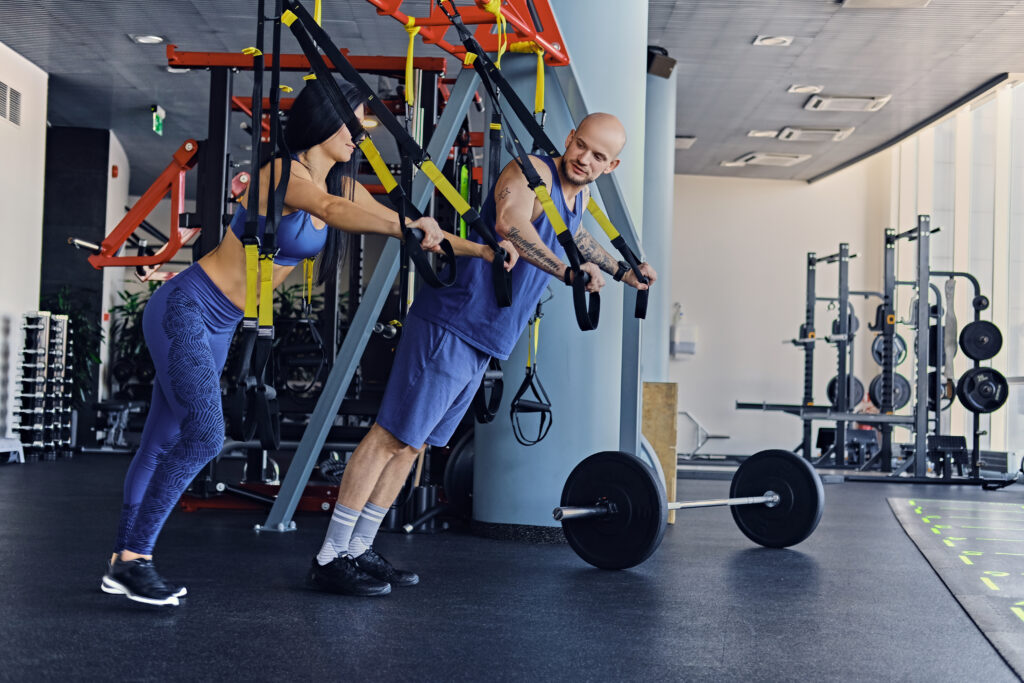
exercising-with-trx-straps-gym-club

FAQ

Read on to learn more about TRX training.

Your TRX certification will not expire. However, we recommend keeping up with new classes released by TRX.

You can obtain a TRX certification by completing the eight-hour TRX Suspension Training course. However, you’ll also need a national certification from an organization like ACE or NASM to become a certified fitness trainer.

TRX is a proven method that is gaining in popularity. It’s a fun and low-impact way to take your workouts up a notch. It’s an option worth considering if you want to diversify what you offer to your clients.

How To Get Zumba Certified: Everything You Need To Know

Like TRX, yoga, and other group exercise techniques, you need certification to legally and effectively run a class or studio. 

As personal trainers ourselves, we know the drill. Let’s walk through how to get Zumba Certification, including the costs and due process. et’s explore the process of Zumba instructor training, including requirements, costs, and how to position yourself for long-term success.

Zumba
circles@2x 1
cross 1

Walk into almost any gym across the globe and you’ll hear it before you see it: high-energy Latin beats, cheering participants, and an instructor leading what looks more like a dance party than a workout. That atmosphere is exactly why Zumba has become one of the most recognized group fitness programs in the world.

The program was created in the late 1990s by Alberto “Beto” Pérez, a Colombian dancer and choreographer who accidentally forgot his traditional aerobics music and improvised a class using Latin rhythms instead. That spontaneous moment turned into a global fitness movement now taught in more than 180 countries.

How Zumba Works: The Interval Formula Behind the Fun

At its core, Zumba is an interval-style cardio workout. It alternates between high-intensity dance sequences and lower-intensity recovery movements. This format keeps the heart rate elevated while preventing early fatigue which is one reason participants can sustain energy throughout the session.

As I’ve seen in the fitness industry, programs that blend structure with enjoyment tend to outperform rigid workout models. Zumba’s formula allows beginners to follow along while still challenging more experienced participants.

How Many Calories Does Zumba Burn?

Because of its interval design, Zumba can be a highly effective calorie-burning workout. Research has shown participants may burn between 300 and 900 calories per hour depending on intensity, body weight, and fitness level.

The combination of aerobic conditioning, coordination work, and muscular endurance makes it more than just dancing; it becomes a total-body cardiovascular session.

Why Participants Keep Coming Back

The reason Zumba remains globally popular isn’t just calories, it’s psychology.

Participants love it because:

  • It feels inclusive and welcoming

  • No advanced dance experience is required

  • The music boosts mood and reduces stress

  • Classes create a sense of community

From an instructor’s perspective, that emotional connection matters. When people associate exercise with enjoyment instead of obligation, attendance improves, referrals increase, and retention grows.

As someone deeply involved in trainer development, I’ve noticed that group programs rooted in music and community tend to generate stronger loyalty than purely performance-based workouts. That loyalty is what helped Zumba scale worldwide and it’s what continues to make it attractive for aspiring instructors.

Why I Recommend Zumba as a Smart Entry Into the Fitness Industry

Breaking into the fitness industry can feel overwhelming. Between advanced certifications, specialty niches, and business logistics, many aspiring trainers delay getting started. But not every path requires years of preparation. In my experience mentoring fitness professionals, Zumba offers one of the most accessible entry points into the industry.

Eddie Lester often tells new trainers that momentum matters more than perfection. Starting with a format that allows you to teach quickly while building confidence can accelerate long-term success.

Low Barrier to Entry

Unlike many advanced fitness credentials, Zumba does not require prior certification or a formal fitness background. You must be at least 18 years old to enroll, but there are no mandatory prerequisites.

While a dance or group exercise background can be helpful, it’s not required. This accessibility removes a major psychological barrier for individuals who love movement but may not yet feel ready to pursue a full personal training certification.

Fast Certification Process

One of the biggest advantages is speed. The Basic Level 1 training can be completed in as little as one day (around 8–10 hours depending on format). After completing the training, you receive your license to begin teaching.

As I’ve seen in the fitness industry, faster certification pathways allow new instructors to gain real-world experience quickly. Teaching early builds confidence, stage presence, and leadership skills that no textbook can replicate.

Strong Community Appeal

Zumba classes naturally create community. The music-driven format, synchronized movement, and upbeat atmosphere encourage interaction and consistency. Participants don’t just attend for exercise, they return for the experience.

From a business standpoint, this is powerful. Programs that foster connection typically retain members longer and generate word-of-mouth referrals more effectively than solo training models.

Eddie Lester often reminds trainers that community-based formats can reduce marketing costs because your students become your promoters.

Scalable Income Potential

Zumba also provides scalable earning opportunities. Instructors can begin part-time teaching a few weekly classes and gradually expand into:

  • Hosting special events
  • Running themed workshops
  • Offering private sessions
  • Adding additional class formats

Because classes are group-based, income is not capped the same way one-on-one training can be. With consistent attendance, revenue grows alongside class size.

Flexibility Across Teaching Environments

Another reason I recommend Zumba as a starting point is flexibility. Instructors can teach in multiple settings:

  • Commercial gyms
  • Private studios
  • Community centers
  • Schools
  • Corporate wellness programs
  • Virtual platforms

This versatility allows instructors to test different environments before committing to a long-term business model. Whether you prefer structured employment at a gym or entrepreneurial independence, Zumba fits both paths.

For those exploring their place in the fitness industry, beginning with a format that blends accessibility, community, and earning potential can create both confidence and clarity about your long-term direction.

How to Become a Zumba Instructor (Step-by-Step Breakdown)

Starting a career in group fitness doesn’t have to be complicated. One reason I often suggest Zumba to aspiring instructors is because the pathway is clearly structured and beginner-friendly. Below is the practical roadmap to getting licensed and ready to teach.

Step 1 – Meet the Basic Requirements

Before enrolling in training, you’ll need to confirm a few simple eligibility standards.

Age Requirement (18+)
You must be at least 18 years old to register for instructor training. There are no advanced academic or fitness prerequisites required.

No Formal Prerequisites
Unlike many personal training certifications, you do not need prior credentials to begin. You don’t have to hold a CPT license or complete a degree in kinesiology.

Dance Background (Helpful but Not Required)
While rhythm and coordination can make the transition smoother, they are not mandatory. As I’ve seen in the fitness industry, enthusiasm and willingness to learn often matter more than technical dance experience.

Eddie Lester often reminds trainers that confidence develops through repetition not perfection on day one.

Step 2 – Complete Basic Level 1 Instructor Training

The official entry point into teaching is the Basic Level 1 Instructor Training, offered through the program’s authorized platform.

What You Learn

During this training, instructors are taught:

  • The four core rhythms (salsa, merengue, cumbia, reggaeton)

  • Foundational step patterns

  • How to structure a full class

  • Cueing techniques and stage presence

  • The Zumba interval formula

This training focuses on practical application so you can lead classes confidently.

Duration

The Basic Level 1 course can typically be completed in a single day, usually around 8–10 hours depending on format. This makes it one of the faster entry points into group fitness instruction.

Training Formats

You can choose the format that fits your schedule and learning style:

  • In-person workshops

  • Live virtual training sessions

  • Self-paced online modules (when available)

This flexibility allows you to begin regardless of location.

Step 3 – Earn Your Zumba License

After successfully completing Basic Level 1 training, you receive a license that permits you to begin teaching official classes.

What the License Allows

With your license, you are permitted to:

  • Teach official Zumba classes

  • Use branded choreography frameworks

  • Promote yourself as a licensed instructor

This license is typically valid for six months following training.

Certification vs. License – What’s the Difference?

Many people use these terms interchangeably, but there is a distinction:

  • Certification refers to completing the training program.

  • License grants you the legal right to teach under the brand name.

Understanding this difference is important for clarity and compliance.

Step 4 – Join the ZIN™ Network (Optional but Powerful)

After becoming licensed, many instructors choose to join the ZIN™ (Zumba Instructor Network) membership program.

While technically optional, it offers significant advantages.

Key Benefits

  • Extended teaching rights while membership remains active

  • Access to ongoing education

  • Community networking with instructors worldwide

Monthly Music & Choreography Access

Members receive new music and ready-to-use choreography each month. This helps keep classes fresh without requiring instructors to constantly create new routines from scratch.

From a business standpoint, updated material improves retention and client satisfaction.

Marketing Materials

ZIN members gain access to branded promotional tools, instructor listings, and marketing support to help attract students.

Eddie Lester often emphasizes that marketing support is what separates hobby instructors from long-term professionals.

Ongoing Support

The network provides community access, event invitations, and additional specialty training opportunities. For new instructors, that guidance can significantly reduce the learning curve.

zumba_dance-class

Let’s Dance - Start Your Zumba Instructor Training Journey

A successful Zumba class and Zumba business require plenty of certification, patience, and initiative, but the result is rewarding. Motivated teachers rake in over $60,000 per year, turning a craft they love into a full-time position. Zumba.com is the best place to st
art on your journey toward your unique class or studio.

And if you want to become a world-class personal trainer, look no further than Fitness Mentors. We have everything you need to become a certified personal trainer or exercise coach. Get started today and turn your love of exercise into a profitable career. 

Check out our latest: How to Become an Exercise Physiologist

Zumba Certification Cost (Full Breakdown & What to Expect)

  • Basic Level 1 cost range


  • Advanced format pricing


  • Early registration discounts


  • ZIN membership cost


  • Renewal options

How I Suggest New Zumba Instructors Find Clients Faster

One of the biggest challenges new Zumba instructors face is building a student base. In my experience mentoring fitness professionals, the fastest way to grow your classes is a combination of strategy, visibility, and consistency. Eddie Lester often emphasizes that a structured approach to client acquisition separates hobbyists from career instructors.

NCCA Certifications for the Fitness Industry

NCCA Certifications for the Fitness Industry

Do you aspire to become an NCCA personal trainer but aren’t sure which certification aligns with your career goals?

Or maybe curious about the different NCCA personal training certification programs and their prerequisites?

Getting certified through the NCCA-accredited personal training certification pathway can give you a strong advantage in the fitness industry. Accreditation not only builds client trust but also increases your chances of employment with top gyms and health organizations.

Before choosing the right certification, it’s essential to understand what the NCCA is, why it matters, and which certifying bodies are included in the NCCA accredited certification list. This guide simplifies the options and highlights the most popular programs on NCCA certifications for the fitness industry.

circles@2x 1
cross 1

What Does NCCA Stand for in Fitness?

NCCA is short for National Commission for Certifying Agencies and is the gold standard of accreditation for health, fitness, and wellness certifications. Most employers prefer hiring professionals who hold an NCCA personal trainer certification because it guarantees a high level of credibility and competency.

Accredited programs are popular as they are the gold standard. NCCA grants prestigious certifications that broaden your scope for employment.

Established in 1989, NCCA is an independent, non-governmental agency responsible for setting standards for the fitness and health industry. NCCA is one of the top accreditations around the world that sets the benchmark for certification programs.

What Does It Mean to Hold an NCCA Accredited Personal Training Certification?

The NCCA-accredited CPT programs test your written knowledge and practical skills through a comprehensive personal trainer program and examination.

Getting an NCCA accreditation sets you apart as a professional personal trainer. Since NCCA is the leading standard in the accreditation of certification, it boosts the trust in the certification program while ensuring that the competence and skills of the trainer are on par with the industry requirements. 

NCCA certification also ensures employers that you have the highest level of skills and ability for the fitness industry.

NCCA Requirements For Personal Trainer Certifications

The agencies accredited by NCCA need to meet a specific set of standards before they can issue the NCCA personal training certification. The NCCA analyzes the programs and systems of the certifying agencies and investigates the curriculum set by them to get a clearer picture and understanding of the following:

  • To check whether the agency conducts examinations in an unbiased manner.
  • To ensure that the program assesses the minimum proficiency level of the candidate.
  • To ensure enough support and guidance from the certifying agencies to their certified professionals.
  • To make sure that the agency protects its clients from incompetent trainers.

The National Commission for Certifying Agencies makes sure that the certifying agencies work in a regulated manner to extend utmost support to the candidates and ensure complete protection for the people by determining the skill level of the personal trainers.

NCCA Accredited Certification List

Here are the certifying bodies currently offering NCCA-accredited personal trainer certification programs:

Every program has its own set of guidelines and prerequisites. You can choose the best according to your career requirements and your knowledge level. 

Top Four NCCA Personal Trainer Certification Options

While the NCCA accredited fifteen personal trainer certifications, our top four choices include the National Academy of Sports Medicine (NASM), National Council on Strength and Fitness (NCSF), American Council on Exercise (ACE), and International Sports Sciences Association (ISSA). The ISSA recently acquired NCCPT, making their CPT program NCCA certified as well.

Let’s dive in deeper to these four:

1. National Academy of Sports Medicine (NASM)

Opened in 1987, the National Academy of Sports Medicine is a premier certifying agency, regarded as the best certification program by many professionals.  Its NCCA personal training certification is highly regarded by gyms and employers.

NASM is known for its Optimum Performance Training (OPT) model. This model enables trainers to advance their clients using secure, safe, and effective methods. As a prestigious agency, NASM primarily focuses on training instructions and exercise techniques.

There are four available study options – self-study, premium self-study, guided study, and the all-inclusive package. The examination consists of 120 questions you need to complete in two hours. To pass the exam, you need a score of 70% or above.

2. International Sports Sciences Association (ISSA)

Founded in 1988, ISSA is a 100% online certification program, and it is an entry-level personal trainer program. It offers five NCCA accredited certifications that are well-recognized in the fitness industry. 

ISSA offers extensive study material and various specializations for aspiring personal trainers. ISSA strongly emphasizes business-oriented personal training in its study materials.

The ISSA exam follows a unique pattern. It is an open-book test consisting of 200 questions, with a pass rate of 90%. You need to score 75% or above to pass the test. 

3. National Council on Strength and Fitness (NCSF)

Founded in 1996, National Council on Strength and Fitness is a community-driven fitness and health initiative. This certification aims to elevate the standards of the personal trainers and their inclusion in the same professional bracket as therapists and doctors. 

NCSF offers four packages – home study, home study plus, workshop, and workshop plus.

The NCSF exam consists of 150 questions that you need to complete in three hours. You require a score of at least 70% to pass the test.

4. American Council on Exercise (ACE)

American Council on exercise is the most popular non-profit certifying agency and considered one of the top-most personal trainer certifications. 

ACE follows an integrated fitness training model and offers a primary study package and a plus study package.

The exam consists of 150 multiple-choice questions divided into three sections. The pass rate for the examination is 65%.

Final Notes From A Certified Personal Trainer

Choosing the best personal trainer program depends on your personal preferences and passion. You can select an appropriate program from the available NCCA certifications that can help you become a successful personal trainer and excel in the fitness industry. There are even programs that focus on personal training your clients online.

No matter which certification you choose, a career in personal training can be incredibly enriching!

Read more: How To Start A Personal Training Business: The Ultimate Guide

And for added momentum in your personal training certification, don’t forget that Fitness Mentors offers in-depth, proven study guides to help you reach your career goals!

Featured Posts
Subscribe
To Our Blog
Your subscription could not be saved. Please try again.
Your subscription has been successful.

The 5 Best Continuing Education Courses for Personal Trainers

After 20+ years as a personal trainer in Los Angeles, holding 10 certifications and specializations, and teaching personal training at the vocational college level, I’ve seen firsthand what separates trainers who thrive from those who stagnate: a commitment to continuing education.

CEUs (Continuing Education Units) aren’t just a box to check for recertification. The right continuing education courses sharpen your skills, open new revenue streams, and build the credibility that keeps clients choosing you over every other trainer in the room.

At Fitness Mentors, we’ve helped thousands of personal trainers navigate their CEU requirements without wasting time or money on courses that don’t move the needle. This guide breaks down the 5 best continuing education courses for personal trainers in 2026 ranked not just on content quality, but on real-world career impact.

How to Choose the Right Continuing Education Course: The 3P Framework

Before you invest in any CEU program, run it through three filters I call the 3P Framework:

  1. Purpose — What career outcome are you chasing? Are you trying to specialize in nutrition, corrective exercise, or online coaching? Do you need to shore up your business skills and close more clients? Every CEU you earn should advance a specific career goal. If you can’t articulate why you’re taking a course, it’s probably not the right course.
  2. Population — Who are your clients? A trainer working primarily with post-rehabilitation clients needs very different knowledge than one coaching collegiate athletes. Match your CEU investments to the people you actually train — or the people you want to train. This single filter eliminates 80% of the noise in the “best CEU courses” conversation.
  3. Passion — What topics genuinely excite you? Education sticks when you care about the subject. If you’re forcing yourself through material that bores you, you won’t apply it — and your clients won’t benefit. Passion-driven learning compounds over time. Pick courses that light you up.

Practical Considerations: Budget & Timeline

Not all CEUs are equal in cost or time commitment. Quick, affordable online CEUs are ideal for last-minute recertification. In-depth certifications require larger investments but deliver greater specialization and long-term earning potential. Know which situation you’re in before you enroll.

circles@2x 1
cross 1

The 5 Best Continuing Education Courses

1. Certified Online Personal Trainer (Fitness Mentors)

The fitness industry has fundamentally shifted. Virtual coaching is no longer a niche it’s a primary revenue channel for trainers who know how to build and market an online business. The Fitness Mentors Certified Online Personal Trainer course was built for this reality.

This program goes beyond the basics of programming workouts remotely. It equips you with the digital tools, client communication systems, and marketing strategies you need to build a sustainable online fitness business from scratch.

What You’ll Learn:

  • How to design personalized online training programs that drive measurable results without in-person supervision
  • Client communication, accountability systems, and motivation strategies adapted for virtual coaching
  • How to build your fitness brand across social media, apps, and video platforms
  • Marketing strategies to attract, convert, and retain virtual clients long-term

Pros:

  • Fully online and self-paced-study on your schedule
  • Reflects the explosive growth of virtual training demand worldwide
  • Includes free introductory modules so you can evaluate fit before committing
  • Positions you to build a scalable business beyond local geography

Cons:

  • Success requires self-discipline and active marketing implementation
  • Less hands-on feedback compared to in-person mentorship

Best For: Trainers who want to expand their coaching beyond the gym floor, build an independent online business, or add remote clients to their existing roster.

2. NASM Certified Nutrition Coach (CNC)

Clients don’t achieve lasting results from training alone and they know it. When you can speak confidently and credibly about nutrition, you become indispensable. The NASM Certified Nutrition Coach is widely considered the gold standard nutrition credential for personal trainers.

This isn’t a surface-level nutrition overview. The CNC combines evidence-based nutritional science with behavioral coaching methodology, giving you the tools to help clients make sustainable dietary changes not just temporary fixes.

What You’ll Learn:

  • Macro and micronutrient fundamentals, supplement science, and practical meal planning
  • Behavioral coaching techniques to help clients build lasting lifestyle habits
  • Nutrition strategies for diverse goals: weight loss, muscle gain, athletic performance, and healthy aging

Pros:

  • College-level, fully online curriculum at a self-paced format
  • Provides all 20 CEUs needed for NASM recertification in a single course
  • Adds a high-value service line (nutrition coaching) without requiring a separate RD credential
  • Supported by robust case studies and real-world client scenarios

Cons:

  • Higher cost (~$1,000) with limited enrollment windows per year
  • Primarily grounded in traditional nutrition science; less coverage of emerging dietary research

Best For: Trainers who want to specialize in nutrition coaching, differentiate from competitors, or comprehensively address the client results gap that exercise alone can’t close

3. Business and Sales: The Guide to Success as a Personal Trainer (Fitness Mentors)

Business and Sales Your Guide to Success as a Personal Trainer

I wrote this course. I wrote it because it’s the course I wish I had when I started and because business skills are the single most overlooked gap in most trainers’ education.

No matter how good your programming is, you won’t build a career if you can’t attract clients, convert inquiries into paying members, and retain them long-term. This course directly addresses the financial engine of your personal training business.

What You’ll Learn:

  • A step-by-step system for generating leads and converting them into paying clients
  • Sales techniques designed specifically for the fitness industry without feeling pushy or transactional
  • Business documentation and operational systems to run your practice like a professional
  • How to build a personal training brand with long-term stability

Pros:

  • Affordable ($349) with a fully online, home-study format
  • Provides all CEUs needed for recertification
  • Actionable from Day 1 strategies work for both new trainers and veterans
  • Earns you the Fitness Sales Specialist (FSS) designation upon completion

Cons:

  • Requires active implementation knowledge without action doesn’t close clients
  • Less exercise science content than other CEU options (intentionally that’s not what this course is for)

Best For: Trainers who are technically skilled but struggling to grow their client base, increase revenue, or build a business that doesn’t depend on the next referral.

4. Pain Management Specialist (Fitness Mentors)

Most trainers will eventually work with clients dealing with chronic pain, postural dysfunction, or movement limitations and most trainers are not adequately prepared for it. The Pain Management Specialist course changes that.

This program gives you a systematic framework for assessing posture, identifying muscle imbalances, and designing corrective exercise protocols that reduce pain and restore quality movement. It’s one of the highest-impact CEU investments for trainers working with older adults or general population clients.

What You’ll Learn:

  • How to assess posture and movement patterns to identify root causes of pain and dysfunction
  • Corrective exercise strategies to address common pain presentations safely and effectively
  • How to improve client flexibility, strength balance, and overall movement quality
  • The muscle mechanics and anatomical foundations that underpin pain management

Pros:

  • Comprehensive corrective exercise and pain management curriculum
  • Fully online and self-paced with one year of access to complete the program
  • Includes all CEUs needed for recertification
  • Immediately applicable with general population and older adult clients

Cons:

  • $399 investment (discounts available through Fitness Mentors)
  • Challenging final exam that requires genuine study
  • More demanding time commitment than shorter CEU options

Best For: Trainers specializing in older adults, post-rehabilitation populations, or anyone who wants to be the trainer clients with pain trust above all others.

5. NCSF Strength Coaching Specialist

If your goal is to work with competitive athletes at the collegiate or professional level the NCSF Strength Coaching Specialist is the credential that opens those doors. This is not an introductory strength and conditioning course. It’s a rigorous, sport-specific certification that earns respect in athletic performance circles.

What You’ll Learn:

  • How to design sport-specific conditioning programs for football, basketball, baseball, hockey, track, and field
  • Advanced periodization models, athletic assessment protocols, and performance testing
  • The sport science principles that underpin elite-level training

Pros:

  • Highly respected in collegiate and professional athletic training communities
  • In-depth coverage of advanced strength and conditioning science
  • Positions you to compete for team and institutional training contracts

Cons:

  • $399 cost; requires a bachelor’s degree to sit for the exam
  • Significant study hours and a rigorous final exam
  • Requires ongoing CEUs every two years to maintain certification

Best For: Trainers pursuing careers with sports teams, collegiate programs, or high-performance athletes who demand coaching at the highest level.

Additional CEU Options & Resources

Beyond these five core certifications, Fitness Mentors offers a range of specialized CEU courses for trainers who want to go deeper in specific niches:

Specialized Populations: Seniors and older adults (mobility, balance, fall prevention), pre/postnatal training (safe modifications for expecting and postpartum clients), and youth fitness.

Movement Quality: Functional training and corrective exercise courses that improve client movement patterns, prevent injury, and extend training longevity.

Free CEU Options: For trainers approaching a recertification deadline, several short-form online courses cover introductory nutrition, corrective exercise fundamentals, and fitness safety and count toward CEU requirements. These are ideal for filling small gaps without a major time or financial commitment.

How to Verify Course Accreditation

Not all CEU providers are equal. Before enrolling anywhere, confirm that the course is recognized by your certifying organization (NASM, ACE, NCSF, ISSA, NFPT, or equivalent), clearly states the number of CEUs provided, and issues a verifiable certificate of completion. When in doubt, check directly with your certifying body.

Frequently Asked Questions

How many CEUs are required per year?

Most personal trainer certifications require 20 CEUs every two years, though requirements vary by organization. Always confirm directly with your certifying body. Keeping a running list of completed courses makes it easy to track where you stand.

Can I complete CEUs entirely online?

Yes. All five courses highlighted in this guide are available online. Self-paced, fully online CEU programs are now the standard and for working trainers managing full client schedules, that flexibility is essential.

How do I balance CEUs with a full-time training schedule?

Schedule dedicated study blocks during off-peak training hours. Choose online, self-paced formats that let you work at your own pace. Break larger courses into manageable modules and track progress weekly. With the right course structure, most trainers can complete CEU requirements without disrupting their income or client relationships.

Which CEUs add the most value to my career?

The highest-value CEUs are the ones aligned with your specific career goals and client base. Nutrition coaching, corrective exercise, business and sales, and specialized population training (seniors, pre/postnatal, athletes) consistently deliver the strongest return both in client outcomes and income potential. When evaluating any program, prioritize courses accredited by recognized fitness organizations and taught by practitioners with documented real-world experience

circles@2x 1
cross 1

Careers with Great Work-Life Balance

Best Work life Careers with Great Work Balance in 2026

The Best Careers with good work-life balance

In today’s world, technology was meant to give us more freedom, yet it often does the opposite, blurring the lines between work and personal life. With emails, messages, and deadlines always within reach, disconnecting has become harder than ever, making it difficult to spend quality time with the people and activities we love.

Instead of creating more balance, many find themselves working longer hours, experiencing higher stress, and enjoying less flexibility at work. In fact, nine out of ten Americans feel their jobs don’t provide enough flexibility to meet family needs, and more than half believe they would perform better if given more control over their schedules.

This growing demand for balance is reshaping career choices, as professionals increasingly seek out employers and roles that value flexibility, happiness, and personal well-being.

Below, you’ll find an infographic highlighting the top careers with great work-life balance, backed by data and insights into what truly makes a job fulfilling.

Careers with Great Work Life Balance Fitness Mentors
circles@2x 1
cross 1

Indicators of Work-Life Balance

Just what do American’s look for when seeking careers with great work-life balance? According to the OECD Better Life Index, six of the major indicators are:

  1. Total hours worked per week– This is an obvious one, but the fewer hours worked per week the more favorably a job is looked at.
  2. Fun rating– Some jobs are a lot more fun than others and many careers actually provide this type of balance within the job.
  3. Average pay– Pay is an important consideration for any career and for those people who want a job with great work-life balance and good average pay, these professions should be considered.
  4. Growth potential– Upward mobility is important to many professionals and is a major factor when deciding a career path.
  5. Flexibility– Having a schedule that is flexible is becoming more and more important to many individuals.
  6. Stress– Finding a balance between work and stress can be a career decision that makes you happier and healthier.

Work life balance careers 2026

According to career website Glassdoor and our own analysis of jobs with great work-life balance, Some of the most promising careers that meet this criteria include:

  • Lifeguard– While saving lives is no joke, lifeguards enjoy flexible schedules, casual environments such as the beach or a swimming pool, and are highly regarded by society.
  • Data Scientist– Ranking at the top spot of Glassdoor’s list, the data scientist is in high demand, boasts great pay, and is integral to the success of their employers.
  • Personal Trainer– Personal trainers consistently come up on lists of professionals with a great work-life balance due to their flexible working hours, benefit to society, and low-stress jobs.
  • SEO Specialist– Another career that is in high demand, the SEO specialist helps rank websites in search engines and can virtually work from anywhere there’s an internet connection. This makes it highly appealing for business travelers and those that like to see the world while making a living.
  • Social Media Manager– The social media managers job is to create fun, engaging content across their clients’ social networks and can also work from nearly anywhere.
  • Hollywood Stuntman– The most fun job on this list, the Hollywood stuntman is no stranger to excitement and hanging with celebrities.
  • Solutions Architect– A solutions architect is one of those jobs no one knows about but wishes they did because of the high pay and ability to work remotely.
  • Dental Hygienist- Coming in hot for one of the best part-time jobs as well as a great job for working moms, this jobs offers great flexibility and pay.
  • Hair Stylist- According to career site CareerCast, the hair stylist has the least stressful job of 2015 and has considerable job growth opportunities.
  • Tour Guide- Another job with low stress and that tends to be a lot of fun, the tour guide is a top job for those seeking great work-life balance.

Jobs where you work less than 40 hours a week

According to financial website 24/7 Wall Street, the airline pilot has the best job with the highest pay and most time off. Working about half of what most consider a full-time job at 21 hours, these professionals have a median annual income of over $100k and can make as much as $139,330 per year.

While pilots work the least and make a great income, personal trainers should also be mentioned on this list. With the ability to set their own hours and rates (if they are self-employed), the typical personal trainer works less than 40 hours per week and still makes a respectable median salary, all while helping others design and carryout effective workout plans.

Fun Rating

Along with working with celebrities, hanging on the sets of exciting action and adventure movies, and doing crazy stunts like crashing Ferrari’s, getting set on fire and doing martial arts with kung-fu experts, stunt men can make as much as $250,000 a year if in high demand.

Another job that easily makes our list of top jobs on the fun scale is a video game tester. These professionals test for bugs while playing video games and can make as much as $55k each year. Does anyone remember Grandma’s Boy?

Best Average Pay

If you’re seeking a job with great work-life balance but want a higher xenical xenical orlistat average pay than most, check out the solutions architect position. These professionals have a median salary of $112k and a solutions architect in a TechCrunch interview said it’s not uncommon for him to get shot in the face by a NERF dart while on the phone with a customer. Money and NERF darts? Where do I sign up?

Growth Potential

blur business chart 159888

A great work-life balance can mean different things to different people. For some, the ability to have a lot of opportunity for upward mobility or income is very important. For those who value growth potential in their careers, consider jobs in either mobile applications development or personal training.

The personal training industry is speculated to grow 13 percent through 2022 and the salary increase of a mobile applications developer is forecasted to grow 10.2 percent each year.

Flexibility

Is flexibility in your work hours something that’s important to you? Check out these professions that offer considerable flexibility in specific sectors:

  • Best telecommuting or remote job: SEO Specialist– These professionals can work from home, the beach, or anywhere there’s internet.
  • Most flexible schedule (hours determined by worker): Consultant– Consultants don’t have employers that dictate specific work hours making this an extremely flexible job.
  • Best freelance job: Graphic Designer– For the self-employed contractor, perhaps there is no better job than a graphic designer.
  • Best part-time job: Dental Hygienist– Working less than 40 hours a week and still making decent money is why a dental hygienist position is so appealing.
  • Best short-term or seasonal jobPhotographer– If long-term obligations aren’t your thing, consider a career as a professional photographer.

Stress

Stress can lead to headaches, elevated blood pressure levels, and trouble sleeping according to WebMD. Our jobs can often be the center of these problems which is why many job seekers look for jobs with low stress levels.

A hair stylist is a career with considerably low stress and offers job growth in the area of self-employment. A career as enlisted military personnel has been identified as one of the most stressful careers for obvious reasons although this job is held in very high esteem by society and us at Fitness Mentors in particular. Big thanks to our troops!

Best Work-Life Balance by Background

When considering work-life balance in careers we also wanted to identify with a few popular sub-sectors of professionals. What we found was that the following three professional-types were increasingly looking for jobs that offered great work-life balance:

  1. Working Moms
  2. Business Travelers
  3. Digital Nomads

Best Jobs for Working Moms

Working moms have a lot going on. They have to take care of a lot of household responsibilities as well as the kids and also provide for their families. The two best jobs that help working moms maintain a good work-life balance are jobs that offer considerable flexibility as well as attractive pay.

According to Monster.com, two of the best jobs for working moms are a dental hygienist and fitness trainer. Dental hygienists can often work part-time or very flexible hours so that they have time to tend to their family lives. Similarly, fitness trainers can create their own schedule and make a competitive hourly pay if they are motivated.

Best Jobs for Business Travelers

Do you love to travel but think that a permanent career means that you’ll be glued to your desk? Think again, Business News Daily identifies a travel agent and traveling nurse as two excellent jobs for jet-setters.

Part of a travel agent’s responsibility when providing sound vacation advice is to actually have firsthand experience with the suggestions that they make. This means travel is a work requirement and can be written off as a business expense while also allowing you to form relationships with luxurious resorts or dining destinations that might actually compensate you for recommending their properties.

Traveling nurses make Business News Daily’s list of great jobs for people who love to travel because the position allows you to move from location-to-location, enjoy great pay and benefits and a rewarding career that is always in demand.

Best Jobs for Digital Nomads

If you work in the digital age and like the idea of being able to set up shop anywhere, a digital nomad lifestyle is for you.

Topping work and travel website Global Goose’s jobs that allow you to plug in and get it done are jobs for web designers and SEO specialists. Building websites is a skill that is in high demand and if you have a good reputation it could mean the work will continue to allow you to live your nomadic lifestyle how you want.

A similar profession is the SEO specialist, a digital professional that often works as a marketing consultant or with a team to help clients achieve superior search engine rankings. Both these jobs allow you to work on a laptop and travel as you please.

circles@2x 1
path-6-1.png
path 6@2x 1

What Does Work-Life Balance Mean

to You?

There are lots of jobs out there that afford you great work-life balance, but the definition is subjective. Before you quit your job or pursue one of the above ask yourself what type of balance is most important to you and you’ll have a good idea of jobs that may or may not fit that criteria.

In the end, you’ll be happier that you opened up your life to spend more time with the people that you love and doing the things that make you smile.

circles@2x 1
cross 1

Personal Trainer Career Roadmap

Featured Posts

Subscribe
To Our Blog

Sports and Injuries: Which Activities Pose the Greatest Risk to Your Health?

Understanding the Intersection of Sports and Health Risks

From better physical condition to encouraging discipline and teamwork, sports and physical activities offer many advantages. But equally crucial is to recognize and grasp the hazards involved, especially the possibility of injury. The issue of what sport has the most injuries brings attention to the urgent need for prevention and awareness measures. High-risk sports and knowledge of typical injury patterns help athletes, coaches, and doctors to be proactive in lowering risks. This covers stressing recuperation and fitness programs, using improved protective gear, and pushing correct technique. In the end, striking a balance between the pleasures of sports and a concentration on safety guarantees that participants may enjoy long-term athletic involvement with minimum chance of injury.

When one considers the junction between sports and health hazards, it becomes imperative to take physical toll that athletic activities can inflict on players under consideration. Many people question, what sport has the most injuries? While the answer may vary depending on the source, studies usually point to sports like football, basketball, and soccer as main contributors owing of their great amount of physical contact and intense gameplay. Particularly at professional and collegiate levels, football is notably underlined for its connection with concussions, ligament damage, and repeated strain. Knowing these hazards highlights the necessity of better safety precautions, appropriate instruction, and awareness to make sure athletes may participate with minimum long-term health effects.

Impact of Sports Injuries on Health and Lifestyle

Usually involving muscles, bones, ligaments, or tendons, sports injuries are physical damages suffered during physical activity. Acute injuries—such as sprains or fractures brought on by unexpected trauma—as well as chronic injuries—that result from repeated stress on particular body parts—can be categorized here. Football and basketball are among the high-impact sports with most injuries; their strong physical demands and frequent collisions help to explain why. Sports injuries often result from incorrect training methods, overuse, lack of warm-up, or insufficient safety gear; all of these factors raise an athlete’s risk of injury. Prevention of injuries and preservation of long-term physical health with the stem cells for athletes depend on an awareness of these elements.

Particularly in cases involving the worst sport injuries, sports injuries can have significant effects on health and way of life. Severe injuries such dislocations, ruptured ligaments, or spinal damage can cause long-term physical restrictions, severe pain, or perhaps lifelong disability. Beyond the physical effects, these injuries sometimes provide major psychological difficulties including stress, depression, or loss of confidence as athletes negotiate protracted recuperation times and possible career constraints. Furthermore, such injuries can interfere with daily life and make ordinary chores challenging as well as needing significant medical treatment or rehabilitation. Athletes’ route to recovery involves not only physical mending but also mental resilience rebuilding and lifestyle adaptation.

Factors Contributing to Sports Injuries

Among the several causes of sports injuries include incorrect conditioning, insufficient training, and the physical demands of certain activities. High-intensity sports sometimes cause great physical strain on the body, which increases the injury risk. For example, because of their fast-paced and collision-heavy character, contact sports like football and basketball routinely cause sprains, fractures, and concussions. Furthermore, inadequate training and preparation could raise vulnerability to injuries since unconditioned muscles and joints are less suited to manage stress. Football, basketball, and soccer are frequently mentioned as the sports with the highest injury rates in research, however understanding what sport has the most injuries largely depends on the scope of participation as well as the inherent dangers of the activity. Close attention to technique, strength training, and enough warm-ups help to greatly lower these hazards.

Even beyond the physical demands of the activity itself, factors including equipment, safety gear, and ambient circumstances significantly affect the likelihood of sports injuries. While old or inappropriate gear may increase vulnerabilities, properly maintained, sport-specific equipment can significantly reduce dangers. For instance, badly fitted helmets or shoulder pads can fail to offer sufficient protection against hits in the sport with most injuries—that of football. Comparably, surface and environmental elements like uneven playing grounds or slick courts can cause falls, sprains, and other injuries. Not only improves safety but also performance by lowering the possibility of avoidable injuries by making sure surfaces are kept in good condition and athletes have suitable equipment.

High-Risk Sports and Their Injury Profiles

Because football, or soccer, is one of the most played games globally and also prone to injuries, many wonder what sport has the most injuries. Because of their frequent contact and quick direction changes, soccer ankle sprains are rather prevalent Sometimes quick pivoting or tackling causes ACL tears in players; these injuries take longer to recover. The requirement of protection is emphasized since head injuries and falls can lead to concussions. Knowing these risks emphasizes the need of preventive actions and player care both on and off the field.

Another physically taxing game with some of the worst sport injuries is rugby, especially with regard to shoulder and neck injuries. Tackle and scrummaging strains these areas by their extreme physical contact. Often suffering shoulder dislocations, rotator cuff tears, and cervical spine injuries are rugby players. High-impact tackles and collisions can result in major injuries needing either long-term rehabilitation or surgery. To prevent incapacitating injuries, players have to apply good technique, training, and preventive behaviors.

Due to its fast-paced gameplay and frequent physical contact, hockey, both ice and field versions, is another contender when determining what sport has the most injuries. Ice hockey players routinely collide with other players, boards, and the ice, which is dangerous. Head impacts cause concussions, stick or puck hits cause fractures, and mouth guard misuse causes oral injuries. Field hockey sticks and balls can cause severe bruising or fractures, especially during intense play. Helmets, face shields, and padding, together with tight safety standards, can reduce these hazards and keep players safe in this adrenaline-packed sport.

Gymnastics is typically mentioned when discussing what sport has the most injuries owing to its demanding routines that require flexibility, balance, and strength. Repetitive and severe movements can stress the body, causing wrist, spine, and knee ailments. Handstands and tumbling passes put continual weight on the wrists, and extreme arching and twisting can strain or harm the spine. High-impact landings, especially on unpadded surfaces, also strain knees. Proper training, conditioning, and supportive equipment can reduce these injuries in this precision sport.

Joint dislocations and ligament rips are prevalent in wrestling, another competitor in the dispute over what sport has the most injuries. The sport’s grappling, twisting, and extreme body-to-body contact strain shoulders, elbows, and knees. Forceful throws or holds can tear ligaments, which stabilize these joints. Bending and stretching actions that press joints beyond their usual range of motion may dislocate shoulders. To avoid these injuries, thorough technical training, muscle building, and flexibility workouts are needed to prepare the body for this intensive sport.

Psychological Impact of Sports Injuries

Athletes can experience frustration, worry, and sadness after a long injury. The unexpected disruption of habit and incapacity to compete might cause identity loss. Team support, mindfulness, and setting modest, manageable recovery goals can help throughout this difficult period. Moving on to mental strategy or analytical preparation helps sustain their interest for their sport. Recognizing recuperation as a process helps athletes adjust while maintaining long-term goals. When studying what sport causes the most injuries, research frequently point to high-contact sports like football and basketball, emphasizing the necessity of mental resilience alongside physical healing.

Particularly for players in the sport with most injuries, such as football, mental health assistance and physiotherapy are essential in the rehabilitation process. Mental health professionals can assist athletes manage stress and regain confidence during rehabilitation. Physiotherapy and medical intervention must work together for safe and effective healing. Professional care promotes recovery and reduces re-injury by establishing personalized workout programs and monitoring healing progress. These methods promote comprehensive rehabilitation, preparing athletes physically and emotionally for competition.

Balancing Enjoyment and Safety in Sports

Due to their physical demands and challenges, high-risk sports like football, basketball, and rock climbing can cause injury. Many wonder what sport has the most injuries as football constantly scores high in injury statistics. These activities test human endurance and talent, but they also emphasize safety precautions including training, gear, and rules. Precaution and preparation allow participants to enjoy these thrilling sports safely. Remember, safe sports promote personal growth and long-term enjoyment.

Last comments on balancing sports enjoyment and safety underline the need of educated judgments when participating in high-risk activities. Sports are fun, but the worst sport injuries should be avoided. Conditioning, skill training, protective gear, and safety measures can achieve this. Fun and awareness allow players to exceed their limits without sacrificing their health, keeping sports a source of love and joy rather than harm.

Top 7 US States With an Active Fitness Culture

Most people don’t know this, but where you live has the potential to affect how active and healthy you’ll be. Some cities or states simply provide the right resources that encourage people to move actively and exercise more while others don’t.

For instance, natural or geographical features such as the presence of hiking trails makes it more likely for people to jog or take walks. Similarly, man-made town-planning features like nature parks and open spaces encourage physical activity as well. People who live in cities with these features are more likely to form highly engaged communities of fitness enthusiasts.

When deciding where to live, affordability is often one of the most important factors. There’s a list at Slotozilla that ranks US states based on the cost of living. If living a healthy, active life is important to you, it makes sense to also consider whether a state offers things like public parks, walkable neighborhoods, fitness centers, and community activities that promote physical wellness.

In this guide, we present a list of the top most active US states with the most engaged fitness communities.

Vermont

Vermont is not only the second smallest US state but also one of the healthiest populations in the country. The state boasts a natural geography that encourages residents to actively pursue fitness activities.

Vermont is filled with mountainous natural parks where people can hike and cycle. Being able to tap into nature’s resources, people are more likely than not to stay active and healthy. Due to this, the people living in this state engage in individual as well as group fitness activities. Statistics show that up to 65.3% of adults living in Vermont report exercising for at least 30 minutes, three or more days in a week.

Colorado

Colorado is another US state where fitness and physical exercise is hugely popular. The state boasts some of the highest percentages in the country for physical activity with residents actively participating in snow and mountain activities. Some of the most popular include:

  • Skiing
  • Snowboarding
  • Skating
  • Snowmobiling

Colorado has a highly evolved outdoor fitness culture, and the majority of the population is engaged in team sports. There are many fitness clubs and gyms, especially in the state’s two largest cities, Boulder and Denver. With the physical activity level of Colorado residents, it’s no surprise that obesity and diabetes rates in Colorado are significantly lower than the national average.

Montana

Montana is an extremely rural state. It’s no surprise that it has one of the highest percentages of people who work out regularly and form active fitness communities. People in this state are not forced into the sedentary lifestyle that characterizes most conventional urban regions.

Montana also ranks high in states with high gym membership. This points to the reality that there’s a culture within the state that prioritizes fitness and recreation. Though Montana does not have a major league sports team, there are several minor league teams and great involvement in sport at the collegiate and high school levels across the state.

California

The state of California has always had a reputation of being healthy. In fact, 100% of residents in San Francisco, California, live within a 10-minute walk to a park. This is why it isn’t surprising that the state is ranked as one of the fittest in the country. In addition to being exercise buffs, residents in this state also participate actively in sports. Examples of classic sports that are popular in this state include:

  • Football
  • Basketball
  • Soccer
  • Water sports (surfing, sailing and water polo)

The state also has the largest number of gyms in the United States (over 5,000 gyms). As of 2019, roughly 30% of residents in this California have an active gym membership, demonstrating just how health conscious Californians are.

Connecticut

The state of Connecticut prioritizes personal fitness activities as well as community-based health initiatives. This goes a long way in promoting the overall health and fitness of residents in the state.

In a way, residents of this state owe their level of fitness and physical activity to the state’s geography, which promotes outdoor sports. There are a lot of great areas for hiking and biking. Residents also play a lot of golf, and practice water sports on the numerous river courses, leading to a generally healthier population compared to other places.

Utah

Many of the people living in Utah prioritize sports and fitness activities, particularly mountain sports such as climbing. This has been attributed to the presence of remarkable climbing spots in the state due to its location in a mountainous region.

In addition to this, Utah residents also participate in home workouts as well as team sports like football and soccer. Beyond being spectators of these sports, residents also love to play actively. Up to 80% of the state’s total population participates in some form of physical activity or the other, making Utah one of the best states to live in if you prioritize physical activity.

Hawaii

Hawaii is one US state that has always been about the outdoor life. One of the most famous holiday destinations in the United States, people visit the Island from all over the world to explore the pristine beaches and participate in various physical activities.

However, in addition to the water sports (which is clearly the main interest of Hawaiians), the Island also has several beautiful trails, perfect for hiking and a long list of other outdoor activities. It is clear that the state’s stunning natural scenery is a major part of the reason why its citizens spend more time outside and are more actively involved in physical activity. Subsequently, Hawaii has one of the lowest obesity rates in the entire country.

As a summary of the points outlined in this article, the following table represents the most favored sport activities in each of the states above.

State

Most Popular Sporting Activities

Vermont

Hiking and mountain biking

Colorado

Skiing and snowboarding

Montana

Hiking and horseback riding

Connecticut

Basketball, football and golf

Utah

Skiing, hiking and mountain biking

Hawaii

Surfing, stand-up paddleboarding and swimming

California

Surfing, water polo, football


Conclusion

These states listed in this guide have a larger number of people who take up active exercise compared to other states within the country. This also means that residents here are likely to form fitness communities and join group exercises, motivating one another to a healthy lifestyle. These are the best places to live if you are an active person and enjoy a healthy regimen.

Proven Ways to Motivate Fitness Clients Toward Healthier Lifestyles

As a fitness coach, you’re tasked with helping clients make meaningful health decisions that they will stick with. You’re more than a guide through a specific workout or goal; you’re an educator and motivator who will help them live a healthier life in the long term. Unfortunately, many clients lose motivation as soon as they’re out of sight, making it more difficult for them to stick to their goals. You’ll need to know how to help clients keep that motivation even when a delicious dessert tempts them.

Make Goals Achievable and Realistic

Health and fitness goals aren’t likely to be reached if they seem too difficult or drastic. You’ll want to break down healthy habits into smaller steps. Instead of losing a hundred pounds, aim for a monthly weight loss goal of around four to eight pounds, which is much more realistic. Try to aim for walking a mile instead of twenty. If you’re aiming to help your client with healthier eating habits, don’t start with a complete diet change at first. Start with smaller goals, like incorporating one fruit or vegetable into their diet, or reaching for omega-3-rich trail mix instead of potato chips. They may be able to swap out a soda for a diet soda. Baby steps are achievable and accessible for many, and they add up to a more complete health and fitness plan.

Involve Client Values

You’ll want to get to know your client’s lifestyle, personality, goals, and values to make their fitness plan more meaningful and achievable for them. If you’re simply telling them to eat more vegetables, they’re less likely to find motivation for that. If you let them know that eating more vegetables will help them spend more time with their grandchildren, they’re more likely to be receptive. You’ll want to break down each fitness goal into a tangible solution for their lifestyle concerns. Building confidence, having more energy for family, or avoiding costly medical bills later in life are some common goals that have meaning for many clients.

Celebrate the Successes

Clients need to stay determined and motivated to meet their fitness goals. They can easily become discouraged when they feel they aren’t making strides or changes aren’t happening fast enough. You’ll want to celebrate small wins in whatever form they come. At first, wins will look like showing up to the gym regularly for a week or finishing their first session. Even if the client simply chooses an apple instead of a bag of chips, you’ll want to recognize their efforts to build confidence and encourage them to continue.

Check In Outside of the Gym

Your clients obviously don’t live in the gym. They’ll need to stay accountable and motivated in every aspect of their lives, not just when you meet with each other. Try to implement tools or methods that allow them to report their wins or health concerns throughout the week. A weekly check-in can work well to stay on the same page. Health or habit trackers can also help clients log their diet, exercise, and wellness activities for you both to review together. Providing a way for clients to post progress photos can also help them stay motivated. Try to implement a way to communicate with clients outside of the gym, such as messaging apps for quick questions or commenting encouragement on any health updates. Clients will feel more connected with you and motivated to stick to their goals when they know they’re being recognized and held accountable.

Promote an Enjoyable Lifestyle

Many fitness trainers run a “boot camp” style approach with their clients, which may deter many from reaching their goals. Accountability and encouragement are ideal, but you’ll create more meaningful and reliable change when fitness or health habits are fun. Learn how and when your clients enjoy moving. Perhaps one client enjoys dancing instead of running on the treadmill. Maybe another client thrives on their daily bike rides. You’re much more likely to stick to an activity you enjoy; it’s your job to help clients find what works best for their lifestyle, enrichment, and schedule.

Help Them Learn

Many people will make unhealthy dietary or lifestyle decisions simply because they’re not completely informed as to their effects. Many preach to avoid alcohol or eat more vegetables, but rarely explain why. When you suggest changes to your clients’ lifestyles, make sure you’re educating them with facts and evidence relevant to their lifestyles. When they know the why behind the request, they’ll be able to make more informed choices about their health and lives—and with more motivation. You’re not a drill sergeant, you’re a guide and educator. They hired you to help them, and education is a major part of that.

Fitness coaches need to guide their clients on the right path to a healthier lifestyle in the long term. To motivate your clients better, you’ll want to provide education, celebration for small wins, check-ins outside of the gym, achievable goals, and connections to their personal values. Real, lasting change starts with internal motivation. Through education and empowerment, your clients can make informed health decisions that last a lifetime.