There are numerous ways to make money as a personal trainer, but unquestionably the most common way is to start working at a gym.
If you are looking to get certified as a personal trainer, check out our blog on the best personal training certification.

Watch Our Video: Personal Trainer Salary – Which Gyms Pay the Most? How Much do Private and Online Trainers Make?

80% OFF
- Hypertrophy
- Fat Loss
- Strength
- And More

What Cert is Best for You?
We designed this quiz to help you choose the perfect certification based on your learning style and goals.
If the most common question I get asked about personal training is what certification to get, the second most common question has to be “how much can I make as a personal trainer?”
There are numerous ways to make money as a personal trainer, but unquestionably the most common way is to start working at a gym. I started my career as a personal trainer by working at Equinox and 24-Hour Fitness.
Also be sure to join the conversation with hundreds of fitness pro’s, six-figure personal trainers, fitness mentors and coaches on our discord here:
When people first consider becoming a trainer they begin to think about the major gyms and how much they pay. And as much as certification bodies like NASM want to tell you that their average trainers make $42k a year, the reality of a personal trainer salary ultimately lies in what the gyms will pay as this is the most common career route.
However, the gym route is not the only one and many existing or aspiring trainers want to venture into the more entrepreneurial routes of private, or online personal training, as higher income levels are more easily achieved.
So, to help trainers understand what popular gyms pay their trainers and to showcase some insider knowledge on what private and online trainers can make, I’ve put together this post that outlines personal trainer salaries as well as what trainers at the most recognizable gym brands around the country get paid, and how they set up their payment structure. Overall this blog answers the question, “how much can I make as a personal trainer?”.
I’ll also discuss the three pay structures that are common to trainers and provide you with next steps from a seasoned personal trainer who has gone through the experience of getting a gym job first-hand as well as utilized the private and online routes.
Before You Get Paid, You Have to Get Certified
First things first, if you want to work in personal training or at a big box gym like 24-Hour Fitness, Equinox, LA Fitness, or the like, you’ll need a personal training certification from a credentialed fitness organization.
Gyms want their trainers to get, or have, certifications, because they provide a baseline for credibility.
We have written a very comprehensive blog on the best personal trainer certifications where you can take a look at our side-by-side analysis of 10 different, popular personal training certification organizations. If you are unsure the exact steps to become a trainer and the prerequisites — education, age requirements, CPR/AED certifications.
Keep in mind that many gyms may hire you before you get a certification, and some will even have you go through their internal certification, so if you have a gym in mind for your place of employment it doesn’t hurt to ask what their requirements are first. Note that a true personal training certification will allow for a job at a much wider range of locations than just that one gym, something you’ll want to consider as your career evolves.
But before you enter the personal training employee marketplace, it pays to know some of the various pay structures that are common within the personal training industry so you know what to expect going in.
3 Types of Gym Pay Structures Common to Personal Trainers
When you begin your search for gyms that will provide you gainful employment, you can expect the pay structures to fall into one of these three categories:
2. Independent personal trainer
3. 1099 personal trainer
1. Commercial Gym Pay Structure
In the gym world, the gyms who make you get clients and don’t feed them to you will generally pay the most. The opposite is true too; the gyms that feed you clients will generally pay you the least.
Commercial gyms will typically pay you minimum wage to “work the floor” and try to drum up new clients. Once you are actually training clients, you’ll get a bit more per hour as you are increasing the gyms revenue by performing a training session. If you sell a large personal training package, commercial gyms will often give you a commission.
2. Independent Personal Trainer Gym Pay Structure
Independent pay structures, or those that pertain to the self-employed personal trainer, are much more favorable to the trainer, but the negative is that they are obviously not as exposed to as many potential clients as they would be on the floor of a major gym, and are only getting paid when they train.
When you are self-employed, or an independent personal trainer not on a gym’s payroll, you may be able to develop relationships with smaller, privately-owned gyms that will allow you to bring in your own clients.
The catch is that you have to pay the gym a fee when you use their gym to train your client. For example, I used to pay a privately-owned, non-chain gym $15 a session to bring my client in and train them.
I could ultimately charge my client whatever I wanted, and had no pressure from any boss to sell more training sessions as it was entirely up to me. I did have to do more for marketing and found these metal cards to be a professional way of displaying the quality of my business to new potential clients.
Keep in mind that with this independent structure, you are running your own business, which means you are responsible for additional tasks like accounting, taxes, marketing, advertising, sales and lead generation.
Related: How to Set a Pricing Structure for Your Personal Training Business I
3. 1099 by a Gym Pay Structure
The 1099 model is similar to the self-employed trainer model except the gym has a relationship with the clients. A 1099 is a tax form given to an independent contractor as opposed to a W2 which is given to employees.
In this pay structure, the gym does not actually employ you as a personal trainer, but they contract with you so that they can make money on personal training and alleviate themselves from the costs of having an employee.
The 1099 model is like when you hire a plumber to come fix your broken toilet; they are getting paid for their service but they are not your employee.
In the contractor payment style, the personal trainer and the gym typically get a split, like 50/50, on whatever the gym charges. So, if the gym charges $60 for an hour long session, they’d keep $30 and you’d get paid $30. The gym collects the money from the client and then will pay you, the trainer, for the session performed.
With this type of structure the personal trainer will be responsible for claiming taxes on the money they make, as the gym does not set aside any income since the trainer is not an employee.
Now, you may be asking yourself, “how do I know what kind of payment structure the gym I want to work at has?” Excellent question, let’s address that below.
How Popular Brand Name Gyms Pay Their Personal Trainers
While I could have left you hanging with the above information on the three various pay structures that are common for trainers who work at/with gyms, I wanted to do a deeper dive and get some answers from real trainers who work, or have worked, at some popular gym chains.
The Fitness Mentors team reached out to several gyms chains and their current employees, as well as conducted a survey with our current and previous students on Facebook, to get currently used payment structures and insight on how various gyms pay their trainers. We have provided that information below.
If you have any experience with these gyms or would like to comment on something different, please feel free to let us know in the comments so we can update this post.
- Equinox
- 24-Hour Fitness
- La Fitness
- Anytime Fitness
- Crunch Fitness
- YMCA
- Planet Fitness

Equinox Personal Trainer Salary
Non-training payment:
Floor hours at minimum wage – typically 20 hours a week until your client base grows.
Payment structure:
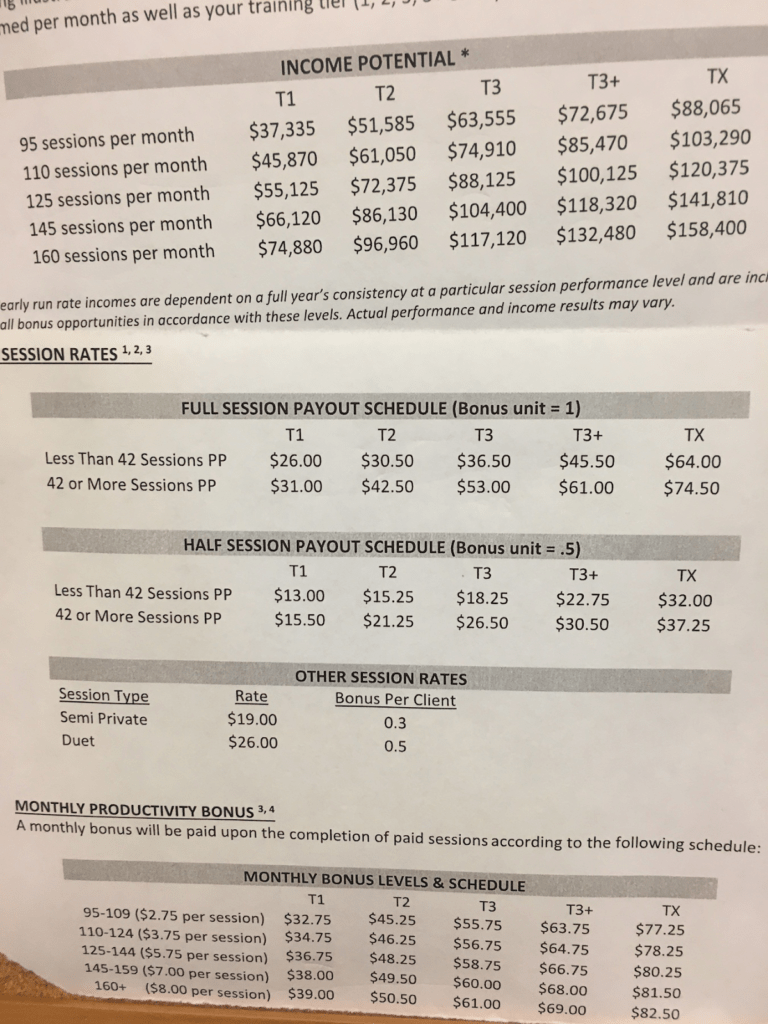
Less than 42 sessions per pay period (2 week pay period):
- Tier 1: $26 per one hour session
- Tier 2: $30.50 per one hour session
- Tier 3: $36.50 per one hour session
- Tier 3+: $45.50 per one hour session
- Tier X: $64 per one hour session
More than 42 sessions per pay period (2 week pay period):
- Tier 1: $31 per one hour session
- Tier 2: $42.50 per one hour session
- Tier 3: $53 per one hour session
- Tier 3+: $61 per one hour session
- Tier X: $74.50 per one hour session
The average full-time trainer at Equinox performs 25-30 training sessions per week.
Equinox Income Potential

24-Hour Personal Trainer Salary
Non-training payment:
Minimum wage for non-training hours.
Payment structure:
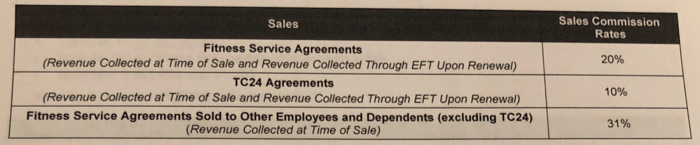
- 20% Commission on all individual personal training package sales paid up front.
- 10% Commission on all TC24 group training package sales.
Also, a 5% bonus commission is added to total salary when 60 training sessions or more are performed in one pay period.
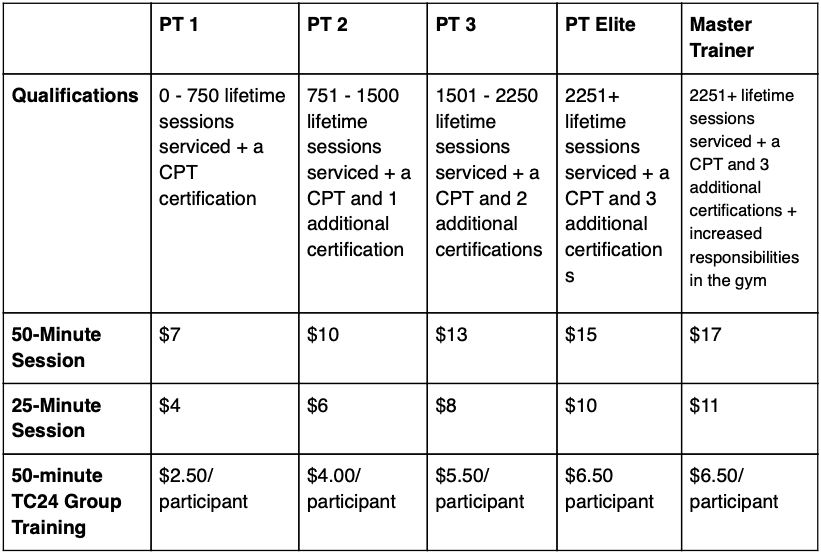
24-Hour Personal Trainer Salary 24-Hour PT Tier Structure and Associated Pay per Session:
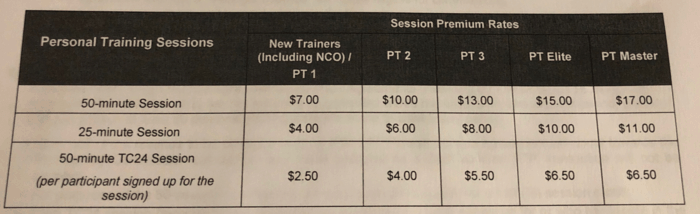
24-Hour Bonus Structure per Training Session:
24-Hour Fitness Commission for Package Sales:
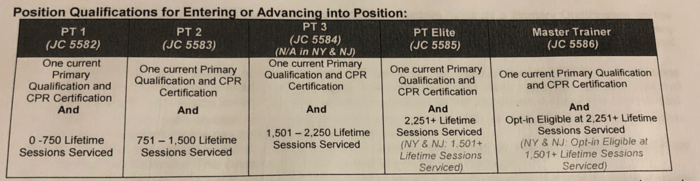
24-Hour Fitness Tiers:
An example monthly salary of a new PT 1 trainer that is building up their business at 24-Hour Fitness is shown below:
- Example minimum wage is $10/hour
- 120 hours worked in the month at $10/hour = $1,200
- 60 training sessions performed in the month x $7 = $420
- $2,500 in training package sales x 20% commission = $500
- Total Monthly Salary = $2120
24-Hour Fitness Salary Example of a Master Trainer
An example monthly salary of a full-time Master Trainer:
- Example minimum wage is $10/hour.
- 160 hours worked in the month at $10/hour = $1,600
- 120 training sessions performed in the month x $17 = 2,040
- $5000 in Training package sales x 20% commission = $1,000
- Monthly Salary = $4,640
- 5% commission added to the monthly salary of $4,640 since more than 60 sessions per pay period were performed = $232
- Total Monthly Salary after 5% bonus commission= $4,872

LA Fitness Personal Trainer Salary
Non-training payment:
Minimum wage for non-training hours.
Payment structure:
$6 – $7.50 per 30 minute session
$12 – $15 per 1 hour session
$7.50 – $15 is for larger cities with higher cost of living like in Los Angeles.
$6 – $12 is for less populated, lower cost of living areas like Arizona.
Other findings:
No findable bonus structure. Trainer turnover is very high.
Every person in the Facebook group concurred that LA Fitness is a less than ideal place to work as a trainer, but a few people mentioned they pay their group exercise instructors significantly better.

Anytime Fitness Personal Trainer Salary
Non-training payment:
Varies
Payment structure:
Varies, these are franchised gyms and each one has a different pay structure.
Answers varied on payment structure for the trainers we surveyed:
- 50/50 split
- Minimum wage plus bonuses to sign people on to monthly training packages
- Trainers can increase income by teaching group exercise classes
Other findings:
Collective agreement that Anytime Fitness is an enjoyable place to work. They are 3,000-5,000 sq ft gyms with only 5-10 trainers per location.

Crunch Fitness Personal Trainer Salary
Non-training payment:
None
Payment structure:
These are franchised gyms and each location may have a different pay structure.
Here are some quotes from Crunch Fitness trainers concerning their salary. Answers varied on payment structure:
I’m only paid for hours trained and commission on sales. I’m not paid while trying to get clients.”
“I work at Crunch. Mine is a level 3 gym but because I just started I’m at level 2 for a few months. If I charge a la carte the client pays $80/hour or $50/30 minute session. Depending on my sales volume I can make between 40% and 65% of what I sell. I’m given “potential clients” but I have to sell them the personal training sessions. There’s not a sales force like at LA Fitness but the income potential is much better. I set my own hours and can work whenever I like. They encourage me to sell package deals which requires a 3 month commitment from the client. They are not allowed to cancel. Money is debited from their account either monthly or biweekly. They can also get a discount if they pay in full. For level 2, if you wanted to be trained 2x week, it would cost $504. For 3x week $697. Those are monthly rates for hour long sessions. Level 3, of course, is higher and most of the trainers at my gym are level 3. We have about 17 trainers. It’s a great place to work! Just takes time to build your clientele.”

YMCA Personal Trainer Salary
Non-training payment:
Minimum wage is paid when not training.
Payment structure:
Basically, YMCA trainers make $15 – $28 per session/hour depending on their tier.
We were able to find some training salary data for YMCA but it is just for the Charlotte, NC area. I assume that cities with higher costs of living would be accounted for in pay (and vice versa for smaller cities), but we were unable to find any other data on that.
The information for YMCA trainers and their tiers can be found below, respectively:
- Tier 1 Trainer– Pay Rate: $15.89 – $19.86; Responsible for training a minimum of 2 sessions per week; Responsible for working the fitness floor 4-8 hours per week for initial 3 months
- Tier 2 Trainer– Pay Rate: $17.48 – $21.85; Responsible for training a minimum of 5 sessions per week; Responsible for working the fitness floor 4-8 hours per week for initial 3 months
- Tier 3 Trainer– Pay Rate: $21.00 – $26.24; Responsible for training a minimum of 10 sessions per week; Responsible for working the fitness floor 4-8 hours per week for initial 3 months
- Tier 4 Trainer– Pay rate: $22.89 – $28.61; Responsible for training a minimum of 20 sessions per week; Responsible for working the fitness floor 4-8 hours per week for initial 3 months; Serve as a Continuing Education Provider for YMCA of Greater Charlotte teaching at least 1 workshop per year; Serve as a mentor to Tier 1-3 trainers
Other benefits include:
- YMCA pays for all the trainers CEUs
- The “Y” also pays the trainers’ recertification fee – approximately $100 every two years

Planet Fitness Personal Trainer Salary
Full-time minimum wage positions.
Payment structure:
Typically no higher pay for trainers, but it is an easy job that requires no sales and just training. Decent for beginners looking to gain training experience but not really career-worthy. No commissions. No bonuses.
Personal Trainer Salary FAQ
Private Personal Trainer Salary
It is a well known fact that private personal trainers have the potential to make far more than gym trainers.
Why? Because private personal trainers can set their own rates.
There is a catch for private personal trainers, however, and that is that they have to drum up enough business to write their own paycheck. But before we get into a sample private personal trainer salary let’s define exactly what a private personal trainer is.
A private personal trainer is a trainer that is self-employed, creates their own work schedule, and is free to choose the clients that they work with. For many personal trainers, this is the end goal of their personal training careers and is what sees some trainers working with celebrities and making big bucks.
Unlike gym trainers, private personal trainers don’t get help from the gym or get funneled clients from fitness organizations. They utilize their own networking, sales, and marketing skill sets to drive leads and ultimately generate new clients.
For that reason, many private personal trainers struggle to make a decent income. You can’t simply get a personal trainer certification and expect leads to come your way. (Check out this course to learn how to build your business and get clients). This is also why so many trainers start out in the gym, get experience, make relationships, begin taking on private clients on the side, and eventually leave the corporate gym environment behind.
How Much Do Private Personal Trainers Make?
A respectable private personal trainer can make upwards of $70,000 per year.
Compare this to the full time salary of a respectable personal trainer at 24-Hour Fitness which would likely fall in the low $40,000 range. And by respectable I mean one with a couple thousand hours of sessions under their belt and training 20-30 sessions per week. This low $40,000 range is also commensurate with what NASM says their average trainer makes.
For example, a 24-Hour Fitness trainer in their middle tier (PT3) makes $13 an hour when training. If you compare a potential salary of an entry-level trainer at 24-Hour Fitness, $22,440/year, to that of a Master Trainer at 24-Hour Fitness, $58,464, and split it down the middle (which is more or less where a PT3 would be), you’d get $40,452.
Now, let’s compare the above salary of a gym trainer to that of a private personal trainer.
The average private personal trainer in the U.S. charges around $50 session. Let’s say this trainer works a total of 30 hours per week and making $1,500 in that time. Multiple this time the weeks in a year, 52, and you have a respectable private trainer who is making $78,000 a year.
Potential Salary of Private Personal Trainer
- Charges $50/session
- Works 30 hours per week (sessions)
- Makes $1,500/week
- Makes $78,000/year
That same trainer can charge $100 a session, work 15 hours a week, and make the same salary.
Gym trainers typically have to work a lot more hours than private personal trainers for a fraction of the salary which is why private training is often the more desirable route. But as we’ll learn, private personal training is not the only way to make money as a trainer outside the gym.
Interested in getting a CPT with an emphasis on entrepreneurship and business development? Check out the FM-CPT for more info.
Next Steps for Aspiring Personal Trainers
Now you know what you can potentially make when you become a personal trainer at a gym. With this information, you may understand the gyms you want to work at and those you potentially want to stay away from.
One thing that should be clear with this information is that personal growth equates to more money as revealed by the tier systems many of these gyms have. The goal of continually developing yourself as a personal trainer is so you can build your book of business and generate a better income for yourself.
If you are interested in becoming an all-around better personal trainer and business-savvy individual, check out my book and online course I’ve made specifically for hungry self-starters looking to earn the income they deserve: Business and Sales: The Guide to Success as a Personal Trainer.
In addition to understanding which gym to kickstart your career, you’ll still want to have an understanding of which personal trainer certification is right for you. Amongst the three most popular certifications are Fitness Mentors, NASM and ACE, of which we cover side-by-side in this in-depth blog post.
If you liked this post or want us to try and find additional information, please let me know in the comments. If you have experience at other big brand gyms and want to share the salary information, please help us educate other personal trainers by sharing your thoughts below.
Check out our Top 5 Exercise Science Careers and The Best Education Paths

- 4.8 Star Rating
- 300+ Reviews
- 30,000+ Students
- 16 Courses
BS Kinesiology, NASM-CPT, CES, PES FNS, MMAS, WLS, FM-CPT, ACE-CPT, Master Personal Trainer
Eddie Lester is the founder and CEO of Fitness Mentors. With more that 17 years experience in the health, fitness and athletics field, he has helped tens of thousands of personal trainers transform their careers and reach their business goals. With a background in Kinesiology and Exercise Physiology Eddie has assisted in research that is spearheading the exercise science field.
His in-depth knowledge of the Health, Wellness and Fitness industry has earned him a place as a regular contributor on high profile sites such as the Personal Trainer Development Center, (Dan to list top sites) online where he writes about nutrition and personal training.
His contributions to help personal trainers include a weekly blog, podcast, youtube channel and multiple books including: Business and Sales: the Guide to Success as a Personal Trainer.
Eddie’s Philosophy often times includes focusing on the bigger picture in which daily positive contributions lead to a major impact on himself, his family, his community and the world.
Eddie is commonly found at the beaches of Southern California with his wife Courtney and five kids.