Bikini Competition Posing Guidelines for Bodybuilders

Whether you are a pro competitor or a newbie, one thing remains the same: having a solid posing routine for the stage. As you train for your competition, your posing routine must be perfected to ensure a strong stage presence. 

So, let’s look at a few ways you can achieve to get the best competition day results.


Basic posing tips for your competition routine

  1. Nailing your posing walk—Your walk is your first chance to make the great impression you need in front of the judges. It’s the perfect opportunity to show your stage confidence and personality. Walking confidently communicates who you are and how proud you are of your work.

Another aspect of your posing walk is feeling comfortable in your shoes. Since all competitors need to wear high heels, practicing in them is a must! Make sure you are confident walking in them, this will give you that winning edge.

  1. The right bikini poses – Before choosing your poses, it is important to master your posing walk. The judges are looking for some things in particular: 
  • Muscle tone foundation
  • A full-shaped figure with rounded glutes and curvy shoulders
  • Full body symmetry 
  • No muscle separation or striations 
  • An appealing overall appearance 

To make sure these criteria are met, you need to work closely with a posing coach and take plenty of videos and photos of yourself posing. Another tip is to practice from the judge’s perspective, about five feet below you. This is so you can perfect your posing routine. Perfecting your posing routine has one goal – it highlights your strengths and downplays any area you want to improve. Try posing in front of a mirror, from different angles, and setting this will ensure you look your best on stage. 

  1. Mastering your posing transitions – Your posing routines requires 
  • Front poses
  • Back poses
  • Side poses 
  • Sign off 

While posing can seem very simple, you need to use your routine to show your strengths. Show your muscle definition in glutes, hamstrings, arms, and shoulders. Remember you don’t have a lot of stage time, so make every moment count. 

  1. Accessorize just right – Your presentation on stage includes more than just your hard-earned figure. From your bikini competition suit to your hair, makeup, and jewelry. Everything should work well together to enhance your stage look. But to be on the safer side, do not make these common mistakes – 
  • Picking a suit color that doesn’t suit your skin tone
  • Wearing flashy or too much jewelry
  • Wearing the wrong makeup on stage
  • Having a distracting hairstyle 
  • Not testing your tan color 

These can seem small now, but they make a huge difference in how the judges view your overall look.


What is a winning bikini competition routine? 

All top bikini competitors have one thing in common – they stay true to their routines. These athletes showcase their personalities, style, attitude, and a well-conditioned physique. So, when you plan your posing routine you need to be sure to show off your hard-earned physique while letting your personality shine through. 

If you want professional help with your posing routine, consider working with a professional posing coach who specializes in helping competitors stand out from the rest. They will guide you through your posing routine until you ace it! 


Judging for Bikini Competitions

Bikini competition judges look for a healthy and toned body, with good symmetry, balance, and shape. Competitors need to present on stage with confidence, stage presence, and poise. The judges will also look at how well your bikini competition suit looks, with makeup, hair, and presentation looks. Competitors have to avoid showing too much muscle separation, and the goal is to achieve a muscular look without looking too defined or lean.

Your micro bikini competition suits and other competition choices will help enhance your physique. The judges look for full-round glutes and a slight midsection. Your legs and shoulders should be firm but not overly muscular. 


Comparisons within groups

During group comparison, athletes perform half turns to show their physique from front to back. Judges will direct you to walk a few steps back and forward while holding poses as a group. Keep in mind that the front, back, and side poses are the most crucial ones, so perfect them as much as you can. 

A strong bikini competition posing routine consists of presentation, practice, and paying attention to every detail. Whether it is the walk, pose, transition, or overall presentation, everything needs to come together and highlight your hard work the most.

How to Become a Personal Trainer in 4 Simple Steps

how to become a personal trainer

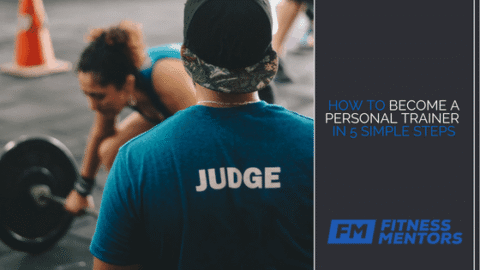
How to Become a Personal Trainer in 5 Simple Steps

This is the heading
cptquiz1Mesa-de-trabajo-1

What Cert is Best for You?

We designed this quiz to help you choose the perfect certification based on your learning style and goals.

28954

Watch Our Video: How to Become a Personal Trainer in 5 Simple Steps

Table of Contents

Have you always wanted to become a personal trainer?

You’re halfway there. But, as with most things in life, wanting is only the first step of the journey.

In order to become a trainer and succeed as one, you need to have the right game plan in place and follow it up with consistent action — just like your workouts. As you’ll see in this guide, there are five simple steps you’ll need to take to become a personal trainer. And we’ll be covering the best ways to tackle each one.

If you are interested in training clients online check out our How to Become an Online Personal Trainer blog.

1. Get Your Prerequisites Completed First

Before you begin with a personal trainer course, you’ll likely need to have a few items checked off before you can get certified. These are:

  1. 18 years or older
  2. High school diploma or GED
  3. CPR/AED certification

Most personal training certification bodies require these items before you sit down for the final exam. Additionally, many companies are requiring the Automated External Defibrillator (AED) Certification along with the Emergency Cardiac Care (CPR), but these certifications can usually be packaged together by the same provider.

The American Red Cross is a popular choice for the CPR/AED certification, and you can check out their website to find classes near you.

cptquiz1Mesa-de-trabajo-1

What Cert is Best for You?

We designed this quiz to help you choose the perfect certification based on your learning style and goals.

2. Nail Down the Best Certified Personal Trainer Course (for you)

What is the best personal trainer certification?

A better question is “what is the best personal trainer certification for me?” The certification body you choose is a highly subjective decision — and often a confusing one — so here are some questions you can ask yourself before committing to one over another:

How do I learn new concepts best?

Do you understand concepts better when they’re presented in-person with a teacher or can you handle learning on your own?

Personal training education isn’t a one-size-fits-all approach. You actually have several options, including:

  • Certification via accredited US company (self-study)
  • Vocational college (in-person)
  • University programs with Bachelors or Masters (in-person)
  • Unaccredited online options (self-study)
  • Gym program (in-person)

Learn more about the different personal trainer courses.

How much time do you have?

Are you looking to get certified as soon as possible or would you prefer to get a college degree along with your certification? The self-study options are the quickest approach whereas the vocational college and university programs are obviously more long-term.

As you answer these questions, you should also be thinking about the differences between each personal training program.

Here are some answers to some common FAQs about becoming a trainer that may also help you decide which route you want to go:

Do I Need to Go to College to Become a Personal Trainer?

If the thought of becoming a full-time student isn’t something that interests you, you’re in luck.

You don’t need to go to college to become a personal trainer.

While a university program will give you the most in-depth learning experience, including learning subjects that aren’t solely personal-training focused, it comes at a price not everyone can afford, both in time and money.

However, if you have your sights set on becoming a personal trainer and you love school or are already working towards earning a Bachelor’s or Master’s, a college degree can strengthen your expertise and build trust with future clients.

This is especially important in the beginning of your personal training career when you’re still building your client base.

So if you don’t need a college degree, the next question is:

What Kind of Education Do I Need to Be a Personal Trainer?

As we talked about in this guide, there are five education routes you can follow to become a personal trainer:

  1. Certification by a US company
  2. Vocational college
  3. University programs with a Bachelor’s or Master’s degree
  4. Unaccredited online options
  5. Internal gym programs

Each option has its own educational program and certification procedures. By completing one of them, you’ll hold a certification from that institute to teach people as a personal trainer.

Keep in mind, only the first three options on that list are accredited.

Let’s go over the difference between an accredited and an unaccredited program so you know which sounds best for you.

Do I Need to Find an Accredited Program?

An accredited program, such as Fitness Mentors, NASM or ACE, means that it has been credentialed by the National Commission for Certifying Agencies (NCCA), National Board of Fitness Examiners (NBFE) or other top accrediting bodies. While there are other personal trainer program credentialing bodies, the NCCA is considered the gold standard.

More importantly perhaps, NCCA-certified personal training programs are generally recognized at most health facilities, meaning if you go with one of these you are almost guaranteed a job at a corporate gym.

Some of the most popular Accredited personal trainer bodies include:

• NASM • ACE

• Fitness Mentors

• NFPT  • ACSM  • NESTA  

• NSCA  • NCSF  • NCCPT

On the other hand, unaccredited courses may not be accepted by corporate gyms and fitness studios.

Unaccredited courses are usually better for someone who already has an established network of clients through their own training methods and has no intentions of working at a corporate facility.

The majority of potential personal trainers will want to find an accredited program.

You’ll receive a more in-depth education and will be better prepared to find a job once you pass your test.

You can opt for an accredited self-study program, such as Fitness Mentors, NASM or ACE, or you can enroll in a vocational college or bachelor’s program at your local college, as mentioned earlier. Vocational schools or colleges will have relationships with accredited certification bodies so you’ll walk away with a degree and your CPT.

Once you select a program, grab a calendar and set your exam date.

3. Choose an Exam Date & Prepare

Picking an exam date is the first major step towards seeing your personal trainer dreams through.

Put it off and you may end up backburnering your goal indefinitely.

That’s why certain programs have you set a date right away for this very reason.

Keep in mind, you should be realistic with your date.

Fortunately, this next section can help you understand the real magnitude of the work so you can adjust your timeline and plan accordingly.

How Long Does it Take to Become a Personal Trainer?

Consider your schedule, current workload, and other obligations before setting a date that’s too close for comfort.

You should give yourself at least three to six months, depending on your certification, to prepare. Plan on committing anywhere from 75-100 hours to doing so.

Here’s a breakdown of the expected study time for each personal training program specifically:

  • NCCPT: 80-100 hours is the recommended study time
  • FITNESS MENTORS: 80 hours is the recommended study time
  • NESTA: You must complete the test within 90 days of requesting the exam voucher so study well before this time
  • ACSM: 3, 6, 12, or 24-month options
  • ACE: Schedule test within 6 months of purchase date, but you can take it before 9 months
  • ISSA: 6 months to complete
  • NASM: Must complete in under 6 months
  • NCSF: Must complete in under 6 months
  • NCSA: 120 days after purchasing exam
  • NFPT: 12 Months after purchasing exam
  • AFAA: N/A

With your target test date in mind, you can then work backwards to plan out how many chapters you’ll need to cover each week and month in order to be best prepared for it.

However, if you want to fast track your certification, without sacrificing how much information you’re learning, use this study schedule to knock it out in just two months:

  • Read one or two hours per day at a minimum
  • Create your own chapter-by-chapter notes from the book/coursework
  • Use study guides to review hand-picked topics for reference
  • Listen to audio lectures to review the information while driving/working out/during down time
  • Take practice tests for each chapter
  • Quiz yourself on 5-10 chapters of the book at a time every few weeks
  • Reread study guides as you build upon new concepts
  • Quiz yourself and document the questions you miss; revisit the sections of the book discussing the topics you didn’t get right
  • Take a quiz every day leading up to the final week of study
  • Sit down for an entire practice exam and write down questions you missed; revisit topics you need a better understanding of
  • Take the official certification exam when you consistently earn at least 85% passing score on practice exams

You can also use study resources to help you work out pre-test jitters while you get a feel for the test’s format.

All this can help ensure you make it to this next (huge) step.

4. Pass Your Exam

There’s nothing better than seeing the words PASS after you submit your personal training certification exam.

But you can only get there if you put in the necessary time reading and studying the material and understanding the concepts.

Practicing test questions and using practice test preps also help increase your chances of passing your exam.

And once you do, you’ll officially be ready to start working as a personal trainer.

5. Land a Job as a Personal Trainer

Before you spend countless hours applying for jobs you may not enjoy, you should take the time to figure out what you really want and think about what gets you excited first.

You’ll save time by only applying to positions that check these boxes. Or, you may decide you don’t want to work for anybody and take a more independent route.

So consider these questions:

  • Do you prefer to work primarily in-person or online?
  • Do you prefer large group training classes or one-on-one sessions?
  • Would you prefer to work for yourself or somebody else?
  • If you prefer to be employed, would you prefer to work in a big box gym, boutique gym, or some other setting?

If you’re looking to gain experience, it can also help to approach the staff where you currently work out to see if there are any openings.

Since you’re already familiar with the place and the staff may be familiar with you, you’ll boost your chances of getting your foot in the door.

The last burning question many soon-to-be trainers have is:


How Much Money Can You Make as a Personal Trainer?

personal trainer salary

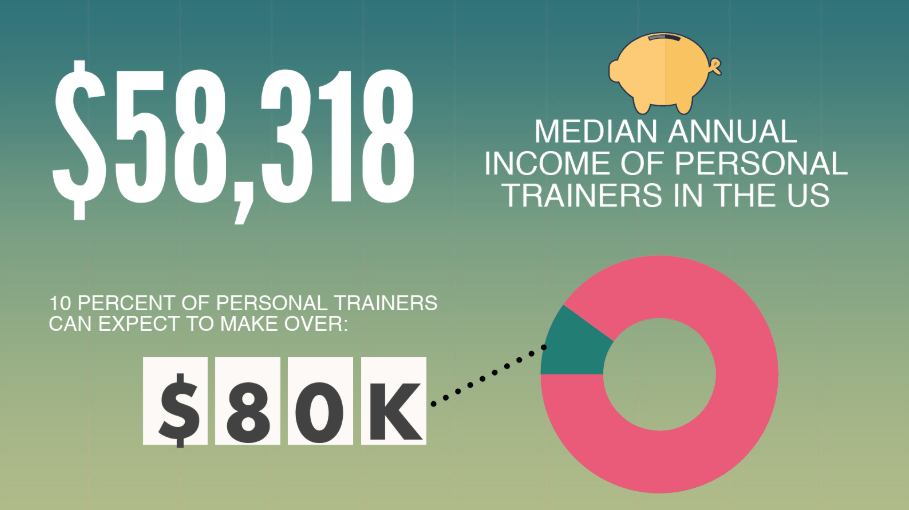
The good news is personal trainer salaries have an average median of $58,318 and 10% make over $80,000 per year! 

When you do what you love and you truly help people become their healthiest, happiest selves, your salary may not be your top priority in comparison. But, there is no doubt you’ll be compensated well for all your hard work.

Now that you know what it takes to become a personal trainer, and you understand how to ace all five steps to get there, it’s time to start chasing your dream.

JUMPSTART YOUR CAREER

12 Customizable Program Templates!
Regularly $169. Get access today for $31.
FM-Customizable-Program-Templates

FAQs on How to Become a Personal Trainer

The qualifications most personal training certifications require include: age 18 or older, has a high school diploma or equivalent degree, a CPR/AED certification, and the passing of a certified personal trainer course.

Some personal training certifications, like the Fitness Mentors CPT, can be obtained in a month with rigorous study. Most programs, however, take 3 months or more to complete the coursework, study and pass the final exam.

On average, personal trainers have an average median of almost $60,000 and 10% of trainers make over $80,000 a year.

Becoming a certified personal trainer is not nearly as time-consuming or challenging as other professions. However, a fair amount of studying and dedication are needed to complete a course and grow and build a client base.

A career in personal training typically begins at the gym for most trainers. This is the most ideal place to learn how to train, speak with prospects, and work on your sales technique.

Research suggests one in ten trainers earn six-figure salaries.

Personal trainers can use their skills to perform other jobs such as gym managers, sales managers, fitness writers, workout program developers, and group fitness instructors..

Most gyms require a qualification from a third-party accredited personal training body or their own internal certification for trainers to gain employment.

A personal training certification is not a legal requirement in order to assist others with their fitness goals. However, the safety and wellbeing of clients is a primary concern of the industry as a whole, which is why it is such an important aspect of any certification.

Personal training can be a great part time job. As an independent trainer you are free to charge as much as you’d like, choose your hours, and try to generate as much supplemental income as possible.


Become a Personal Trainer Today

With all this information under your training belt, now’s the time to take action.

Start by knocking out your prerequisites.

Then choose an education route you know you’ll stick with. Work through the rest of the tips in this guide and you’ll be one step closer to passing your certification test and achieving your personal training goals.

If you are interested in getting certified with the goal of building a lifelong career, check out the Fitness Mentors certifications.

Share this blog post!

Table of Contents

Personal Trainer Salary: Which Gyms Pay the Most?

Personal Trainer Salary  Which Gyms Pay the Most

There are numerous ways to make money as a personal trainer, but unquestionably the most common way is to start working at a gym.

If you are looking to get certified as a personal trainer, check out our blog on the best personal training certification.

Fitness Mentors NASM

Watch Our Video: Personal Trainer Salary – Which Gyms Pay the Most? How Much do Private and Online Trainers Make?

$6 Dollar Mentorship Banner 1

80% OFF

12 Customizable Program Templates!
Regularly $169. Get access today for $31.
FM-Customizable-Program-Templates
cptquiz1Mesa-de-trabajo-1

What Cert is Best for You?

We designed this quiz to help you choose the perfect certification based on your learning style and goals.

If the most common question I get asked about personal training is what certification to get, the second most common question has to be “how much can I make as a personal trainer?”

There are numerous ways to make money as a personal trainer, but unquestionably the most common way is to start working at a gym. I started my career as a personal trainer by working at Equinox and 24-Hour Fitness. 

Also be sure to join the conversation with hundreds of fitness pro’s, six-figure personal trainers, fitness mentors and coaches on our discord here:

When people first consider becoming a trainer they begin to think about the major gyms and how much they pay. And as much as certification bodies like NASM want to tell you that their average trainers make $42k a year, the reality of a personal trainer salary ultimately lies in what the gyms will pay as this is the most common career route.

However, the gym route is not the only one and many existing or aspiring trainers want to venture into the more entrepreneurial routes of private, or online personal training, as higher income levels are more easily achieved.

So, to help trainers understand what popular gyms pay their trainers and to showcase some insider knowledge on what private and online trainers can make, I’ve put together this post that outlines personal trainer salaries as well as what trainers at the most recognizable gym brands around the country get paid, and how they set up their payment structure. Overall this blog answers the question, “how much can I make as a personal trainer?”.

I’ll also discuss the three pay structures that are common to trainers and provide you with next steps from a seasoned personal trainer who has gone through the experience of getting a gym job first-hand as well as utilized the private and online routes.

Before You Get Paid, You Have to Get Certified

Keep in mind that with this independent structure, you are running your own business, which means you are responsible for additional tasks like accounting, taxes, marketing, advertising, sales, setting up a reliable system to accept online payments, and lead generation.First things first, if you want to work in personal training or at a big box gym like 24-Hour Fitness, Equinox, LA Fitness, or the like, you’ll need a personal training certification from a credentialed fitness organization.

Gyms want their trainers to get, or have, certifications, because they provide a baseline for credibility. Additionally, because personal trainers work closely with the public in a physical capacity, almost all corporate gyms and independent studios require a clean background check before finalizing your employment. If you have any concerns regarding this step, it is highly recommended to review the gym’s specific vetting policies beforehand.

We have written a very comprehensive blog on the best personal trainer certifications where you can take a look at our side-by-side analysis of 10 different, popular personal training certification organizations. If you are unsure the exact steps to become a trainer and the prerequisites — education, age requirements, CPR/AED certifications.

Keep in mind that with this independent structure, you are running your own business, which means you are responsible for additional tasks like accounting, taxes, marketing, advertising, sales, setting up a reliable system to accept online payments, and lead generation. Note that a true personal training certification will allow for a job at a much wider range of locations than just that one gym, something you’ll want to consider as your career evolves.

But before you enter the personal training employee marketplace, it pays to know some of the various pay structures that are common within the personal training industry so you know what to expect going in.

3 Types of Gym Pay Structures Common to Personal Trainers

When you begin your search for gyms that will provide you gainful employment, you can expect the pay structures to fall into one of these three categories:

1. Commercial gym
2. Independent personal trainer
3. 1099 personal trainer

1. Commercial Gym Pay Structure


In the gym world, the gyms who make you get clients and don’t feed them to you will generally pay the most. The opposite is true too; the gyms that feed you clients will generally pay you the least.

Commercial gyms will typically pay you minimum wage to “work the floor” and try to drum up new clients. Once you are actually training clients, you’ll get a bit more per hour as you are increasing the gyms revenue by performing a training session. If you sell a large personal training package, commercial gyms will often give you a commission. 

2. Independent Personal Trainer Gym Pay Structure

Independent pay structures, or those that pertain to the self-employed personal trainer, are much more favorable to the trainer, but the negative is that they are obviously not as exposed to as many potential clients as they would be on the floor of a major gym, and are only getting paid when they train.

When you are self-employed, or an independent personal trainer not on a gym’s payroll, you may be able to develop relationships with smaller, privately-owned gyms that will allow you to bring in your own clients.

The catch is that you have to pay the gym a fee when you use their gym to train your client. For example, I used to pay a privately-owned, non-chain gym $15 a session to bring my client in and train them.

I could ultimately charge my client whatever I wanted, and had no pressure from any boss to sell more training sessions as it was entirely up to me. I did have to do more for marketing and found these metal cards to be a professional way of displaying the quality of my business to new potential clients. 

Keep in mind that with this independent structure, you are running your own business, which means you are responsible for additional tasks like accounting, taxes, marketing, advertising, sales and lead generation.

Related: How to Set a Pricing Structure for Your Personal Training Business I

80% OFF

12 Customizable Program Templates!
$169 → $31.
FM-Customizable-Program-Templates

3. 1099 by a Gym Pay Structure

The 1099 model is similar to the self-employed trainer model except the gym has a relationship with the clients. A 1099 is a tax form given to an independent contractor as opposed to a W2 which is given to employees.

In this pay structure, the gym does not actually employ you as a personal trainer, but they contract with you so that they can make money on personal training and alleviate themselves from the costs of having an employee.

The 1099 model is like when you hire a plumber to come fix your broken toilet; they are getting paid for their service but they are not your employee.

In the contractor payment style, the personal trainer and the gym typically get a split, like 50/50, on whatever the gym charges. So, if the gym charges $60 for an hour long session, they’d keep $30 and you’d get paid $30. The gym collects the money from the client and then will pay you, the trainer, for the session performed.

With this type of structure the personal trainer will be responsible for claiming taxes on the money they make, as the gym does not set aside any income since the trainer is not an employee.

Now, you may be asking yourself, “how do I know what kind of payment structure the gym I want to work at has?” Excellent question, let’s address that below.

How Popular Brand Name Gyms Pay Their Personal Trainers

While I could have left you hanging with the above information on the three various pay structures that are common for trainers who work at/with gyms, I wanted to do a deeper dive and get some answers from real trainers who work, or have worked, at some popular gym chains.

The Fitness Mentors team reached out to several gyms chains and their current employees, as well as conducted a survey with our current and previous students on Facebook, to get currently used payment structures and insight on how various gyms pay their trainers. We have provided that information below.

If you have any experience with these gyms or would like to comment on something different, please feel free to let us know in the comments so we can update this post. 

Equinox logo

Equinox Personal Trainer Salary

Non-training payment:

Floor hours at minimum wage – typically 20 hours a week until your client base grows.

Payment structure:

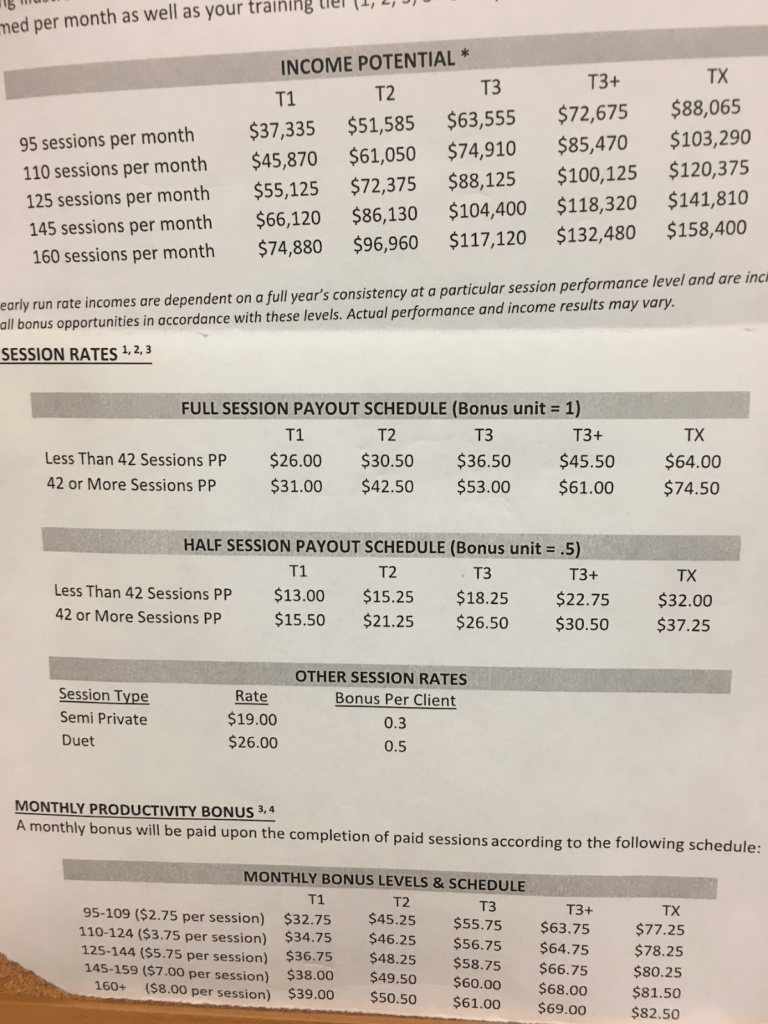
Less than 42 sessions per pay period (2 week pay period):

  • Tier 1: $26 per one hour session
  • Tier 2: $30.50 per one hour session
  • Tier 3: $36.50 per one hour session
  • Tier 3+: $45.50 per one hour session
  • Tier X: $64 per one hour session

More than 42 sessions per pay period (2 week pay period):

  • Tier 1: $31 per one hour session
  • Tier 2: $42.50 per one hour session
  • Tier 3: $53 per one hour session
  • Tier 3+: $61 per one hour session
  • Tier X: $74.50 per one hour session

The average full-time trainer at Equinox performs 25-30 training sessions per week.

Equinox Income Potential

Equinox Income Potential
24 Hour Fitnesss Logo

24-Hour Personal Trainer Salary

Non-training payment: 

Minimum wage for non-training hours.

Payment structure:

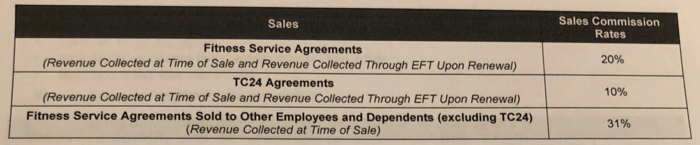
  • 20% Commission on all individual personal training package sales paid up front.
  • 10% Commission on all TC24 group training package sales.

Also, a 5% bonus commission is added to total salary when 60 training sessions or more are performed in one pay period.

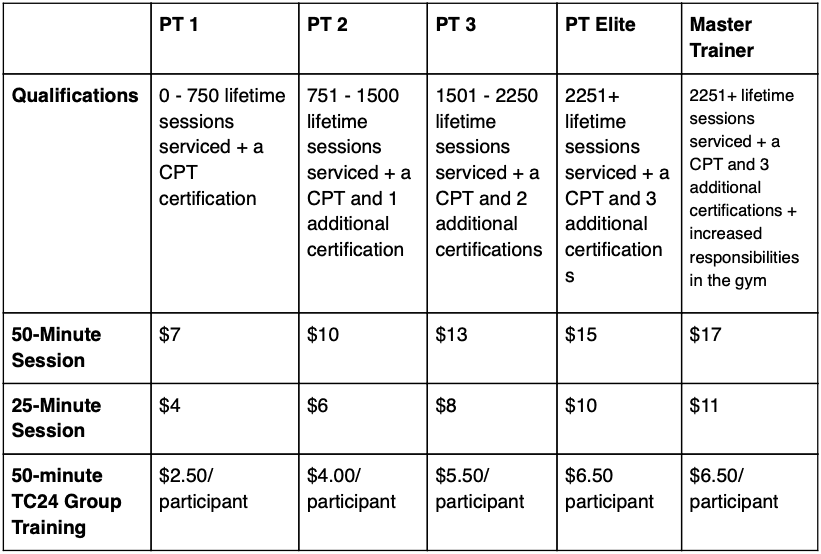
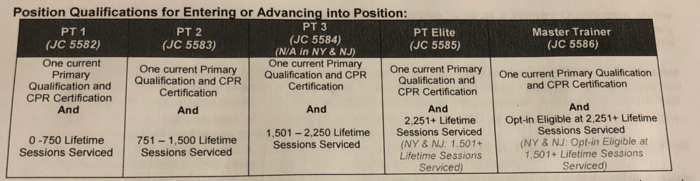
24-Hour Personal Trainer Salary 24-Hour PT Tier Structure and Associated Pay per Session:

24 Hour PT Tier Structure and Associated Pay per Session

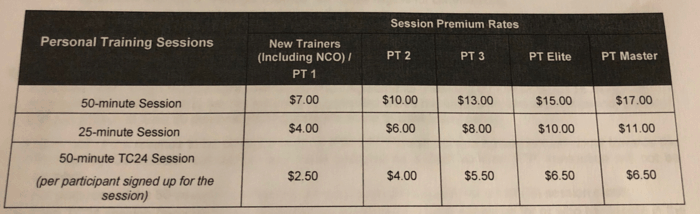
24-Hour Bonus Structure per Training Session:

24 1

24-Hour Fitness Commission for Package Sales:

24 2

24-Hour Fitness Tiers:

24 3
An example monthly salary of a new PT 1 trainer that is building up their business at 24-Hour Fitness is shown below:
  • Example minimum wage is $10/hour
  • 120 hours worked in the month at $10/hour = $1,200
  • 60 training sessions performed in the month x $7 = $420
  • $2,500 in training package sales x 20% commission = $500
  • Total Monthly Salary = $2120

24-Hour Fitness Salary Example of a Master Trainer

An example monthly salary of a full-time Master Trainer:
  • Example minimum wage is $10/hour.
  • 160 hours worked in the month at $10/hour = $1,600
  • 120 training sessions performed in the month x $17 = 2,040
  • $5000 in Training package sales x 20% commission = $1,000
  • Monthly Salary = $4,640
  • 5% commission added to the monthly salary of $4,640 since more than 60 sessions per pay period were performed = $232
  • Total Monthly Salary after 5% bonus commission= $4,872
la fitness logo png 3 1

LA Fitness Personal Trainer Salary

Non-training payment: 

Minimum wage for non-training hours.

Payment structure:
$6 – $7.50 per 30 minute session
$12 – $15 per 1 hour session

$7.50 – $15 is for larger cities with higher cost of living like in Los Angeles.
$6 – $12 is for less populated, lower cost of living areas like Arizona.

Other findings:

No findable bonus structure. Trainer turnover is very high.

Every person in the Facebook group concurred that LA Fitness is a less than ideal place to work as a trainer, but a few people mentioned they pay their group exercise instructors significantly better.

anytime fitness

Anytime Fitness Personal Trainer Salary

Non-training payment: 

Varies

Payment structure:

Varies, these are franchised gyms and each one has a different pay structure. 

Answers varied on payment structure for the trainers we surveyed:

  • 50/50 split 
  • Minimum wage plus bonuses to sign people on to monthly training packages 
  • Trainers can increase income by teaching group exercise classes

Other findings:

Collective agreement that Anytime Fitness is an enjoyable place to work. They are 3,000-5,000 sq ft gyms with only 5-10 trainers per location.

crunch fitness

Crunch Fitness Personal Trainer Salary

Non-training payment:

None
 

Payment structure:

These are franchised gyms and each location may have a different pay structure.

Here are some quotes from Crunch Fitness trainers concerning their salary. Answers varied on payment structure:

I’m only paid for hours trained and commission on sales. I’m not paid while trying to get clients.”

“I work at Crunch. Mine is a level 3 gym but because I just started I’m at level 2 for a few months. If I charge a la carte the client pays $80/hour or $50/30 minute session. Depending on my sales volume I can make between 40% and 65% of what I sell. I’m given “potential clients” but I have to sell them the personal training sessions. There’s not a sales force like at LA Fitness but the income potential is much better. I set my own hours and can work whenever I like. They encourage me to sell package deals which requires a 3 month commitment from the client. They are not allowed to cancel. Money is debited from their account either monthly or biweekly. They can also get a discount if they pay in full. For level 2, if you wanted to be trained 2x week, it would cost $504. For 3x week $697. Those are monthly rates for hour long sessions. Level 3, of course, is higher and most of the trainers at my gym are level 3. We have about 17 trainers. It’s a great place to work! Just takes time to build your clientele.” 

ymca 3 logo png transparent

YMCA Personal Trainer Salary

Non-training payment:

Minimum wage is paid when not training. 

Payment structure:

Basically, YMCA trainers make $15 – $28 per session/hour depending on their tier. 

We were able to find some training salary data for YMCA but it is just for the Charlotte, NC area. I assume that cities with higher costs of living would be accounted for in pay (and vice versa for smaller cities), but we were unable to find any other data on that.

The information for YMCA trainers and their tiers can be found below, respectively:

  • Tier 1 Trainer– Pay Rate: $15.89 – $19.86; Responsible for training a minimum of 2 sessions per week; Responsible for working the fitness floor 4-8 hours per week for initial 3 months
  • Tier 2 Trainer– Pay Rate: $17.48 – $21.85; Responsible for training a minimum of 5 sessions per week; Responsible for working the fitness floor 4-8 hours per week for initial 3 months
  • Tier 3 Trainer– Pay Rate: $21.00 – $26.24; Responsible for training a minimum of 10 sessions per week; Responsible for working the fitness floor 4-8 hours per week for initial 3 months
  • Tier 4 Trainer– Pay rate: $22.89 – $28.61; Responsible for training a minimum of 20 sessions per week; Responsible for working the fitness floor 4-8 hours per week for initial 3 months; Serve as a Continuing Education Provider for YMCA of Greater Charlotte teaching at least 1 workshop per year; Serve as a mentor to Tier 1-3 trainers

Other benefits include:

  • YMCA pays for all the trainers CEUs
  • The “Y” also pays the trainers’ recertification fee – approximately $100 every two years
539119d901c6b76668f4227f51378a6a

Planet Fitness Personal Trainer Salary

Non-training payment: 

Full-time minimum wage positions. 

Payment structure:

Typically no higher pay for trainers, but it is an easy job that requires no sales and just training. Decent for beginners looking to gain training experience but not really career-worthy. No commissions. No bonuses. 

Personal Trainer Salary FAQ

Yes, making good money as a personal trainer is very viable. Even entry-level personal trainers can make upwards of $25 an hour, and easily up to $100 an hour if they are experienced.
Our research indicates that personal trainers make anywhere from minimum wage up to $75 an hour, at more prestigious gyms. Private personal trainers can make even more per hour, charging up top $100 an hour.
The typical beginner personal trainer starts off their career in a gym as opposed to training private clients. On average, personal trainers make around $42,000 per year but the salary can vary by city, with more urban areas commanding higher salaries.
Personal training is a great career choice because it is constantly ranked highly for providing an excellent quality of life, flexible work hours, and a solid work-life balance.
Yes, many trainers that put in hard work can make $100,000 or more a year as a personal trainer. Personal trainers that take their businesses online also benefit from higher incomes as they can sell services while they sleep and are not limited to the available hours in a day as are in-person trainers.
No, it is not difficult to get a personal training job once you have a personal trainer certification. Many gyms are actively hiring personal trainers and the health and wellness industry as a whole is forecasted to continue its growth trend.

Private Personal Trainer Salary

It is a well known fact that private personal trainers have the potential to make far more than gym trainers.

Why? Because private personal trainers can set their own rates.

There is a catch for private personal trainers, however, and that is that they have to drum up enough business to write their own paycheck. But before we get into a sample private personal trainer salary let’s define exactly what a private personal trainer is.

A private personal trainer is a trainer that is self-employed, creates their own work schedule, and is free to choose the clients that they work with. For many personal trainers, this is the end goal of their personal training careers and is what sees some trainers working with celebrities and making big bucks.

Unlike gym trainers, private personal trainers don’t get help from the gym or get funneled clients from fitness organizations. They utilize their own networking, sales, and marketing skill sets to drive leads and ultimately generate new clients.

For that reason, many private personal trainers struggle to make a decent income. You can’t simply get a personal trainer certification and expect leads to come your way. (Check out this course to learn how to build your business and get clients). This is also why so many trainers start out in the gym, get experience, make relationships, begin taking on private clients on the side, and eventually leave the corporate gym environment behind.

How Much Do Private Personal Trainers Make?

A respectable private personal trainer can make upwards of $70,000 per year.

Compare this to the full time salary of a respectable personal trainer at 24-Hour Fitness which would likely fall in the low $40,000 range. And by respectable I mean one with a couple thousand hours of sessions under their belt and training 20-30 sessions per week. This low $40,000 range is also commensurate with what NASM says their average trainer makes.

For example, a 24-Hour Fitness trainer in their middle tier (PT3) makes $13 an hour when training. If you compare a potential salary of an entry-level trainer at 24-Hour Fitness, $22,440/year, to that of a Master Trainer at 24-Hour Fitness, $58,464, and split it down the middle (which is more or less where a PT3 would be), you’d get $40,452.

Now, let’s compare the above salary of a gym trainer to that of a private personal trainer.

The average private personal trainer in the U.S. charges around $50 session. Let’s say this trainer works a total of 30 hours per week and making $1,500 in that time. Multiple this time the weeks in a year, 52, and you have a respectable private trainer who is making $78,000 a year.

Potential Salary of Private Personal Trainer

  • Charges $50/session
  • Works 30 hours per week (sessions)
  • Makes $1,500/week
  • Makes $78,000/year

That same trainer can charge $100 a session, work 15 hours a week, and make the same salary.

Gym trainers typically have to work a lot more hours than private personal trainers for a fraction of the salary which is why private training is often the more desirable route. But as we’ll learn, private personal training is not the only way to make money as a trainer outside the gym.

Interested in getting a CPT with an emphasis on entrepreneurship and business development? Check out the FM-CPT for more info.

Next Steps for Aspiring Personal Trainers

Now you know what you can potentially make when you become a personal trainer at a gym. With this information, you may understand the gyms you want to work at and those you potentially want to stay away from.

One thing that should be clear with this information is that personal growth equates to more money as revealed by the tier systems many of these gyms have. The goal of continually developing yourself as a personal trainer is so you can build your book of business and generate a better income for yourself.

If you are interested in becoming an all-around better personal trainer and business-savvy individual, check out my book and online course I’ve made specifically for hungry self-starters looking to earn the income they deserve: Business and Sales: The Guide to Success as a Personal Trainer.

In addition to understanding which gym to kickstart your career, you’ll still want to have an understanding of which personal trainer certification is right for you. Amongst the three most popular certifications are Fitness Mentors, NASM and ACE, of which we cover side-by-side in this in-depth blog post. 

Further resources:

Sports Research Paper Topics and Ideas

If you liked this post or want us to try and find additional information, please let me know in the comments. If you have experience at other big brand gyms and want to share the salary information, please help us educate other personal trainers by sharing your thoughts below.

Check out our Top 5 Exercise Science Careers and The Best Education Paths

Instructor

CEO of fitnessmentors.com – Teaching 30,000+ students how to become CPT’s


BS Kinesiology, NASM-CPT, CES, PES FNS, MMAS, WLS, FM-CPT, ACE-CPT, Master Personal Trainer

Eddie Lester is the founder and CEO of Fitness Mentors. With more that 17 years experience in the health, fitness and athletics field, he has helped tens of thousands of personal trainers transform their careers and reach their business goals. With a background in Kinesiology and Exercise Physiology Eddie has assisted in research that is spearheading the exercise science field.

His in-depth knowledge of the Health, Wellness and Fitness industry has earned him a place as a regular contributor on high profile sites such as the Personal Trainer Development Center, (Dan to list top sites) online where he writes about nutrition and personal training.

His contributions to help personal trainers include a weekly blog, podcast, youtube channel and multiple books including: Business and Sales: the Guide to Success as a Personal Trainer.

Eddie’s Philosophy often times includes focusing on the bigger picture in which daily positive contributions lead to a major impact on himself, his family, his community and the world.

Eddie is commonly found at the beaches of Southern California with his wife Courtney and five kids.

Sports and Injuries: Which Activities Pose the Greatest Risk to Your Health?

Understanding the Intersection of Sports and Health Risks

From better physical condition to encouraging discipline and teamwork, sports and physical activities offer many advantages. But equally crucial is to recognize and grasp the hazards involved, especially the possibility of injury. The issue of what sport has the most injuries brings attention to the urgent need for prevention and awareness measures. High-risk sports and knowledge of typical injury patterns help athletes, coaches, and doctors to be proactive in lowering risks. This covers stressing recuperation and fitness programs, using improved protective gear, and pushing correct technique. In the end, striking a balance between the pleasures of sports and a concentration on safety guarantees that participants may enjoy long-term athletic involvement with minimum chance of injury.

When one considers the junction between sports and health hazards, it becomes imperative to take physical toll that athletic activities can inflict on players under consideration. Many people question, what sport has the most injuries? While the answer may vary depending on the source, studies usually point to sports like football, basketball, and soccer as main contributors owing of their great amount of physical contact and intense gameplay. Particularly at professional and collegiate levels, football is notably underlined for its connection with concussions, ligament damage, and repeated strain. Knowing these hazards highlights the necessity of better safety precautions, appropriate instruction, and awareness to make sure athletes may participate with minimum long-term health effects.

Impact of Sports Injuries on Health and Lifestyle

Usually involving muscles, bones, ligaments, or tendons, sports injuries are physical damages suffered during physical activity. Acute injuries—such as sprains or fractures brought on by unexpected trauma—as well as chronic injuries—that result from repeated stress on particular body parts—can be categorized here. Football and basketball are among the high-impact sports with most injuries; their strong physical demands and frequent collisions help to explain why. Sports injuries often result from incorrect training methods, overuse, lack of warm-up, or insufficient safety gear; all of these factors raise an athlete’s risk of injury. Prevention of injuries and preservation of long-term physical health with the stem cells for athletes depend on an awareness of these elements.

Particularly in cases involving the worst sport injuries, sports injuries can have significant effects on health and way of life. Severe injuries such dislocations, ruptured ligaments, or spinal damage can cause long-term physical restrictions, severe pain, or perhaps lifelong disability. Beyond the physical effects, these injuries sometimes provide major psychological difficulties including stress, depression, or loss of confidence as athletes negotiate protracted recuperation times and possible career constraints. Furthermore, such injuries can interfere with daily life and make ordinary chores challenging as well as needing significant medical treatment or rehabilitation. Athletes’ route to recovery involves not only physical mending but also mental resilience rebuilding and lifestyle adaptation.

Factors Contributing to Sports Injuries

Among the several causes of sports injuries include incorrect conditioning, insufficient training, and the physical demands of certain activities. High-intensity sports sometimes cause great physical strain on the body, which increases the injury risk. For example, because of their fast-paced and collision-heavy character, contact sports like football and basketball routinely cause sprains, fractures, and concussions. Furthermore, inadequate training and preparation could raise vulnerability to injuries since unconditioned muscles and joints are less suited to manage stress. Football, basketball, and soccer are frequently mentioned as the sports with the highest injury rates in research, however understanding what sport has the most injuries largely depends on the scope of participation as well as the inherent dangers of the activity. Close attention to technique, strength training, and enough warm-ups help to greatly lower these hazards.

Even beyond the physical demands of the activity itself, factors including equipment, safety gear, and ambient circumstances significantly affect the likelihood of sports injuries. While old or inappropriate gear may increase vulnerabilities, properly maintained, sport-specific equipment can significantly reduce dangers. For instance, badly fitted helmets or shoulder pads can fail to offer sufficient protection against hits in the sport with most injuries—that of football. Comparably, surface and environmental elements like uneven playing grounds or slick courts can cause falls, sprains, and other injuries. Not only improves safety but also performance by lowering the possibility of avoidable injuries by making sure surfaces are kept in good condition and athletes have suitable equipment.

High-Risk Sports and Their Injury Profiles

Because football, or soccer, is one of the most played games globally and also prone to injuries, many wonder what sport has the most injuries. Because of their frequent contact and quick direction changes, soccer ankle sprains are rather prevalent Sometimes quick pivoting or tackling causes ACL tears in players; these injuries take longer to recover. The requirement of protection is emphasized since head injuries and falls can lead to concussions. Knowing these risks emphasizes the need of preventive actions and player care both on and off the field.

Another physically taxing game with some of the worst sport injuries is rugby, especially with regard to shoulder and neck injuries. Tackle and scrummaging strains these areas by their extreme physical contact. Often suffering shoulder dislocations, rotator cuff tears, and cervical spine injuries are rugby players. High-impact tackles and collisions can result in major injuries needing either long-term rehabilitation or surgery. To prevent incapacitating injuries, players have to apply good technique, training, and preventive behaviors.

Due to its fast-paced gameplay and frequent physical contact, hockey, both ice and field versions, is another contender when determining what sport has the most injuries. Ice hockey players routinely collide with other players, boards, and the ice, which is dangerous. Head impacts cause concussions, stick or puck hits cause fractures, and mouth guard misuse causes oral injuries. Field hockey sticks and balls can cause severe bruising or fractures, especially during intense play. Helmets, face shields, and padding, together with tight safety standards, can reduce these hazards and keep players safe in this adrenaline-packed sport.

Gymnastics is typically mentioned when discussing what sport has the most injuries owing to its demanding routines that require flexibility, balance, and strength. Repetitive and severe movements can stress the body, causing wrist, spine, and knee ailments. Handstands and tumbling passes put continual weight on the wrists, and extreme arching and twisting can strain or harm the spine. High-impact landings, especially on unpadded surfaces, also strain knees. Proper training, conditioning, and supportive equipment can reduce these injuries in this precision sport.

Joint dislocations and ligament rips are prevalent in wrestling, another competitor in the dispute over what sport has the most injuries. The sport’s grappling, twisting, and extreme body-to-body contact strain shoulders, elbows, and knees. Forceful throws or holds can tear ligaments, which stabilize these joints. Bending and stretching actions that press joints beyond their usual range of motion may dislocate shoulders. To avoid these injuries, thorough technical training, muscle building, and flexibility workouts are needed to prepare the body for this intensive sport.

Psychological Impact of Sports Injuries

Athletes can experience frustration, worry, and sadness after a long injury. The unexpected disruption of habit and incapacity to compete might cause identity loss. Team support, mindfulness, and setting modest, manageable recovery goals can help throughout this difficult period. Moving on to mental strategy or analytical preparation helps sustain their interest for their sport. Recognizing recuperation as a process helps athletes adjust while maintaining long-term goals. When studying what sport causes the most injuries, research frequently point to high-contact sports like football and basketball, emphasizing the necessity of mental resilience alongside physical healing.

Particularly for players in the sport with most injuries, such as football, mental health assistance and physiotherapy are essential in the rehabilitation process. Mental health professionals can assist athletes manage stress and regain confidence during rehabilitation. Physiotherapy and medical intervention must work together for safe and effective healing. Professional care promotes recovery and reduces re-injury by establishing personalized workout programs and monitoring healing progress. These methods promote comprehensive rehabilitation, preparing athletes physically and emotionally for competition.

Balancing Enjoyment and Safety in Sports

Due to their physical demands and challenges, high-risk sports like football, basketball, and rock climbing can cause injury. Many wonder what sport has the most injuries as football constantly scores high in injury statistics. These activities test human endurance and talent, but they also emphasize safety precautions including training, gear, and rules. Precaution and preparation allow participants to enjoy these thrilling sports safely. Remember, safe sports promote personal growth and long-term enjoyment.

Last comments on balancing sports enjoyment and safety underline the need of educated judgments when participating in high-risk activities. Sports are fun, but the worst sport injuries should be avoided. Conditioning, skill training, protective gear, and safety measures can achieve this. Fun and awareness allow players to exceed their limits without sacrificing their health, keeping sports a source of love and joy rather than harm.


Top 7 US States With an Active Fitness Culture

Most people don’t know this, but where you live has the potential to affect how active and healthy you’ll be. Some cities or states simply provide the right resources that encourage people to move actively and exercise more while others don’t.

For instance, natural or geographical features such as the presence of hiking trails makes it more likely for people to jog or take walks. Similarly, man-made town-planning features like nature parks and open spaces encourage physical activity as well. People who live in cities with these features are more likely to form highly engaged communities of fitness enthusiasts.

When deciding where to live, affordability is often one of the most important factors. There’s a list at Slotozilla that ranks US states based on the cost of living. If living a healthy, active life is important to you, it makes sense to also consider whether a state offers things like public parks, walkable neighborhoods, fitness centers, and community activities that promote physical wellness.

In this guide, we present a list of the top most active US states with the most engaged fitness communities.

Vermont

Vermont is not only the second smallest US state but also one of the healthiest populations in the country. The state boasts a natural geography that encourages residents to actively pursue fitness activities.

Vermont is filled with mountainous natural parks where people can hike and cycle. Being able to tap into nature’s resources, people are more likely than not to stay active and healthy. Due to this, the people living in this state engage in individual as well as group fitness activities. Statistics show that up to 65.3% of adults living in Vermont report exercising for at least 30 minutes, three or more days in a week.

Colorado

Colorado is another US state where fitness and physical exercise is hugely popular. The state boasts some of the highest percentages in the country for physical activity with residents actively participating in snow and mountain activities. Some of the most popular include:

  • Skiing
  • Snowboarding
  • Skating
  • Snowmobiling

Colorado has a highly evolved outdoor fitness culture, and the majority of the population is engaged in team sports. There are many fitness clubs and gyms, especially in the state’s two largest cities, Boulder and Denver. With the physical activity level of Colorado residents, it’s no surprise that obesity and diabetes rates in Colorado are significantly lower than the national average.

Montana

Montana is an extremely rural state. It’s no surprise that it has one of the highest percentages of people who work out regularly and form active fitness communities. People in this state are not forced into the sedentary lifestyle that characterizes most conventional urban regions.

Montana also ranks high in states with high gym membership. This points to the reality that there’s a culture within the state that prioritizes fitness and recreation. Though Montana does not have a major league sports team, there are several minor league teams and great involvement in sport at the collegiate and high school levels across the state.

California

The state of California has always had a reputation of being healthy. In fact, 100% of residents in San Francisco, California, live within a 10-minute walk to a park. This is why it isn’t surprising that the state is ranked as one of the fittest in the country. In addition to being exercise buffs, residents in this state also participate actively in sports. Examples of classic sports that are popular in this state include:

  • Football
  • Basketball
  • Soccer
  • Water sports (surfing, sailing and water polo)

The state also has the largest number of gyms in the United States (over 5,000 gyms). As of 2019, roughly 30% of residents in this California have an active gym membership, demonstrating just how health conscious Californians are.

Connecticut

The state of Connecticut prioritizes personal fitness activities as well as community-based health initiatives. This goes a long way in promoting the overall health and fitness of residents in the state.

In a way, residents of this state owe their level of fitness and physical activity to the state’s geography, which promotes outdoor sports. There are a lot of great areas for hiking and biking. Residents also play a lot of golf, and practice water sports on the numerous river courses, leading to a generally healthier population compared to other places.

Utah

Many of the people living in Utah prioritize sports and fitness activities, particularly mountain sports such as climbing. This has been attributed to the presence of remarkable climbing spots in the state due to its location in a mountainous region.

In addition to this, Utah residents also participate in home workouts as well as team sports like football and soccer. Beyond being spectators of these sports, residents also love to play actively. Up to 80% of the state’s total population participates in some form of physical activity or the other, making Utah one of the best states to live in if you prioritize physical activity.

Hawaii

Hawaii is one US state that has always been about the outdoor life. One of the most famous holiday destinations in the United States, people visit the Island from all over the world to explore the pristine beaches and participate in various physical activities.

However, in addition to the water sports (which is clearly the main interest of Hawaiians), the Island also has several beautiful trails, perfect for hiking and a long list of other outdoor activities. It is clear that the state’s stunning natural scenery is a major part of the reason why its citizens spend more time outside and are more actively involved in physical activity. Subsequently, Hawaii has one of the lowest obesity rates in the entire country.

As a summary of the points outlined in this article, the following table represents the most favored sport activities in each of the states above.

State

Most Popular Sporting Activities

Vermont

Hiking and mountain biking

Colorado

Skiing and snowboarding

Montana

Hiking and horseback riding

Connecticut

Basketball, football and golf

Utah

Skiing, hiking and mountain biking

Hawaii

Surfing, stand-up paddleboarding and swimming

California

Surfing, water polo, football


Conclusion

These states listed in this guide have a larger number of people who take up active exercise compared to other states within the country. This also means that residents here are likely to form fitness communities and join group exercises, motivating one another to a healthy lifestyle. These are the best places to live if you are an active person and enjoy a healthy regimen.

Proven Ways to Motivate Fitness Clients Toward Healthier Lifestyles

As a fitness coach, you’re tasked with helping clients make meaningful health decisions that they will stick with. You’re more than a guide through a specific workout or goal; you’re an educator and motivator who will help them live a healthier life in the long term. Unfortunately, many clients lose motivation as soon as they’re out of sight, making it more difficult for them to stick to their goals. You’ll need to know how to help clients keep that motivation even when a delicious dessert tempts them.

Make Goals Achievable and Realistic

Health and fitness goals aren’t likely to be reached if they seem too difficult or drastic. You’ll want to break down healthy habits into smaller steps. Instead of losing a hundred pounds, aim for a monthly weight loss goal of around four to eight pounds, which is much more realistic. Try to aim for walking a mile instead of twenty. If you’re aiming to help your client with healthier eating habits, don’t start with a complete diet change at first. Start with smaller goals, like incorporating one fruit or vegetable into their diet, or reaching for omega-3-rich trail mix instead of potato chips. They may be able to swap out a soda for a diet soda. Baby steps are achievable and accessible for many, and they add up to a more complete health and fitness plan.

Involve Client Values

You’ll want to get to know your client’s lifestyle, personality, goals, and values to make their fitness plan more meaningful and achievable for them. If you’re simply telling them to eat more vegetables, they’re less likely to find motivation for that. If you let them know that eating more vegetables will help them spend more time with their grandchildren, they’re more likely to be receptive. You’ll want to break down each fitness goal into a tangible solution for their lifestyle concerns. Building confidence, having more energy for family, or avoiding costly medical bills later in life are some common goals that have meaning for many clients.

Celebrate the Successes

Clients need to stay determined and motivated to meet their fitness goals. They can easily become discouraged when they feel they aren’t making strides or changes aren’t happening fast enough. You’ll want to celebrate small wins in whatever form they come. At first, wins will look like showing up to the gym regularly for a week or finishing their first session. Even if the client simply chooses an apple instead of a bag of chips, you’ll want to recognize their efforts to build confidence and encourage them to continue.

Check In Outside of the Gym

Your clients obviously don’t live in the gym. They’ll need to stay accountable and motivated in every aspect of their lives, not just when you meet with each other. Try to implement tools or methods that allow them to report their wins or health concerns throughout the week. A weekly check-in can work well to stay on the same page. Health or habit trackers can also help clients log their diet, exercise, and wellness activities for you both to review together. Providing a way for clients to post progress photos can also help them stay motivated. Try to implement a way to communicate with clients outside of the gym, such as messaging apps for quick questions or commenting encouragement on any health updates. Clients will feel more connected with you and motivated to stick to their goals when they know they’re being recognized and held accountable.

Promote an Enjoyable Lifestyle

Many fitness trainers run a “boot camp” style approach with their clients, which may deter many from reaching their goals. Accountability and encouragement are ideal, but you’ll create more meaningful and reliable change when fitness or health habits are fun. Learn how and when your clients enjoy moving. Perhaps one client enjoys dancing instead of running on the treadmill. Maybe another client thrives on their daily bike rides. You’re much more likely to stick to an activity you enjoy; it’s your job to help clients find what works best for their lifestyle, enrichment, and schedule.

Help Them Learn

Many people will make unhealthy dietary or lifestyle decisions simply because they’re not completely informed as to their effects. Many preach to avoid alcohol or eat more vegetables, but rarely explain why. When you suggest changes to your clients’ lifestyles, make sure you’re educating them with facts and evidence relevant to their lifestyles. When they know the why behind the request, they’ll be able to make more informed choices about their health and lives—and with more motivation. You’re not a drill sergeant, you’re a guide and educator. They hired you to help them, and education is a major part of that.

Fitness coaches need to guide their clients on the right path to a healthier lifestyle in the long term. To motivate your clients better, you’ll want to provide education, celebration for small wins, check-ins outside of the gym, achievable goals, and connections to their personal values. Real, lasting change starts with internal motivation. Through education and empowerment, your clients can make informed health decisions that last a lifetime.

Using Foreign Language Skills to Expand your Fitness Coaching Business

BrandShoot

In an increasingly globalized world, the ability to communicate effectively in multiple languages is a key tool of many professions, not least the fitness coaching. As the fitness industry continues to grow, the demand for personalized training experiences that engage diverse numbers of people has never been stronger. Language competence is the solution to bridging the cultural gap between coaches and clients of diverse backgrounds so that fitness professionals can connect more strongly with each group.

Coaching is not merely about instructing clients in performing exercises or providing nutrition counsel; it is finally about relationships and building trust. Clients are more likely to be actively engaged in their fitness lives when they feel they are being heard and valued. Bilingualism or multilingualism can have a profound effect upon a coach’s capacity to ensure this. By being capable of speaking the client’s home language, coaches can provide a more individualized experience, chatting effectively about specific needs and concerns.


Benefits of Bilingualism as a Fitness Coach

Not only does being bilingual enrich personal communication but also enhance a multitude of benefits that can help in business success and the spread as a fitness coach. Some of the significant benefits of being bilingual as a fitness coach are:

A. Building Client Relationships by Effective Communication

One of the most obvious benefits of bilingualism as a fitness coach is the ability to communicate effectively with clients of any background. When coaches can communicate in a client’s native language, it establishes a more relaxed and trusting environment. Using an English learning app can be an easy and convenient way for coaches to build essential language skills without interrupting their busy schedules. This extra effort shows clients you’re willing to meet them halfway, breaking down barriers and building rapport. Clients will be more willing to discuss their goals, concerns, and motivations if they are able to do so in their own language.

This open flow of information enhances greater comprehension and understanding, allowing coaches to find a niche that suits particular clients. Good communication can ultimately lead to more effective training sessions and improved client outcomes.

B. Access to a Broader Client Base and Market Opportunities

Bilingual fitness coaches can access a wider pool of prospective clients. By marketing services in multiple languages, coaches are able to appeal to those who would otherwise be excluded due to language. This inclusiveness not only increases the coach’s client base but offers new market potential.

For example, a Spanish-speaking coach can connect with the growing Hispanic population seeking fitness guidance.

C. Increasing Client Satisfaction and Retention Rates

When clients are listened to and valued, they are more likely to return for subsequent sessions. Bilingual fitness trainers have a unique advantage when it comes to providing personalized experiences that resonate with their clients.

By addressing problems and preferences in the client’s language, trainers have the potential to increase satisfaction rates considerably. Satisfied clients will tell their relatives and friends, bringing word-of-mouth business for the fitness coaching company. This cycle of feedback enhances not just client retention but also public image, solidifying the coach’s position in the market even more.


How to Use Language Skills in Your Coaching Business

With today’s ever-more globalized marketplace, fitness coaches who can leverage their language abilities can open up new markets and expand their coaching practice. Some successful strategies for tapping into these language abilities to expand your reach and influence within the fitness industry are as follows.

A. Developing Multilingual Marketing Materials

As a way of getting and retaining a diverse client base, it is necessary to create marketing materials that appeal to speakers of various languages. This can involve translating your site, creating bilingual brochures, or marketing your services on social media in multiple languages. Supplementing language skills to your marketing campaign not only says a lot about inclusivity, but it also illustrates that you care about serving diverse communities. To communicate information in a client’s native language improves understanding and assists in establishing trust, and it is easier for potential clients to relate to your brand.

B. Offering Classes or Sessions in Other Languages

One of the simplest ways to apply your language ability is to offer classes or individual training sessions in other languages. Not only does this appeal to non-native speakers, but it also creates a welcoming environment for clients who may feel more comfortable speaking in their own language. For instance, if you are fluent in Spanish, consider offering classes solely for Spanish-speaking clients. This not only increases your customer base but also builds a community of players.

C. Networking Within Multilingual Communities

Building connections within multilingual communities can significantly enhance your exposure and reputation as a fitness trainer.

Join local events, seminars, or meetings that cater to diverse groups and take the initiative to emphasize your language abilities. Collaborating with local businesses, cultural centers, or community organizations will provide you with some valuable networking opportunities and word-of-mouth referrals. By becoming a part of these communities, you indicate that you are willing to learn and respond to the needs of clients of various backgrounds, which accordingly can lead to more enduring client loyalty and referral.


Challenges and Solutions in Implementing Language Skills

While the advantages of incorporating foreign language capabilities into your fitness training business are significant, deployment problems may arise. Addressing them head-on by way of effective solutions is the key to a seamless addition of language skills to your products.

A. Overcoming Language Barriers with Technology

One of the greatest challenges that fitness coaches could face is potential language barriers, especially when working with clients who use a different language from that of the coach. Miscommunication leads to the misinterpretation of fitness goals, exercise techniques, and nutrition recommendations.

Solution: Leverage technology to bridge these gaps. There are numerous translation apps and software that offer real-time translation, allowing coaches to better communicate instructions and feedback.

B. Language Proficiency Training and Coaching Skills

Acquiring proficiency in a foreign language, particularly in a niche field such as fitness coaching, is daunting. Coaches may struggle with the specific words defining exercises, nutrition, and wellness when they are translated to a foreign language, which can disrupt their smooth communication.

Solution: Invest in language learning courses that focus on fitness-related terms and communication. Web-based courses, urban-area language courses, or even native-speaking language exchange relationships can provide valuable practice.

C. Gaining Access to the Right Resources for Language Learning

With all the resources out there for learning languages, it may be tempting to have too many tools and materials to use. It is important to choose the best tools and materials in order to progress and stay motivated.

Solution: Research and compile a list of top language learning tools specifically designed for fitness coaching. This might include specialized texts, online courses focused on fitness vocabulary, or smartphone apps appropriate for language learners.

Through being purposeful about addressing these problems with targeted solutions, fitness coaches can successfully implement their language skills, leading to enhanced coaching practice and enhancing their ability to work with a diverse client base.


Highlighting the Importance of Language Skills in Business Expansion

Lastly, the importance of language skills in business expansion cannot be overlooked.

Trainers who invest in language skills not only enhance their provision of services but also emerge as leaders in a competitive business environment. As the fitness industry expands and evolves, those who can communicate across language and cultural boundaries will find themselves at the very cutting edge of the industry with the power to make a lasting impact on clients and community alike. Bilingualism is not just a quality of better service; it is an investment in the future success of your fitness coaching business.

When Workouts Go Wrong: What Every Trainer Should Know About Client Safety

In over 20 years of training clients and coaching thousands of fitness professionals through certification and beyond, I’ve seen all the triumphs, the transformations, and yes, the moments that go wrong. A client collapses mid-circuit. A knee gives out on a squat. An online session ends with a panicked phone call. These aren’t hypotheticals. They happen, and when they do, the question isn’t just “what do I do?”   it’s “was I prepared?”

Client safety isn’t a box you check on day one. It’s a standard you hold yourself to every single session, whether you’re training someone in a gym, their living room, or via a video call. It covers legal protection, clear communication, proper planning, and the kind of trust that keeps clients coming back   and keeps you out of court. Here’s what I’ve learned, and what every trainer needs to know.

Know Your Scope of Practice

I always tell trainers I mentor: the fastest way to end your career isn’t a lawsuit, it’s overstepping your lane. Stick to what you’re qualified to do. That means no diagnosing injuries, no designing clinical nutrition plans, and no playing physical therapist unless you hold those credentials.

The International Personal Trainer Academy is clear that staying within your professional scope is one of the most important legal guidelines a trainer can follow. Recommending a protein shake? Fine. Telling a client how to manage their arthritis or prescribing a supplement protocol? Not fine. When in doubt, refer out. Build relationships with doctors, physical therapists, and registered dietitians so you have a trusted network to send clients to when they need more than you’re qualified to provide.

Get CPR and First Aid Certified  Then Stay Certified

This one shouldn’t be optional, and frankly, with most certification bodies like NASM and ACE it isn’t. But I’m continually surprised by how many trainers let their CPR and AED credentials lapse. If a client goes into cardiac arrest during a session, you have roughly four minutes before irreversible brain damage begins. Four minutes. Your ability to respond confidently with CPR and an AED isn’t just a professional box to check   it’s a potential lifesaver.

I recommend renewing CPR/AED certification every two years at minimum, and familiarizing yourself with AED locations in every facility you work in before your first session there. If you train clients at home, know the nearest emergency services and have a protocol in place.

Have a Written Emergency Action Plan

A formal Emergency Action Plan (EAP) is something I suggest every trainer put in writing before they train their very first client. Your EAP should outline exactly what happens if something goes wrong: who calls 911, where the nearest AED is, how to communicate with emergency responders, and how the session gets documented afterward.

If you’re working in a commercial gym, collaborate with management to understand their facility’s EAP. If you’re running your own operation   whether in a private studio or training clients at home, create your own. I’d suggest printing it out and keeping it in your training bag. Chaos is not the time to figure out your plan.

Do a Thorough Client Assessment

Skipping the initial assessment might save you 20 minutes. It could cost you everything. A proper health history intake and the PAR-Q (Physical Activity Readiness Questionnaire) can surface conditions that absolutely require exercise modifications: heart problems, recent surgeries, uncontrolled hypertension, diabetes, and more.

Insure Fitness Group notes that identifying pre-existing conditions before training begins is one of the most effective ways to prevent injuries before they occur. And beyond safety, having those records on file is one of the most important legal protections you have. If something goes wrong and a lawsuit is filed, your documentation either proves you were diligent   or exposes you if you weren’t.

Document Everything

A good personal injury attorney will tell you that simple documentation goes a long way.

Good documentation is your legal backbone. I always tell trainers in my courses: if it isn’t written down, it didn’t happen. Keep thorough records of:

  •         Initial assessments, PAR-Qs, and signed waivers
  •         Workout programs and progressions
  •         Notable client feedback, complaints, or unusual responses to training
  •         Incident reports for any injuries, no matter how minor

TorHoerman Law explains that if a client can prove they were injured due to your negligence, they can file a personal injury claim. Your paper trail either defends you or defeats you. Cross every t and dot every i before a problem arises, not after.

Proper Form Is Non-Negotiable

Early in my career, I watched a trainer let a client push through heavy deadlifts with a rounded lower back because the client insisted he “knew what he was doing.” Two sessions later, that client was out for six weeks with a herniated disc. Don’t let that be your story.

Poor form is one of the leading causes of injury in fitness, particularly during high-intensity workouts or when training with heavy loads. My advice: break every movement down to its fundamentals. Master the bodyweight version before adding load. Prioritize posture before you add speed or resistance. And don’t be afraid to regress a movement   that’s not a setback, that’s smart, responsible programming. The client who trains safely for five years will always outperform the one who gets injured chasing ego.

Understand Overtraining and Progression Risks

One area trainers often underestimate is the danger of progressing clients too quickly. Overtraining syndrome is real, and in extreme cases   particularly with new clients thrown into intense boot-camp-style workouts   rhabdomyolysis (a breakdown of muscle tissue that can lead to kidney damage) is a genuine risk.

I suggest following a conservative progression model, especially with new or returning clients. Build in adequate rest and recovery. Monitor performance metrics and mood changes, which are early indicators of overtraining. Your job isn’t to destroy someone in the first session, it’s to build them up sustainably over time. That’s what gets results, and that’s what keeps clients   and you   out of trouble.

Special Populations Require Special Consideration

If you’re working with pregnant clients, elderly adults, or those managing chronic conditions like diabetes, obesity, or cardiovascular disease, the standard assessment and programming model isn’t enough. These populations have unique physiological needs and contraindications that can turn a routine exercise into a medical emergency if not properly accounted for.

In my own practice and through Fitness Mentors, I strongly encourage trainers who work with special populations to pursue relevant specializations   such as NASM’s CES (Corrective Exercise Specialization) or a pre/postnatal certification   before taking on these clients. Always require medical clearance from a physician before starting any program with a high-risk individual. Your enthusiasm to help everyone is admirable; your preparation to do it safely is essential.

Create a Safe Training Environment

Whether you’re training in a commercial gym, a private studio, or outdoors, client safety begins with the environment itself. That means:

  •         No tripping hazards or equipment left unsecured
  •         Clean, regularly inspected, well-maintained equipment
  •         Adequate space for dynamic movements and safe spotting
  •         A stocked first aid kit within reach at all times

I also suggest establishing a habit of inspecting your equipment before every session. Worn cables, frayed bands, and loose bolts are liability landmines. If you own your equipment, you have a legal duty to maintain it. If you work in a facility, report problems immediately in writing so there’s a documented record of your diligence. Facility-level safety also extends beyond the training floor facilities that invest in a modern gym access system from providers like coram add another layer of accountability by monitoring entry points and member activity, which helps protect both trainers and clients from after-hours incidents or unauthorized access.

Online Training: Different Environment, Same Responsibility

Remote coaching has exploded in popularity, and I’ve seen tremendous results with it. But online training introduces unique liability challenges that trainers often don’t think about until something goes wrong.

When you’re working through a screen, you can’t physically spot a client or stop a dangerous movement the moment you see it. That means your verbal coaching has to be even sharper, your exercise selection more conservative, and your client screening even more rigorous. I suggest having online clients complete a full assessment and sign digital waivers before their first session. Remind them at the start of every session to check their space for hazards: pets underfoot, slippery floors, furniture within fall distance. Make it a routine, not an afterthought.

Also consider how your documentation changes in a virtual setting. Keep records of session programs, client communications, and any reported discomfort or incidents   even if it’s just a quick note after a Zoom call.

Communication Is Everything

Some clients won’t tell you when something hurts. They might be shy, embarrassed, or think pain is part of the process.

So, it’s up to you to create a space where they can speak up.

Slate points out that trainers sometimes toe the line between coach, motivator, and therapist.

While that’s flattering, it means you must set clear boundaries and regularly check in about how they are feeling physically and emotionally during sessions.

Know When and How to Refer Out

One of the most underrated skills a trainer can develop is knowing when not to train someone. If a client discloses signs of disordered eating, describes symptoms that sound like depression or anxiety, or presents with physical complaints that are beyond your scope   refer them to the appropriate professional. A therapist. A physician. A registered dietitian.

This isn’t admitting defeat. It’s demonstrating the kind of professional judgment that separates great trainers from reckless ones. I suggest building your referral network early in your career so you always have someone to call. Your client’s wellbeing comes before your session count.

Don’t Skip the Waivers

Waivers aren’t just a formality. They’re informed consent documents that explain the inherent risks of physical activity and clarify what your client is agreeing to. While they won’t protect you from all legal action, they significantly reduce your liability exposure. Your waiver should clearly outline:

  •         The physical risks involved in exercise
  •         The client’s responsibility to report pain, discomfort, or medical changes
  •         Their explicit consent to participate in the training program

I suggest having a personal injury law firm review your waiver and intake forms, especially as your business grows. Think of it as legal insurance for your career. It’s a one-time investment that can save you significantly down the line.

Know What to Do When Something Goes Wrong

Protect Yourself with Professional Liability Insurance

Every trainer   full-time, part-time, or online   should carry professional liability insurance. No exceptions. It covers you if a client claims you caused their injury through negligence, and it’s more affordable than most trainers expect. Many insurance providers tailor policies specifically to fitness professionals.

Don’t think of it as an expense. Think of it as a career lifeline. After 20 years in this industry, I’ve seen what happens when a trainer faces a lawsuit without coverage. It’s not pretty. Get covered before you need it.

Even with every precaution in place, incidents happen. If a client strains a muscle, faints, or falls during a session, stay calm and follow this protocol:

  •         Stop the session immediately. Do not push through.
  •         Administer basic first aid or call for emergency help if needed.
  •         Document the incident in detail as soon as possible.
  •         Follow up with the client afterward, in writing.
  •         Consult a personal injury attorney if there’s any chance of legal action.

Your response in the first moments after an incident matters enormously. A calm, professional, and documented response can be the difference between a minor disruption and a career-defining lawsuit.

Final Words:

In my years of training clients, mentoring trainers, and teaching at the vocational level, the most successful fitness professionals I’ve encountered share one thing in common: they treat safety not as a burden, but as a standard of excellence. They’re the ones clients trust, refer friends to, and stay with for years.

When you build a practice grounded in preparation, documentation, communication, and genuine care for the people in front of you, you don’t just protect yourself legally, you build the kind of reputation that sustains a long, fulfilling career. That’s the job. Do it well.

Why Expert Coaching Matters for Triathlon and Endurance Sports

Training for a triathlon or endurance sport pushes the body and mind extremely hard toward some obscure limit. Reaching full potential demands ridiculously intense training regardless of whether you’re swimming, biking, or running. Here is where expert coaching comes in. A good coach doesn’t dictate workouts they guide progress keenly and help avoid injuries smartly by training with finesse. Athletes can improve remarkably quickly with expert guidance and perform exceptionally well under pressure at crucial moments. 


Tailored and Periodized Training Programs

Expert coaching matters significantly in triathlon and endurance sports largely because coaches can craft custom training regimens with carefully planned periodization. Personal Trainer crafts a custom regimen customized program according to each individual’s distinct physiological makeup and lifestyle constraints. 

Triathlon demands strengths in swimming cycling and running while marathon specifics vary greatly in training intensity and volume over cycles. A rigorous scientific methodology keeps athletes on edge and sufficiently reposed ensuring peak form on competition day rather than chronic exhaustion. Without expert guidance, athletes often fall prey to haphazard training.


Advanced Technique Optimization across Disciplines

Triathlon demands proficiency in distinct disciplines including: 

  • Swimming
  • Cycling
  • Running

Endurance sports frequently entail very specialized kinetic actions under intensely competitive circumstances. Expert personal trainers possess knowledge providing advanced technique optimization effectively in each area with varying degrees of success. In swimming, it involves improving stroke mechanics and breathing to make swimming faster, which can be hard for athletes who coach themselves. For cycling, it means making sure the bike fits well for power and comfort, and teaching how to cycle efficiently. 

A coach can meticulously analyze gait while running and subsequently prescribe super-effective drills to improve overall form. 


Injury Prevention and Recovery Management

Triathlon and endurance training demands impose tremendous bodily stress making meticulous recovery management and injury prevention crucial. An experienced fitness coach readily identifies subtle precursors of excessive strain or flawed technique that might precipitate physical harm quickly. 

Preventative exercises can be implemented by them and cross-training is suitably recommended in training schedules. A knowledgeable coach can revamp training plans quickly allowing recovery and maintaining decent fitness through rehab with medical professionals. 

A coach’s prowess in balancing brutally progressive overload with recovery strategies matters greatly for high-level performance sustainability.


Mental Fortitude and Race Strategy Development

An experienced Personal Trainer skillfully hones an athlete’s grit and forges custom competition plans with precision and unwavering dedication. Coaches devise tactics quickly for tackling pre-race jitters and breaking lengthy routes into fairly small bits successfully. Triathlon demands custom tactics on race day such as pacing smartly across transitions and carefully timing nutrition for a mighty final push. A coach’s expertise may help athletes stay cool and motivated, which can help them stay optimistic and make smart choices under pressure. 


Responsibility and Honest Feedback

The path to becoming a triathlete and performing endurance training might be long and isolating. A professional personal trainer can hold you accountable and give you honest criticism that self-coached athletes can’t get. Knowing that a professional will check your progress every week and keep track of your efforts makes you more disciplined and dedicated. 


The coach is an outside observer who gives honest criticism on how well the player is doing, how well they are using their technique, and how hard they are working. They can spot patterns of tiredness, lack of desire, or too much enthusiasm that an athlete would overlook because they are too involved. This regular, well-informed monitoring is a great way to keep things moving forward and make sure that growth stays on track.


How Fitness and Lifestyle Changes Help with Depression

Depression is a common mental health issue that can interfere with your emotions and your daily life. The level of depression an individual faces depends on the underlying cause, their history with depression, and responses to various treatment options. Depression can worsen with time, so it’s in your best interest to seek treatment if you detect symptoms. If you don’t treat depression early, it can spiral  out of control and reduce your standard of living.

Mental health professionals often prescribe medication and therapy as treatment options for depression. People can take antidepressants under medical supervision to improve their mood, and there are various forms of therapy like Transcranial Magnetic Stimulation (TMS) that have also been proven to be effective for forms of depression that are resistant to drugs. TMS therapy Naperville is a non-invasive treatment that stimulates the areas of the brain that control mood. This stimulation increases brain activity and the connectivity between brain cells after treatment.

While medication and therapy help with depression, many people benefit from a wider approach to mental health. Moving, following daily routines, and eating well can help the brain. These actions can boost the benefits of professional treatment and strengthen emotional resilience over time. In this context, targeted formulations such as Lysoveta may serve as an additional layer of support, providing nutrients associated with cognitive and mood regulation. When combined with evidence-based care, these complementary strategies help create a more comprehensive framework for managing depression.

As an alternative or addition to these treatment options, people suffering from depression can embrace fitness and lifestyle changes to manage and eliminate the symptoms of depression. Studies have shown that fitness-related physical activities can be as effective as medication in treating mild or moderate depression. 

During exercise, the brain releases chemicals known as endorphins, which improves mood and reduces the feeling of pain. Physical activity also boosts the production of dopamine and serotonin, two neurotransmitters that regulate mood and the brain’s emotional response. A focus on fitness can aid with depression, along with lifestyle changes such as: 

  • Going to the gym
  • Eating balanced meals 
  • Getting proper sleep
  • Organizing one’s life
  • Reaching out to supportive friends
  • Creating time for self-care
  • Finding new hobbies 

Along with the biochemical benefits of embracing fitness and changing your lifestyle, these actions give people suffering from depression a sense of purpose and control over their lives. For example, going to the gym regularly gives them something to look forward to, a place to be, fitness goals to accomplish, and opportunities to meet and interact with new people. Depressed people of all ages, including seniors, can benefit from exercising.

Fitness and lifestyle changes are attractive forms of depression treatment, as they cost less than medical intervention and rely on the body’s natural biochemistry to produce results. However, it is worth noting that physical activity and lifestyle are not substitutes for professional medical care. For handling medical treatment related to depression using an online pharmacy like Curely can be of great benefit. In many cases, they work well, but if a person suffering from depression tries them and does not get results, they should visit a medical clinic for diagnosis and treatment. 

While embracing fitness and lifestyle changes are effective against depression, they are not magical cures. People experiencing symptoms of depression should consult a medical practitioner for an extensive evaluation and a recommendation of the best treatment option for them. Fitness and lifestyle changes can offer adequate support to an existing treatment plan to hasten recovery. However, people can engage in them to help deal with mild or moderate depression before symptoms get worse.


Gallery of Goals: Vision Boards with Muscle and Movement

What in case your fitness goals didn’t just live on a notepad or spreadsheet? What if they lit up, moved, flexed, and converted into ambitious, visible reminders of the lifestyles you’re building as a non-public teacher—or the results you’re assisting your customers gain?

The traditional imaginative and prescient board—slicing fitness models out of magazines and gluing them on cardboard—is getting a high-overall performance improvement. With effective new AI gear like Dreamina’s AI image generator, you may now create vision boards that are immersive and energizing. Imagine staircases made of kettlebells to represent development, glowing fitness center areas within the sky to depict dream studios, or rivers of light symbolizing restoration and waft.

AD 4nXeaP9UbXjCDz9KF00qgOQe4LRdXeytuEiWkJhHXY7eOpAZ3NUxq XehF6 EULxCXdwGabu VHO2Rm2mMZxkTeApbZEes8aDzKOv7DEJbn UK0 7jqNzN2VcYtpwkoZ4kzq8W79GpA?key=PgidoFuV7nW8dzh9GlvnwA

Let’s rework your goals into a residing, motivational gallery—fit for the lifestyle you educate.


Sculpting Vision Boards for the Fitness Mindset

As a health professional, your dreams are tied to strength, motion, impact, and toughness. Why not replicate that via resourceful, surreal visuals?

Reimagined ideas for non-public training goals:

  • Career Expansion: Skip the popular pictures of gyms. Picture a high-tech fitness utopia—your final schooling space full of futuristic equipment and glowing pathways for client progress.
  • Client Success: Instead of before/after pictures, consider silhouettes transforming in radiant tiers, each representing milestones reached through your coaching.
  • Health & Balance: See health as a peaceful oasis—perhaps a floating studio surrounded by the aid of tranquil waters and greenery, symbolizing restoration and breathwork.

AD 4nXcLCI87i2vDO0B20Llf0VSzAhPVBMZic15Vc434wgMkHisaNBplpPHU0JISFUphy vI73jOqY2FTLqEHSrOCHzeTy ifzFm N n22peU1NYNfse7svfLG9Jd3E3bqLNXsO43 aO?key=PgidoFuV7nW8dzh9GlvnwA

Dreamina is an AI visualizer that helps you build those standards without problems. A few activities, and also you’re producing art that mirrors your highest aspirations as an instructor and motivator.

Powerful Visual Affirmations for Trainers

Affirmations count, especially when paired with visuals that stimulate and inspire. These visible mantras hit differently, due to the fact that they communicate to both the body and the mindset of a teacher.

Examples of visual affirmations:

  • “I Build Strength Daily” – Determined to deadlift under a cosmic hurricane, drawing lightning into every rep.
  • “I Guide Transformation” – Glowing footprints across a wasteland of doubt, symbolizing the route your customers walk with you.
  • “I Am My Discipline” – An instructor meditating at dawn on top of a rock mountain made of stacked weights and consumer testimonials.

Dreamina’s AI logo generator permits you to create symbolic emblems too—emblems that represent your private assignment. Perhaps a barbell wrapped in vines for growth, or a flame inside a heart to show cause-driven motivation.

AD 4nXfdGAIhmt0etq7Ab8Qx3jqKqP Vahoed3lSst 8AABHa8L8wYkD E3oZW37JnOCZCFlW HfQpmhczsxMQiTNP5FFsSTNhSnwSzYr aPWWfX6uL3ISE4qSX6GBmTKvjepQbyPnNBlw?key=PgidoFuV7nW8dzh9GlvnwA

From Flat Boards to Living, Layered Visions

Fitness isn’t static—it’s a tale of movement and progression. So your vision board should flow, layer, and evolve in the same way your education adventure does.

Ideas for layered, multidimensional boards:

  • The Progress Trail: Layer steps and milestones leading from certification to purchaser modifications to leadership roles.
  • Training Realms: Create extraordinary “zones” on your board for electricity, mobility, intellectual fitness, nutrition, and relaxation.
  • Elemental Force: Represent each place of your existence and work with elemental textures—fireplace for passion, water for flexibility, earth for grounding, air for readability.

With Dreamina, you can customize textures like neon-lit gym flooring, chrome-coated weight trees, or calming nature-stimulated zones to make your goals a fully dimensional enjoy.


Motivational Stickers for Trainers at the Go

Your vision doesn’t need to stay in one region. Turn your dreams into small, effective reminders you could carry or vicinity anywhere—from health club tools to planners to monitors.

Sticker concept ideas for running shoes:

  • Mini-Milestones: Icons of key desires—a trophy for finishing a path, a flame for launching your emblem, or a dawn for early grind sessions.
  • Training Symbols: A kettlebell for electricity, a heartbeat graph for persistence, or a compass for leadership.
  • Power Words: “Evolve,” “Push,” “Guide,” “Recover” in striking, handwritten fonts.

Dreamina’s decal author helps you to generate a set of this sticker maker. Use them in client welcome packets, smartphone wallpapers, or even on your water bottle. Every time you notice one, you reconnect with your bigger “why.”

AD 4nXcnKZ1DwhJeSPwlQnwwRHVAIxZgZPRPwGVejNaaj15Q2ezp2mxGxQrcnaiHYpqKJ7LTUkrJKrmocWSsgww5qH DFVboLG07vyJYxZgazrFjvbdPlnpsCCefeCiXf6s7um8G 3Tgqg?key=PgidoFuV7nW8dzh9GlvnwA

A Gallery for Every Training Chapter

Why stop at one board? Just as you periodize your education, you could subject matter your vision boards to match levels of boom, seasons, or regions of your profession.

Board thoughts for health specialists:

  • The Strength Studio: Dedicated to personal growth—certifications, bodily desires, coaching mastery.
  • The Client Impact Wall: Imagery and symbols representing the lives you’ve modified via your packages and assistance.
  • The Balance Room: Focused on sleep, nutrition, healing, pressure control, and normal teacher well-being.

Each board can have a curated playlist, a coloration topic, and even a made-up “mascot”—like a phoenix teacher or a spirit lion with a stopwatch—giving identity to your pursuits. Rotate them seasonally: new beginnings in spring, patron extent in summertime, peak performance in fall, and introspection in This technique turns your vision boards into an effective education associate—an area to regroup, reframe, and reenergize.

AD 4nXf9COX 3fEstT sHtD17v2TUcL6KVesKn7UA6uIOVNefFXcWmj9g ZhW HSlG u u60C2HEIElyBzwy8xcpoAfoCshgNvbDmR7EOR IJjXZP OKxlFedKqLW

Conclusion

As a non-public teacher, your work lives at the intersection of power and story. Your destiny isn’t only a list of certifications or customer goals—it’s a complete-spectrum way of life that deserves colorful, evolving visual illustration.


With Dreamina’s AI-driven creativity gear, you may craft a vision board that aligns with you, one that’s as dynamic, purpose-driven and formidable as your training philosophy.


Whether it’s a glowing image of resilience, a sticky label that reminds you to breathe among classes, or a whole gallery of professional milestones, your visual roadmap will replicate the teacher and creator you are. So collect your dreams, drop the restrictions of everyday forums, and start building a vision that flexes with energy, that means, and momentum.