







Online Coaching Certification Course
Online Trainer Templates
Facebook Marketing Course
Free Resources
Courses
25% off ALL CEUs with code “Fitness 25”!
Personal Trainer Certification Guides
Personal Trainer Tools and Essentials
Personal Trainer Business Resources
Personal Trainer Career Resources
Nutrition Certification Guides
Featured Resources

Recently there has been a lot of interest around the quality of food and how that might affect the body. We wanted to share with you a lecture delivered by Fitness Mentors CEO, Eddie Lester to help clear up some confusion around how foods exist in nature and how processing xenical 120 mg might be an issue. His recent visit to California State University Long Beach was to help students understand how certain foods might work for you, while some might work against you.
Click play below and let us know what your thoughts are by commenting below.
How to Become a Personal Trainer in 5 Simple Steps
Personal Trainer Salary
Top 5 Exercise Science Careers
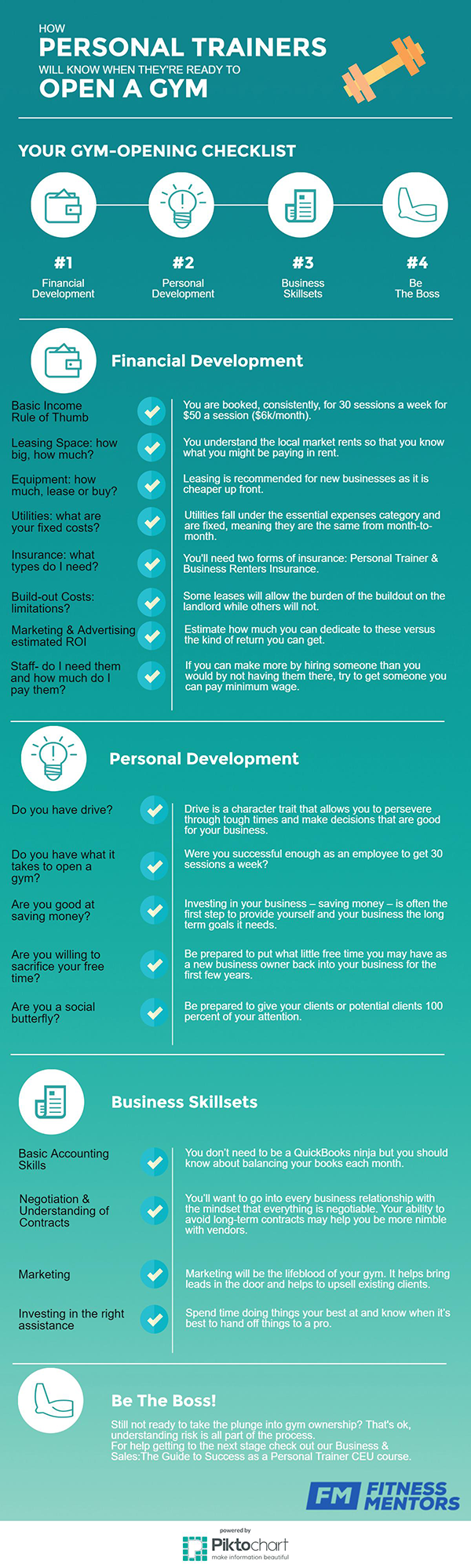
Thinking about opening a gym? This guide walks personal trainers through the financial benchmarks, personal traits, and business skills you need before making the leap from employee to gym owner.
Opening a gym is the goal that lives quietly in the back of many personal trainers’ minds. You’ve spent years building expertise, earning client trust, and developing your training style and at some point, the idea of building something of your own starts to feel less like a dream and more like a logical next step.
But knowing when you’re truly ready is not just a gut feeling. It requires an honest assessment of your financial situation, your personal drive, and whether you have or can acquire the business skills needed to sustain a fitness business beyond the first year.
This guide covers the three core pillars of gym ownership readiness for personal trainers: financial development, personal development, and business skillsets. By the end, you should be able to answer the questions that actually matter before signing a lease or registering an LLC.
If you cannot answer these with confidence right now, keep reading. That’s exactly what this guide is for.
Before we dive in, let’s establish who this guide is aimed at. We’re assuming:
If you’re still building your clientele or haven’t yet identified your niche, that’s your first priority not a lease.
Money is where gym ownership dreams most often hit a wall. The good news for personal trainers: you already have a built-in revenue stream from your clients. The challenge is understanding exactly how much you need to earn before adding the overhead of a physical space.
A practical rule of thumb for trainers considering a small gym: you should be consistently booking at least 30 sessions per week at your going rate. At $50 per session, that’s approximately $6,000 per month in gross income.
Why $6,000/month? Because in a lean early-stage gym model, a meaningful portion of your income will go back into the business. You need enough left over to cover your own living expenses without dipping into business capital.
Note that this figure varies significantly by location. In a high-cost market like New York City or San Francisco, $6,000/month may barely cover rent. In lower-cost markets in the Midwest or South, the same income gives you considerably more runway.
For an early-stage personal training studio, plan on spaces in the 500–1,500 square foot range. This is enough room for one-on-one sessions, small group training, and basic equipment without taking on more rent than your early client volume can support.
Before committing to a location, research commercial rents in your target area. A resource like CBRE’s commercial real estate platform allows you to look up market rents by neighborhood and get a realistic picture of what you’ll be paying. Always lease before you consider buying you need to prove the business model first, and commercial real estate loans for first-time business owners without a track record are difficult to secure.
Equipment investment scales with your training model:
If your equipment needs push past what you can pay for upfront, consider leasing. Equipment leasing reduces your initial capital outlay, typically includes maintenance support, and gives you the option to upgrade as your revenue grows.
Utilities are predictable monthly expenses that you should get actual figures for before signing a lease ideally from the previous tenant or the landlord directly. These include:
Personal trainers opening a gym need two distinct types of insurance coverage:
Many commercial spaces are raw shells that require work before they’re functional as a gym. Changing rooms, a small reception area, rubber flooring, mirrors, and lighting can all represent significant costs and the question of who pays for these varies by lease.
Before signing, negotiate build-out responsibilities. Some landlords will cover or subsidize tenant improvements; others push the cost entirely to the tenant. Anything agreed upon must be specified in the lease contract. Verbal agreements mean nothing get it in writing.
The U.S. Small Business Administration recommends that early-stage small businesses allocate approximately 7–8 percent of gross revenue to marketing. For a gym generating $6,000/month in revenue, that’s roughly $420–$480/month dedicated to attracting and retaining clients.
Think of your marketing budget not as an expense but as a client acquisition investment. The channels most relevant to fitness businesses include:
In the early stages, you will wear many hats trainer, admin, cleaner, marketer, and accountant. That’s normal. But as your client base grows, your time becomes a finite resource, and tasks that don’t require your direct expertise start costing you money by pulling you away from revenue-generating activities.
A part-time front-desk or admin hire even at minimum wage can free up significant time if they handle scheduling, client communication, and basic operations while you train. The question to ask is simple: will having this person here allow me to generate more revenue than I’m paying them? If yes, hire.
Financial planning is the easier part. The harder conversation is about who you are as a person and whether the traits that make a great personal trainer overlap with or conflict with the traits that make a successful business owner. They don’t always.
Entrepreneurship rewards people who can delay gratification, sustain motivation through slow periods, and make decisions that are good for the business even when they’re personally uncomfortable. Ask yourself honestly: have you demonstrated the ability to work toward a goal for 12–18 months without an immediate payoff?
A useful benchmark: are you currently booking 30+ sessions per week? If yes, you’ve already demonstrated the discipline and client relationship skills that translate to gym ownership. If you’re struggling to fill your schedule now, opening a gym doesn’t solve that problem it amplifies it.
If you can’t consistently attract and retain clients as an independent trainer, a physical location won’t change that. Your marketing and relationship skills need to be strong before you take on overhead.
Business owners who thrive are rarely the ones who spend every dollar they make. Are you currently saving a meaningful portion of your income? When you have a good month and bring in extra revenue, do you reinvest it or spend it?
Opening a gym means there will be months especially in year one where unexpected expenses hit, a client base temporarily dips, or rent goes up. Your personal savings and your ability to keep business expenses lean during those periods will determine whether you survive them.
The myth of the business owner with unlimited free time is just that a myth, especially in the early years. Personal trainers operate on client schedules, which means your working hours are largely dictated by when your clients want to train. When you’re not training, you’re handling the business: marketing, accounting, vendor calls, gym maintenance, and everything else.
For the first two to three years of a gym, expect to work more hours than you ever did as an employee. If that trade-off more work now for more autonomy later genuinely excites you rather than drains you, that’s a good sign.
Gym ownership is a relationship business. You need to be able to attract new clients, retain existing ones, communicate effectively with vendors and landlords, and potentially manage staff. Personal trainers who thrive as business owners tend to be naturally outgoing, genuinely interested in people, and skilled at making clients feel seen and supported.
Introversion isn’t disqualifying, but if maintaining energy through client-facing interactions is something you currently find difficult, scaling a gym where you’re responsible for the experience of every person who walks through your door will require conscious effort and systems to compensate.
You don’t need an MBA. But you do need functional competence or the ability to hire someone who has it in several core business areas.
You should understand the difference between revenue and profit, how to read a basic profit and loss statement, and how to keep personal and business finances completely separate. Software like QuickBooks or Wave makes this manageable even without an accounting background.
For year-end tax filing, quarterly estimated taxes, and anything involving payroll, hiring a CPA is strongly recommended. The cost is modest relative to the protection it provides, and many firms offer periodic accounting software training for new business owners.
Every significant business relationship involves negotiation your lease, equipment purchases, vendor contracts, and any marketing partnerships. Going into these conversations with a clear understanding of your walk-away point, the other party’s incentives, and what you’re willing to trade makes a significant difference in the outcomes you get.
A foundational text worth reading before negotiating a lease or major contract: Getting to Yes by Roger Fisher and William Ury. The core insight that the best negotiations focus on interests rather than positions will serve you well across every business relationship you build.
You don’t need to be a lawyer. You do need to read contracts before signing them, understand what you’re committing to, and identify terms that expose you to long-term risk. For leases and contracts involving significant sums, engaging a business attorney for a review is a worthwhile investment typically a few hundred dollars versus the risk of being locked into terms you didn’t fully understand.
Pay particular attention to lease length, termination clauses, rent escalation provisions, and who is responsible for maintenance and build-out costs.
For most small gym owners, marketing is the activity that most directly determines survival. The trainers who build sustainable gyms are the ones who can consistently generate new leads and retain existing clients not just deliver great sessions.
At minimum, you should have a functional strategy across the following:
When you’re doing everything, the ability to prioritize ruthlessly is what separates productive days from chaotic ones. The Eisenhower Priority Matrix which categorizes tasks by urgency and importance is a practical framework for deciding what to handle yourself, what to delegate, and what to eliminate.
The trainers who build successful gyms are not the ones who work the most hours they’re the ones who spend their hours on the activities that most directly grow the business.
Some business tasks have a steep enough learning curve that attempting to DIY them costs more than outsourcing. Common examples for gym owners:
The goal is to spend your time on what you’re best at training clients and building relationships and to hand off the rest to people who can do it better and faster than you can.
The criteria for gym ownership readiness are partly objective and partly personal. On the objective side: consistent 30+ sessions per week, a clear financial picture of your startup costs and monthly overhead, and a defined niche with an established client base you’d bring with you.
On the personal side: demonstrated drive, financial discipline, willingness to sacrifice free time in the short term, and an honest answer to whether you have the personality and skills that running a business requires or the plan to develop them.
Opening a gym is rarely a spontaneous decision made by the most successful gym owners. It’s typically the result of 1–3 years of deliberate preparation. The planning phase is not a delay it’s part of the process.
If you’re not quite there yet, the most useful thing you can do is double down on building your client base, strengthening your financial habits, and developing the business skills that will serve you once you make the leap. That foundation is what separates gyms that make it past year two from those that don’t.
How to Become a Personal Trainer in 5 Simple Steps
Personal Trainer Salary
Top 5 Exercise Science Careers
Many personal trainers start their career working inside a commercial gym. It’s a great place to learn the basics. You meet different clients, practice coaching, and gain real experience on the gym floor.
But after some time, many trainers begin to notice a problem. Even though they are doing the hard work, the gym keeps a big part of the money from every session. For example, a client might pay $70 for a session, but the trainer may only take home $20–$30. Over time, this can feel frustrating, especially when you already have strong coaching skills and loyal clients.
This is why many trainers start thinking about becoming a private personal trainer. Private training gives you more freedom. You can set your own prices, choose your working hours, and work directly with your clients without the gym taking a large cut.
Another reason private training is growing is convenience. Many people now prefer working out at home, in a private studio, or even in a nearby park. Busy schedules, family life, and crowded gyms make personal home training a great option for many clients.
Still, moving from a gym job to private training can feel confusing at first. You may wonder how to find clients, how much to charge, or how to start building your own training business.
The good news is that the transition does not have to happen overnight. Many successful trainers start by slowly building a small private client base while still working at the gym. Step by step, they grow their reputation, gain more referrals, and eventually move into private training full time.
In this guide, you will learn the exact steps to move from gym trainer to private personal trainer. From finding your first clients to setting your rates and building a strong training business, this guide will help you make the transition with confidence. 💪
Number of participants in home gym exercise in the United States from 2006 to 2013 (in millions)*

A private personal trainer is a fitness coach who works independently instead of working for a gym. This means the trainer works directly with clients and is not tied to a commercial fitness center.
Instead of relying on a gym to provide clients, a private trainer builds their own client base and manages their own training schedule. This gives them more control over how they work and how much they earn.
Private personal trainers also have the freedom to choose where and how they train their clients. Training sessions can happen in many different places depending on what works best for the client.
Common places private trainers work include:
Another big difference is that private trainers set their own prices. Instead of sharing revenue with a gym, they decide how much to charge per session, per package, or for online programs.
Private trainers are also responsible for managing their own clients. This includes scheduling sessions, tracking progress, planning workouts, and building strong relationships with the people they train.
Because of this independence, many trainers see private training not just as a job, but as their own small fitness business. With the right approach, it can lead to more freedom, better income, and stronger long-term client relationships.
Many people start their fitness career working as a gym trainer, but over time they start thinking about becoming a private trainer. Both paths involve helping clients get stronger and healthier, but the way the job works is quite different.
Let’s look at the main differences.
A gym trainer works as part of a commercial gym. The gym handles many things like equipment, space, and sometimes marketing.
However, there are a few limits.
The gym keeps a large percentage of the session fee. If a client pays $60–$80 for a session, the trainer may only receive a part of it.
The schedule is often fixed. Trainers usually work shifts and must follow the gym’s working hours.
The gym helps provide clients. Many gyms give trainers new members or leads, which makes it easier to start building experience.
For beginners, working at a gym can be a great way to learn coaching skills and gain confidence.
A private trainer works independently and manages their own training business.
This comes with more freedom but also more responsibility.
Full control over schedule. Trainers can decide when they want to work and how many clients they take.
Higher earning potential. Since there is no gym taking a large cut, trainers keep most of the session income.
They must find their own clients. Private trainers usually rely on referrals, social media, and local marketing to grow their client base.
In simple terms, a gym trainer works as part of a system, while a private trainer runs their own small fitness business. Many trainers begin at a gym to gain experience and later move into private training when they are ready for more freedom and better earning potential.
Working at a commercial gym is a great way for new trainers to start their career. It gives them a place to coach clients, learn how to create workout programs, and gain confidence on the gym floor.
But after some time, many trainers begin to feel limited by the gym system. Even though they enjoy helping clients, they may realize that their growth, income, and freedom are controlled by the gym they work for.
Because of this, many trainers eventually decide to move toward private personal training, where they can work more independently and build their own business.
Here are some of the most common reasons trainers leave commercial gyms.
One of the biggest reasons trainers leave gyms is the limit on how much they can earn. In many gyms, trainers are paid per session, and the pay rate does not increase much over time.
Even if a trainer becomes highly skilled and has many clients, their income may stay almost the same. This can make it difficult for trainers who want to grow their career or earn more from the time and effort they put into coaching.
Private training allows trainers to set their own prices, which often leads to higher earning potential.
In most commercial gyms, the gym takes a large share of the training session fee. For example, a client might pay a high price for a session, but the trainer only receives a small portion of that payment.
This system helps the gym cover costs like equipment, marketing, and space, but it can feel frustrating for trainers who are doing most of the work with the client.
By becoming a private trainer, many coaches prefer keeping the full value of the service they provide.
Another challenge many trainers face in commercial gyms is schedule control. Trainers often need to follow gym shifts, early morning hours, or late evening schedules.
While this works for some people, others want more control over when they work and how many sessions they take each week.
Private trainers can build their own schedule and work at times that fit both their life and their clients’ needs.
Many trainers also dream of creating their own fitness brand. They want their name, coaching style, and training results to be recognized by clients.
In a commercial gym, the gym brand usually comes first. Clients often see the gym as the main service provider instead of the individual trainer.
Private training gives coaches the chance to build their own reputation, online presence, and loyal client community. Over time, this personal brand can help them attract more clients and grow a long-term fitness business.
Not every trainer should jump into private training right away. Working in a gym helps you learn many important skills first. But after gaining some experience, many trainers start feeling ready for the next step.
If you are thinking about leaving the gym and starting private training, there are a few signs that show you may be ready. These signs usually mean you have the skills, confidence, and support needed to begin working independently.
One of the biggest signs you are ready is having clients who enjoy training with you and keep coming back for more sessions.
Loyal clients trust your coaching and like the results they are getting. Some of them may even ask if you offer training outside the gym or if you can coach them privately.
When clients want to continue working with you no matter where you train, it shows that your coaching is valuable and people believe in your ability to help them reach their goals.
Private trainers need to create training plans that fit each client’s goals and fitness level. This means you should feel comfortable designing workout programs for different types of people.
For example, you may train clients who want to lose weight, build strength, improve mobility, or simply stay active. Understanding how to adjust workouts for different needs is an important skill when you train people one-on-one.
If you can confidently plan sessions and adapt workouts when needed, it’s a strong sign you are ready for private coaching.
Trust is a huge part of personal training. When clients listen to your advice, follow your workout plans, and ask for your guidance, it means they see you as a reliable coach.
Clients who trust you are more likely to stay consistent, follow your programs, and recommend you to their friends or family. This kind of relationship is very important when building a private client base.
The stronger your client relationships are, the easier it becomes to grow as a private trainer.
Many trainers eventually feel the desire to create something of their own. Instead of working under a gym brand, they want to build a business that reflects their coaching style and personality.
Becoming a private personal trainer allows you to grow your own brand, choose your training methods, and create the type of service you believe in.
If you feel excited about managing your own clients, setting your own rates, and growing your own fitness career, it may be the perfect time to start your journey as a private personal trainer.
Moving from a gym job to private training does not have to happen all at once. The smartest way to do it is step by step. This allows you to gain confidence, build clients, and grow your income slowly without taking big risks.
Below are simple steps many successful trainers follow when making the transition.
Before starting private training, it is important to gain strong experience while working at the gym. The gym environment helps you practice coaching and learn how to work with different types of clients.
Focus on improving a few key skills.
First, learn coaching techniques. Pay attention to how you explain exercises, correct form, and motivate clients during tough workouts.
Second, learn client psychology. Every client is different. Some need encouragement, while others need structure and accountability. Understanding how people think helps you become a better coach.
Finally, track client results. Keep records of progress like weight loss, strength gains, or improved endurance. When clients see results, they are more likely to stay with you and recommend you to others.
Not every gym member wants private training, but some people prefer a more personal experience. These clients are often the best fit for home or private sessions.
Look for clients such as:
Busy professionals who don’t have time to travel to the gym
Parents who prefer working out at home while managing family responsibilities
Home gym owners who already have equipment but need guidance
These people often value convenience and personal attention, which makes private training a great option for them.
Once you identify interested clients, you can begin offering private sessions outside the gym. Many trainers start by coaching clients in their homes or nearby parks.
Home workouts can be very effective. Many exercises use bodyweight, resistance bands, or simple equipment. The goal is to design workouts that match the equipment your client already has.
Another big benefit of private training is flexible scheduling. You can arrange sessions at times that work best for both you and your client.
Private sessions also provide more personal attention. Without the busy gym environment, you can focus fully on one client and help them perform exercises safely and effectively.
One of the biggest changes when moving to private training is setting your own prices. Instead of receiving a fixed pay from a gym, you decide how much your service is worth.
Several factors can affect your pricing.
Your experience level plays a big role. Trainers with more knowledge and results can often charge higher rates.
Your location also matters. Training in large cities or high-demand areas may allow higher prices compared to smaller towns.
Finally, session length is important. Some trainers offer 30-minute sessions, while others provide 60-minute or even 90-minute sessions. Longer sessions usually cost more.
Take time to research what trainers in your area charge so your rates stay competitive.
The best way to move into private training is slowly. There is no need to quit your gym job immediately.
Many trainers start by keeping some gym clients while adding a few private clients each week. As your private client list grows, you can reduce your gym hours.
This gradual transition gives you time to build a stable income and strong relationships with your new clients.
With patience and consistency, many trainers eventually reach the point where their private training business becomes their main source of work and income.
One of the biggest worries trainers have when moving into private training is finding clients. When you work at a gym, the gym often helps bring people through the door. But as a private trainer, you need to start building your own client base.
The good news is that you don’t have to start from zero. Many trainers already have access to people who trust them and are interested in their coaching. With a few simple steps, you can begin attracting your first private clients.
Your current clients are often the best place to start. These are people who already know your coaching style and have seen the results of your training.
Some of them may prefer more flexible sessions outside the gym. Others may want the convenience of training at home or in a quiet environment.
By simply talking to your clients and explaining that you offer private sessions, you may discover that some of them are interested in working with you outside the gym.
Referrals are one of the most powerful ways to grow your client base. Happy clients often have friends, family members, or coworkers who are also interested in improving their health.
You can politely ask your current clients if they know anyone who might benefit from personal training. Many trainers find that one satisfied client can lead to two or three new clients through simple word-of-mouth.
Over time, referrals can become one of the strongest ways to grow your private training business.
Some people feel unsure about hiring a personal trainer, especially if they have never worked with one before. Offering a free consultation can help remove that fear.
During the consultation, you can talk about the client’s goals, fitness level, and lifestyle. You can also explain how your training program can help them improve their health and reach their goals.
This short meeting helps build trust and gives potential clients a chance to see how you work before committing to regular sessions.
Social media can be a great way to connect with people in your local community. Platforms like Facebook often have neighborhood groups where people discuss local services, events, and recommendations.
You can share helpful fitness tips, answer questions, or mention that you offer private training sessions in the area. When people see useful advice and positive interaction, they may become interested in your coaching.
The key is to be helpful and genuine rather than overly promotional.
Another smart strategy is working with other businesses in your community. For example, you could partner with:
physical therapy clinics
yoga studios
wellness centers
health food stores
These businesses often work with people who care about their health and fitness. By building friendly relationships, they may recommend your training services to their clients.
Local partnerships can help you reach new people while also building a strong reputation in your community.
Private training is more than just taking clients through exercises it’s about giving them a personalized experience that they can’t get in a busy gym. When clients feel supported, motivated, and see real results, they are more likely to stay with you long-term and recommend you to others.
Here’s how to create an experience that makes your private training stand out.
Every client is unique. They have different goals, fitness levels, and schedules. As a private trainer, you can design custom workout programs that fit each client’s specific needs.
For example:
A client recovering from injury might need low-impact exercises.
Someone training for strength may need a progressive weightlifting plan.
Busy professionals may prefer short, high-intensity workouts that fit their schedule.
By tailoring programs to the individual, you show clients that you understand them and care about their progress.
Many private clients train at home, which means you often work with limited equipment. Part of your value as a trainer is helping clients use what they have effectively or recommending affordable additions to their home gym.
You can:
Design workouts using bodyweight, resistance bands, or dumbbells.
Suggest small, budget-friendly equipment upgrades.
Teach clients how to set up their space safely and efficiently.
This planning ensures that clients get effective workouts without needing a full commercial gym.
Tracking results is one of the most motivating parts of private training. Keep records of:
Strength improvements
Weight or body composition changes
Endurance or mobility progress
Sharing these results regularly shows clients that their efforts are paying off. It also helps you adjust their programs as they improve, keeping the workouts challenging and effective.
Many clients struggle to stay consistent with workouts, especially outside a gym. As a private trainer, you provide accountability and motivation:
Checking in between sessions
Celebrating achievements
Encouraging clients to push past plateaus
When clients know someone is guiding and supporting them, they are more likely to stay committed. This is one of the key reasons private training is so valuable and why clients are willing to invest in it.
In today’s world, private training doesn’t have to happen only in person. Many clients enjoy the flexibility of hybrid coaching, where they get guidance both at home and online. This allows you to provide consistent support, keep clients accountable, and help them reach their goals faster even when you aren’t physically there.
Hybrid coaching is especially helpful for clients with busy schedules, long commutes, or limited access to equipment. It also lets you manage more clients without stretching yourself too thin.
Here’s how to make hybrid coaching work effectively.
Workout tracking apps are a game-changer for private trainers. Apps like MyFitnessPal, Trainerize, or FitNotes allow clients to log workouts, reps, weights, and duration.
When clients track their workouts:
You can see their progress in real time.
You can adjust programs based on their performance.
Clients feel motivated because they can see their own improvement.
Using these apps makes it easy to stay connected and ensures clients stick to their plan.
Even if your client trains mostly on their own, weekly check-ins are essential. These can happen via video call, phone, or messaging.
During check-ins, you can:
Review progress from the past week
Adjust workouts based on performance
Celebrate achievements and motivate them for the upcoming week
Regular communication helps clients feel supported and accountable, which leads to better results.
Fitness isn’t just about workouts nutrition plays a huge role in achieving results. Encourage clients to log meals, track water intake, and follow healthy habits.
When you guide clients on their diet without being too strict or judgmental, they are more likely to make consistent, long-term improvements.
Example:
Suggest healthier swaps for cravings
Remind them about portion control
Celebrate small victories like choosing fruit over sweets
By helping clients stay accountable with nutrition, you improve their results and show your value as a private trainer.
Sometimes you won’t be with your client for every workout. Providing online workout plans lets them train safely and effectively between your sessions.
You can:
Send video demonstrations
Provide written workout instructions
Include options for different equipment availability
This ensures that clients stay consistent, stay motivated, and see progress even when you aren’t physically present.
Combining at-home sessions with online coaching creates a flexible, personalized experience. Clients feel supported, stay accountable, and achieve results faster all while giving you the freedom to manage your schedule and grow your private training business.
One of the things that makes private training different from working in a gym is you don’t have access to all the equipment. To make sure your sessions are effective, it’s important to bring a few essential tools that are portable and versatile.
Here’s a simple list of equipment I always bring to client homes:
Resistance Bands – Great for strength training, mobility exercises, and warm-ups. They are light and easy to carry.
Jump Rope – Perfect for quick cardio sessions or warm-up circuits.
Suspension Trainer – A compact tool that lets you do bodyweight exercises anywhere, even using a door frame or tree.
Kettlebells – Useful for strength, endurance, and functional movements. You don’t need many; a few different weights are enough.
Mobility Tools – Foam rollers, massage balls, and stretch straps help clients recover and improve flexibility.
Bringing your own equipment ensures every session is productive, no matter what your client has at home. It also makes you look professional and prepared, which builds trust with your clients.
One of the most exciting parts of becoming a private personal trainer is the potential to earn more money than you would at a gym. Unlike gym jobs where a large portion of your fee goes to the facility, private training allows you to keep most of what you earn.
Here’s a simple breakdown to help you understand earnings:
Private training rates vary depending on experience, location, and session length. On average:
30-minute session: $30–$50
60-minute session: $50–$100
90-minute session: $80–$150
These are just examples, and many trainers adjust their prices as their experience and reputation grow.
Let’s say you train 10 clients per week with 60-minute sessions at $70 per session:
10 clients × $70 = $700 per week
If you gradually add more clients or offer multiple sessions per day, your weekly income can increase significantly.
Using the same example, if you consistently train 10 clients per week:
$700 per week × 4 weeks = $2,800 per month
If you scale up to 20 sessions per week, your monthly income could easily reach $5,600 or more, depending on your rates.
The key is that private training gives you control over your income. The more clients you serve, the more sessions you can schedule, and the higher your earning potential becomes. With experience, referrals, and a strong reputation, private training can become a very profitable career.
Even with experience, many trainers face challenges when moving into private training. Knowing the common mistakes ahead of time can save you time, money, and frustration. Here are some pitfalls I’ve seen and some I experienced myself so you can avoid them.
Some trainers quit their gym job too early before building a solid private client base. This can create financial stress if there aren’t enough clients to support you.
I always recommend gradually adding private clients while keeping some gym sessions until your business is stable. This makes the transition smoother and less risky.
A lot of new private trainers make the mistake of charging too little. It might feel easier to attract clients, but low pricing can undervalue your skills and make it hard to grow.
Instead, set rates that reflect your experience and the value you provide, and don’t be afraid to adjust them as your reputation grows.
Many trainers forget that private training is also a business. Clients often choose trainers they recognize, trust, and feel confident in.
Not building a brand online presence, personal style, and consistent messaging can make it harder to attract new clients. Your brand helps people know who you are and why they should train with you.
Finally, some trainers rely entirely on word-of-mouth or hope clients will find them. While referrals help, consistent marketing is essential to grow your client base.
Marketing doesn’t have to be complicated it can be as simple as posting workout tips on social media, sharing client success stories, or networking with local businesses.
Running a successful private training business requires more than coaching skills. You also need strategy, consistency, and focus on results. Here’s what I’ve learned works best.
Your brand is your reputation. Show people who you are, what you stand for, and the results you help clients achieve.
Use social media, a simple website, or client testimonials to make your brand visible. When clients know your story and see your expertise, they are more likely to trust you.
Results are the foundation of your business. The better your clients do, the happier they are, and the more likely they are to recommend you.
Track progress, adjust programs when needed, and celebrate small wins. Results speak louder than any marketing message.
Happy clients are your best marketing tool. Ask satisfied clients to leave testimonials or share their progress photos.
Social proof shows potential clients that you are capable and trustworthy. It’s one of the fastest ways to attract new clients.
Even if you have some clients, consistent marketing keeps your business growing. Simple steps include:
Posting weekly fitness tips or videos
Sharing client success stories
Engaging in local online groups
Networking with nearby businesses
Consistency builds recognition, trust, and eventually a strong, steady flow of clients.
💪 By avoiding mistakes and following these tips, you can build a thriving private personal training business that grows steadily and rewards your effort.
Yes! Many trainers work independently without being tied to a commercial gym. Independent trainers set their own schedules, choose their clients, and run their own small fitness business. Private training allows more flexibility, control over earnings, and the ability to create personalized experiences for clients.
Private trainers usually find clients through a combination of strategies:
Starting with existing gym clients
Asking for referrals from satisfied clients
Offering free consultation sessions
Using social media and local online groups
Partnering with local businesses like wellness centers or yoga studios
Consistency and personal reputation are key once you help a few clients achieve results, referrals and repeat clients often follow naturally.
Rates vary depending on location, experience, and session length:
30-minute session: $30–$50
60-minute session: $50–$100
90-minute session: $80–$150
Your pricing should reflect your experience, results, and the value you provide. Over time, you can adjust your rates as your reputation grows.
While requirements vary by country, having a recognized personal trainer certification is highly recommended. Certification not only gives you credibility but also ensures you know how to train clients safely and effectively. It also makes clients more confident in hiring you.
Yes! Private personal training can be highly profitable. Unlike gyms that take a large cut, private trainers keep most of their earnings. Depending on the number of clients, session pricing, and consistency, many trainers earn significantly more than they would in a gym. With the right approach, marketing, and client base, private training can become a full-time, high-earning business. 💪


I believe every trainer already has what it takes to close more sales. Most just haven’t been taught to use their natural personality as the asset it truly is.
Understand your selling personality to close more sales
As a personal trainer whose focus is to sell their services to gain new clients and grow your business, it makes sense to understand your “selling personality” and how it affects your closing rate.
According to Psychology Today, there are five personality dimensions that define us. These include agreeableness, conscientiousness (a desire to task well), extraversion, openness and neuroticism (a negative emotional state).
It is said that our personalities are defined by the temperaments we had as babies and the life experiences we had as kids.
Your selling personality is your most valuable asset as a trainer and today I’m going to help you identify the type of selling personality you have, where it can work against you, and exactly how to fix it.
Keep in mind, the goal here isn’t to change who you are. It’s to help you understand the way you naturally sell, how clients perceive you, and how a little self-awareness can unlock a whole new level of closing confidence.
Below are five common types of personal trainer sales personalities, where they go wrong, and how to fix them.
I see this personality more than any other and honestly, it’s one of the most lovable selling styles a trainer can have.
The Instant Friend is the most agreeable of all personal trainer sales personalities. They engage potential clients as if they’re already the best of friends, looking to form an immediate social connection. Their personality is warm and inviting sometimes to a fault.
The Instant Friend can be among the most successful personal trainers out there. They naturally attract clients who want someone they enjoy being around, someone who gets them not just a trainer barking reps at them.
Here’s what I see happen too often with this personality type. They build such a genuine connection that the professional line starts to blur. Clients begin to see them more as a friend than a fitness expert and with that comes less respect, more cancellations, and fewer commitments.
The Instant Friend also tends to hold back on the sale because they never want to come across as pushy. And I get it that feels uncomfortable when you care about people. But here’s the truth: not making the ask isn’t being a good friend. It’s leaving someone without the guidance they actually came to you for.
Take Freddy, for example. He meets Rich, a potential client full of questions about bulking up. Freddy, being the genuinely helpful guy he is, keeps answering freely giving away his time and expertise. But he never invites Rich to take the next step. In the end, Rich walks away feeling informed enough to go it alone, and Freddy never gains a client.
If you recognize yourself as The Instant Friend, here’s what I want you to remember: your warmth is a gift don’t dim it. Just pair it with intention.
After every great conversation, follow it with a clear call to action. Invite them to a free assessment. Give enough to build trust, but not so much that they feel they don’t need you anymore. Your personality will open the door make sure you’re also walking them through it.
I have a lot of respect for this personality type the knowledge, the dedication, the relentless pursuit of expertise. But I’ve also watched The Guru talk themselves right out of a sale, and it’s one of the most frustrating things to witness because it’s so preventable.
The Guru selling personality leads with analytical data, research, and logic rather than emotional connection. Where The Instant Friend wins hearts, The Guru wins minds and there’s a real market for that. They attract driven, goal-oriented “Type A” clients who want results backed by science, not just good vibes.
This is the trainer who doesn’t just meet the continuing education requirements they blow past them. Multiple certifications. Conference circuits. Dog-eared research journals. The Guru doesn’t just want to know the latest in fitness science they and to be the person in the room who knows it first. And that level of dedication, when channeled correctly, is genuinely impressive.
Here’s where I see The Guru lose the room. They walk into a sales conversation armed with everything except the one thing the client actually needs to feel heard.
The Guru has a tendency to lead with expertise rather than empathy. They’ll drop industry terminology, reference specific studies, and map out training methodologies before the client has even finished explaining why they walked through the door. And while all of that knowledge is real and valid, it creates distance instead of trust.
People don’t just want a smart trainer. They want a trainer who makes them feel smart and more importantly, understood.
Take Gary and Gina. Gina is drawn to Gary’s analytical approach initially it feels credible, authoritative. But as the conversation continues, Gary keeps pivoting back to studies and frameworks that Gina doesn’t fully understand. She starts to feel like a case study rather than a person. The connection breaks down not because Gary lacks knowledge, but because he hasn’t made his knowledge feel relevant to her life, her goals, her story.
There’s another layer here too. The Guru can sometimes come across as subtly condescending not intentionally, but when someone consistently redirects the conversation back to what they know, the unspoken message to the client is: what you’re saying isn’t as important as what I already know. That perception, even when unearned, quietly kills the sale.
If you’re The Guru, here’s what I want you to sit with: your knowledge isn’t the problem it’s the sequencing.
Before you lead with what you know, lead with what they feel. Ask deeper questions. Listen beyond the surface answer. When someone tells you their goal, resist the urge to immediately map it to a study or a system. Instead, reflect it back to them first. Let them feel like you truly understand before you demonstrate that you’re the expert who can get them there.
Think of your knowledge as the destination, and your listening as the road that gets you both there. A client who feels genuinely understood will lean into your expertise rather than feeling overwhelmed by it.
The Guru’s edge when used well is incredibly powerful. Pair that credibility with curiosity about the person in front of you, and you’ll not only close more sales, you’ll build the kind of loyal, long-term client relationships that fuel referrals for years.
I’ll be honest, when I see this personality type, I see enormous potential. The Fitness Consultant is the closest thing to a complete seller that exists in personal training. They have the warmth to connect and the knowledge to impress, and when they’re firing on all cylinders, they’re almost unstoppable.
The Fitness Consultant is the best of both worlds a natural blend of The Instant Friend and The Guru. They can sit with a data-driven client and speak confidently about science, research, and methodology. Then turn around and connect deeply with a client who just wants to feel supported and understood. That range is rare, and it’s genuinely powerful.
This personality invests in themselves the way elite performers do. They’re collecting CEUs, attending conferences, reading the latest research not out of obligation, but because they genuinely care about being the most credible, most helpful version of themselves for their clients. And socially, they’re just as invested. They tell stories, ask meaningful questions, and build the kind of trust that turns a first consultation into a years-long relationship.
Here’s the thing I want The Fitness Consultant to hear having range is a strength, but losing your balance is a real risk.
What I see happen is this: The Fitness Consultant gets comfortable. They drift. In one conversation they slide too far into Instant Friend mode talking freely, laughing easily, building great rapport but never steering the conversation toward a commitment. In another, they flip into Guru mode leading with credentials, rattling off jargon, and losing the client in a sea of information that feels impressive but not personal.
The danger is that both feel natural in the moment. That’s what makes it hard to catch.
Take Cary and Caitlin. Caitlin had mentioned in passing that she was impressed by credentials so Cary, picking up on that cue, launched into a detailed breakdown of her Precision Nutrition training and the depth of her programming knowledge. But Caitlin didn’t want a résumé. She wanted Cary to look her in the eye and say, “Here’s exactly how I would help you specifically.” The credibility was there but it was pointed in the wrong direction.
There’s also a subtler issue. Because The Fitness Consultant is so naturally likeable, clients feel comfortable saying no to them. The friendly dynamic that opens the door also makes it easier for people to brush off an invitation to a one-on-one assessment without feeling guilty about it. The very warmth that builds connection can soften the urgency that closes the sale.
If you’re The Fitness Consultant, here’s what I want you to practice: lead with the person, not the package.
Before you decide whether to be the friend or the expert in a conversation, pause and ask yourself what does this person actually need from me right now? Let their energy guide which side of you shows up first. And whichever direction you go, keep circling back to them their goals, their story, their vision.
When it comes to knowledge, think of it as a tool for personalization, not a showcase. Don’t tell a client how impressive your nutrition certification is show them what it means for their specific situation. That shift from general expertise to personal relevance is what transforms a curious conversation into a signed client.
And always move toward the one-on-one assessment. Your likability makes the ask feel natural. Use it. A simple “I’d love to sit down with you properly and build something around your goals specifically” lands differently coming from you than from almost any other personality type. That’s your superpower. Own it.
I’ll tell you something when it comes to sheer hustle, nobody in the room outworks The Network Builder. This personality type has cracked something that many talented trainers never figure out: that building a business is a contact sport, and showing up consistently is half the battle.
The Network Builder thrives where others feel uncomfortable. Networking events, social mixers, community gatherings this is their arena. They work the room with confidence, hand out business cards like they’re going out of style, and have a genuine gift for making strangers feel like old friends within minutes. They’re not afraid to ask for referrals, and because of that boldness, they often build a surprisingly strong book of business through sheer volume and visibility.
This is the trainer people remember. Not always for the deepest conversation, but for the energy, the follow-up text the next morning, and the consistent presence that keeps them top of mind when someone finally decides they’re ready to get serious about their fitness.
Here’s what I want The Network Builder to sit with: knowing a lot of people is not the same as building a business. And this is where I see this personality type quietly limit their own ceiling.
The Network Builder is exceptional at casting a wide net but the real value in personal training lives in the depth of the relationship, not the size of the contact list. The more time spent chasing the next handshake, the less time there is for the one thing that actually generates long-term income: truly knowing your clients, understanding their goals, and delivering results that make them want to refer everyone they know.
There’s another blind spot I see consistently with this type. Because leads come relatively easily, The Network Builder can start to deprioritize continuing education and skill development. Why spend a weekend at a certification course when the calendar is already full? But here’s the truth referrals dry up when results plateau. The Network Builder’s greatest long-term risk isn’t a lack of leads. It’s a lack of depth to back up the brand they’ve built.
And then there’s the moment I see play out again and again with this personality the missed sale hiding in plain sight.
Take Nancy. Three events a week, 25 business cards per event, a follow-up system that most sales professionals would envy. But when Neil a warm, genuinely interested lead told her he was ready for an assessment, Nancy noted it and moved on to the next conversation. She was playing the numbers when the number she needed was already standing right in front of her.
There’s an old saying I keep coming back to: a bird in the hand is worth two in the bush. Nancy had the bird. She just didn’t stop to close her hand.
If you’re The Network Builder, here’s the shift I want you to make stop counting conversations and start qualifying them.
Not everyone in the room is a potential client, and that’s okay. But when someone shows genuine interest when they lean in, ask specific questions, or mention a fitness goal that’s your signal to slow down. Put the business cards away. Give that person your full attention and build enough rapport in that moment to walk away with a commitment, not just a follow-up promise.
Think of every event less as a numbers game and more as a search for three to five real conversations. One meaningful connection that converts is worth more than twenty card exchanges that go cold.
And I’d challenge you to reinvest some of that networking energy back into your craft. Book the certification. Read the research. The deeper your skillset, the stronger your reputation becomes and a strong reputation is the kind of referral engine that no amount of business cards can replicate.
Your energy and your courage to connect are genuine gifts. Now let’s make sure the follow-through matches the hustle.
I want to be careful how I talk about this personality type because the instinct is to villainize it, and I don’t think that’s fair or accurate.
The Hard Seller gets a bad reputation, and sometimes it’s earned. But underneath the pressure tactics and the relentless prospecting is a trainer who is genuinely driven, highly resilient, and completely unafraid of rejection. Those are real skills. The problem isn’t the hunger it’s what happens after the sale is made.
The Hard Seller is often forged in the high-pressure environment of big box gyms, where quotas are real, deadlines are weekly, and the ability to overcome objections is the difference between keeping your job and losing it. That training creates someone who is exceptionally good at reading hesitation, reframing resistance, and finding the angle that finally lands. They’re adaptable, persistent, and relentless in a way that most other personality types simply are not.
And in the right context, that persistence genuinely helps people. Sometimes a client needs someone to push past their own excuses and commit to something that will change their life. The Hard Seller does that better than anyone.
Here’s the truth I need The Hard Seller to hear: closing the sale is not the finish line. It’s the starting gun.
What I see consistently with this personality type is a fundamental misalignment between how they pursue a client and how they serve one. The skills that make them exceptional at getting the signature urgency, pressure, persuasion are the exact opposite of what builds the long-term trust that keeps a client renewing month after month.
The Hard Seller wins the battle and loses the war. They fill their roster and then watch it quietly empty out, because the clients they brought in never felt truly seen or understood. They felt sold to and people don’t stay where they feel like a transaction.
Take Harry and Hazel. Harry was convincing enough that Hazel signed a package even when she wasn’t fully sure. And in the short term, that looked like a win. But Hazel spent that entire month waiting for Harry to show her that he actually understood what she came to him for. That moment never came. So when the package ended, so did the relationship and worse, Hazel told her friends exactly why she left.
That last part is what I really want The Hard Seller to think about. In personal training, your reputation travels fast. A client who feels genuinely cared for becomes a referral machine. A client who feels pressured into a sale becomes a warning story at dinner parties.
If you’re The Hard Seller, here’s what I want you to know you don’t have to soften your drive. You just have to redirect some of it toward the relationship.
The single most powerful thing you can do is have what I call the expectations conversation and have it early. Ask your new clients directly: What does success look like for you? What do you need from me as your trainer to feel like this was worth it? Then tell them what they can expect from you in return. Lay it all out. When expectations are named and agreed upon, trust has a foundation to grow from.
From there, build check-ins into your process. Not just fitness assessments real conversations. How are you feeling about your progress? Is this what you imagined it would be? What would make this even better? These questions do something the hard sell never can: they make the client feel like a priority rather than a number.
The goal isn’t to stop being persistent. It’s to point that persistence at retention just as fiercely as you point it at acquisition. Because a client who renews three times is worth more than three clients who each leave after one package in revenue, in referrals, and in the reputation you’re building one relationship at a time.
Your drive is your greatest asset. Now let’s make sure your clients feel it working for them, not just on them.
The good news for those of you who feel somewhat trapped by your selling personality is that you can change them for the better. According to the Psychology Today article, simply recognizing that we can change our personalities can mean more effective treatment of people, and in the trainer’s case, potential clients.
If you are motivated to alter your selling personality to become a more effective seller/trainer, first identify the type of selling personality you possess. If you identify with some of the areas where these selling personalities go wrong, try to understand how you can adjust your approach so that you can work on getting better at identifying with potential clients.
For more information on becoming a successful personal trainer click the below link and check out our business and sales course.
How to Become a Personal Trainer in 5 Simple Steps
Personal Trainer Salary
Top 5 Exercise Science Careers
The Guru selling personality uses analytical data and logic rather than emotional selling to attract clients who value that type of credibility. They often seek to attract the opposite type of client than The Instant Friend as they are less interested in forming a social connection and more interested in goals.
Their sales technique involves sharing lots of information on research studies, effective workout methods, data and other logic-driven examples to install confidence in “Type A” clients who desire that type of expertise. The Guru is the type of trainer that far exceeds the continuing education requirements of personal trainers, has multiple certifications, and attends more conferences than anyone because they crave knowledge and want to utilize it.
Goes Wrong:
The Guru goes wrong because he is conceded, a know-it-all, and is not personable enough to convert. He doesn’t focus on the client as much as the training. The Guru might dominate the conversation by speaking based on their experience and knowledge – which is well-referenced – however lacks the listening and communication skills to truly resonate with the client and what they are trying to tell him about their fitness needs.
When increasing value to clients, understand that people desire to feel important, and if they don’t (as is often the case of The Guru), they don’t feel valued. When this happens, client retention suffers.
For example, Gary is a Guru personality, and meets Gina, a potential client. Gina likes that Gary is analytical but feels that sometimes Gary is more interested in talking about specific studies or flexing his fitness knowledge than actually listening to what she has to say. Often times, Gary will talk about a specific industry study that is somewhat relevant to what Gina has mentioned but Gina, not understanding industry jargon, gets lost in the conversation and feels that Gary is perhaps not really understanding her goals, therefore losing interest and confidence in him as her potential trainer.
Can be Fixed:
If you have The Guru personality style, be sure to take the time to know the person and their needs. Very often Guru’s assume they know what the client wants too quickly and blows the sale by not listening to the client’s needs and interests.
The Guru needs to keep in mind that training goals are personal ones, and part of their value is catering their training to show value in terms of personalization.

Check out the Expert Interview Series of Fitness Mentors CEO Eddie Lester as featured on the AccuroFit.com Blog. He delivers some great insight into personal training and how to incorporate technology into your training.
How to Become a Personal Trainer in 5 Simple Steps
Personal Trainer Salary
Top 5 Exercise Science Careers
Over 4,000 personal trainers have used this guide to grow their income, fill their schedule, and finally build the business they set out to create. You’re next.
In Business and Sales: The Guide to Success as a Personal Trainer, Eddie Lester cuts through the noise and gives you a clear, step-by-step roadmap to turning your passion for fitness into a profitable, sustainable career.
Most trainers are exceptional at what they do inside the gym but struggle the moment business enters the conversation. Prospecting feels awkward. Pricing feels uncertain. Closing feels pushy. This guide was written to change all of that.
Here’s what you’ll walk away with:
- A certification strategy that builds credibility — because passion alone won’t convince a client to hand over their credit card. Learn how to position your credentials to instantly build trust.
- A personal brand that attracts your ideal clients — define your niche, identify your target demographic, and show up in a way that makes you the obvious choice in your market.
- A sales approach that feels natural, not slimy — hone your selling personality, craft a pitch that connects, and make a first impression that clients remember for all the right reasons.
- Eddie’s “Power Questions” — a proven framework for uncovering what truly motivates a prospect, so you can speak directly to what they actually want and close with confidence.
- A pricing structure that reflects your value — stop undercharging. Learn how to set rates that position you as a premium professional and sustain long-term growth.
- Business checkpoints to keep you on track — real milestones to measure your progress and stay focused as you scale.
The most important lesson in this entire guide? Discipline. The same relentless drive you bring to your clients’ transformations is the exact fuel your business needs. Eddie shows you how to channel it.
If you’re ready to stop winging it and start building a personal training business with real strategy behind it this is the guide that gets you there.

How to Become a Personal Trainer in 5 Simple Steps
Personal Trainer Salary
Top 5 Exercise Science Careers
Most of these books are personal trainer-specific, meaning they were written with you directly in mind. However, I did include a few industry-agnostic books in the mix to provide valuable insight into broader skillsets that every great personal trainer should possess. To make navigation easier, I’ve organized them into the following categories: Business, Sales and Marketing; Flexibility and Pain Management; Strength and Hypertrophy; Power, Olympic Lifting, and Athletic Performance; Nutrition; and Personal Development.
You might be wondering what makes me qualified to recommend personal training books in the first place. Well, for starters, I’ve written my own Business and Sales: The Guide to Success as a Personal Trainer so I know firsthand what it takes to put valuable, actionable content on the page. On top of that, I’m a former college personal training professor, which meant I was required to read an enormous number of books on the subject, in addition to the many I sought out purely out of passion for the craft.
But I digress – my pain is truly your gain. Instead of wading through the hundreds of books out there, you only need to read 13 carefully selected titles to come out significantly better on the other side. Consider this your shortcut to a well-rounded, highly competent personal training career.
After reading some or all of these books, you’ll know how to build and maintain a profitable personal training business from the ground up. You’ll learn how to sell personal training effectively to potential clients, keeping your roster full and your income strong. You’ll also gain deep physical, technical, and anatomical insight across all types of training, empowering you to help nearly any client achieve nearly any goal. You’ll understand how to seamlessly incorporate nutrition into your services, positioning yourself as the ultimate all-in-one resource for your clients.
My hand-picked list of personal trainer books includes:
Business and Sales: The Guide to Success as a Personal Trainer – Eddie Lester
Written by yours truly, this book was created based on my experience helping more than 4,000 trainers achieve their financial goals while training. The book starts with fundamentals like getting a personal training certification and covers sales, business checkpoints, and marketing.
Little Red Book of Selling – Jeffrey Gittomer
Short and sweet, this book on selling can be applied to selling personal training as well. This book focuses less on how to sell and more on why people buy. I like this book because it includes buyer excuses and how to overcome them.
Becoming a Supple Leopard – Dr. Kelly Starrett
A must-read for the personal trainer who loves to learn about human movement. Ever wondered how to help your clients unlearn bad habits when squatting, snatches, or muscle-ups? Learn to work around range of motion issues, break down the areas of the body that restrict movement, and reclaim the mobility of you and your clients.
Strength Training Anatomy – Frederic Delavier
Put your old high school anatomy book away and pick up this one designed for personal trainers. This book is beneficial for those who want to see what is going on under the skin – bones, ligaments, tendons, and connective tissue. This book is described as “having an x-ray for each exercise,” providing you the ultimate in how you can improve your training to build strength in your clients quickly.
Get Buffed I-IV – Ian King
A four-part series, the Get Buffed books will help you take on those clients whose sole purpose in life is to get huge. While the title can be a bit geared towards the serious bodybuilder, there are also a whole bunch of tips and tricks for those who want strength and/or advice on leaning out.
Olympic Lifting: A Complete Guide for Athletes and Coaches – Greg Everett
“The best book on Olympic weightlifting” is what the VP of the Pacific Weightlifting Associated called this book. A comprehensive guide, it is geared to not only athletes, but coaches and trainers who benefit from progressions, error correction, programming, competition, warm-ups, and more.
Essentials of Strength Training and Conditioning – Thomas Baechle
The preferred book for the preparation of the Certified Strength and Conditioning Specialist (CSCS) exam, this five-part book covers an all-inclusive application framework, a program design section, and real-world examples for organizational and administrative (i.e. trainers) professionals in which to operate a specialist program.
Good Calories, Bad Calories – Gary Taubes
I like this book because it sheds light on the ideas of what is considered to be a healthy diet and dismantles them. A truly eye-opening read, this book changed the way I think about diet, how I make recommendations to clients on nutrition, and that the energy sources we take in are all about the varieties and not so much the number of calories. It gets heavy into the fat and carb debate, which you can use to educate clients on better eating habits backed by evidence.
The Protein Power Lifeplan – Michael Eades
Much of the content of this book is based on the authors’ reference to man’s meat-eating days. A true reference to what many call the “original Paleo diet,” The Protein Power Lifeplan contains no recipes but does contain lots of science, research references, and medical advice opposition.
Wired to Eat – Robb Wolf
Written by a former research biochemist and powerlifting champion, Robb Wolf has championed a book that provides weight loss solutions based on personal genetics as they pertain to diet and metabolism. For the trainer, this book will help you individualize your nutritional planning and help you to repair your clients’ appetites, making you the shining light on custom dieting.
Know: A Spiritual Wake-Up Call – Royce Morales
I recommend this book because it shines the light on our ability to understand how to transform one’s life. As a personal trainer, this is often what you are doing, or, at the very least, selling. After reading Know, you’ll gain some insight into how to bring out the power of intention in yourself as well as be able to see it in your clients to help them achieve their personal goals.
The 4-Hour Work Week – Tim Ferris
Personal trainers often gravitate to the industry because of the quality of life benefits the career affords. One of these benefits is hours worked per week, which tends to sit well below the 40-hours of most other American’s. The most popular book on this list, the 4-Hour Work Week provides a blueprint to a luxury lifestyle with high-income and lots of free time as its backbone.
Many of the books on this list are under $20, a small price to pay for a ton of knowledge. Why go through the challenge of becoming an awesome personal trainer when you can learn from the experience of others and quickly apply it to your business model, clients, and your own workout routines? I hope you enjoy this list, and please let me know in the comments if you have any solid recommendations that didn’t make it here.
You’d probably agree with me when I say:
There are no shortcuts to fast and credible personal trainer certifications.
Or, are there?
As it turns out, there are some great ways to get a personal trainer certification, fast. And I’m not talking about those crappy, fake certifications you may have come across from the vast stretches of the interwebs.
I’m talking about a real, accredited, personal trainer certification that will get you a job at most gyms and into a personal training career that you love.
Before you can tap into the personal training field you’ll need to get some things in order that most online personal trainer certification bodies require. For most of these agencies, you’ll need to check off the following three things:
More companies are requiring the Automated External Defibrillator (AED) Certification along with the Emergency Cardiac Care (CPR), but these certifications are usually given together. American Red Cross is one of the primary providers of these courses and you can find a CPR/AED class near you to satisfy this necessary requirement.
Note that you don’t always have to have CPR/AED certifications to purchase most online personal trainer packages (to start your studies), you’ll just need it to become official once you do sit for the final exam.
In a previous post of mine on the “best personal trainer certification” I conclude the blog post with a note that the decision is very subjective and there are certain certifications that may be better-suited for certain individuals. The major factors I find that influence which online personal training certification you go with includes:
At the time I wrote that post, there was one option that I did not include because it did not yet exist. That option is the Fitness Mentors’ Online Personal Trainer Certification. As you’ll learn, it is actually the only truly and fully online, accredited online personal trainer cert. More on why this is important in tip three.
If you have begun to look at your available options for a CPT, you probably understand that you can begin to order study materials and start gaining the knowledge you need to pass the final exam with the swipe of your credit card.
What you may not be aware of, however, is that once you are ready to schedule the exam, you have to take the following, sometimes inconvenient, steps:
This is not even taking into consideration what happens if you try to reschedule an exam, if you are an international student, or if you fail the exam.
The long and short of understanding all the above is this:
You want the fastest, most convenient route to becoming a certified personal trainer.
Anything that detracts from that — such as having to attend anything away from the comfort of your home — can significantly delay how quickly you are able to become certified. This is partly why the Fitness Mentors Online CPT was created; the fitness industry needed an accredited, purely online option for aspiring trainers to get certified with.
If you are going to go through the trouble of getting a CPR/AED and buying personal trainer certification books or study materials, you might as well ensure that you pass the exam the first time around (some personal training certs charge as much as $435 to retake an exam).
For example, Fitness Mentors has created a wealth of study materials ranging from free study guides, premium study guides, audio lectures, and even practice tests to help students prepare themselves the best way possible for their exams.
Study materials that are created by previous exam takers are always helpful. There are usually a wealth of blogs online that feature stories of how people prepared for their personal trainer exam and what questions threw them into a frenzy. I encourage you to read up on these types of blogs and to look into some premium study materials that make studying and learning the material easier, and most importantly, quicker to digest.
If you are setting out to study, take, and pass your online personal trainer certification course in two months, be honest with yourself in terms of how much time you can actually give yourself to studying each day.
Personal trainer certs are not made to be walks in the park; there is a lot of complex biological, programming, and business application information to learn. Truth be told, it can be pretty hard but only if you don’t study and prepare yourself the right way.
But you’re not going to have that problem are you?
As a former college professor who helped students study and prepare for their CPT, I’ve found that a dedicated student can begin studying and be prepared to take (and pass) the CPT in as little as two months.
Here is a basic outline of the strategy you can use to accomplish the same.
How to get a CPT in 2 months:
There is no better time than now to get started on your personal training career. Personal trainers are consistently marked as professionals with exceptional work/life balance, with jobs that have flexible working hours, have growth potential of 13% by 2022, and just generally are more fun careers to begin with.
If you have any questions about the best online personal trainer certification option for you, your experience studying online, or anything else related to online CPTs, please let me know in the comments.

We designed this quiz to help you choose the perfect certification based on your learning style and goals.

When I first started out as a certified personal trainer, I charged my friends and family a meager $25/hour to get some experience. Soon after, I applied at the fanciest gym in town, got the job, and thought the big money would start pouring in.
Like many trainers who don’t have any structure to their pricing, I struggled to get any clients for the $85/hour this particular gym wanted me to charge. What I later found out was that I had no confidence in selling sessions at $85/hour as I only thought myself to be a $25/hour trainer. I was great at building value and selling benefits but lacked confidence in discussing prices.
When I finally got my first client after two months (thanks to my manager stepping in), I gained more confidence because I saw the results they got. I then knew I was worth every bit of $85/hour, and my clientele at that price point increased quickly soon afterward.
The goal of becoming a certified personal trainer is to make a living as one. Making a living is directly correlated to how much you can make based on your rates and being confident in how you present them.
If you’re not working for a commercial gym, it’s up to you to set your own pricing structure. You can now become a certified online personal trainer and add additional revenue by setting prices based on all services you offer.
The goal of becoming a certified personal trainer is to make a living as one.
Today we’ll look at basing factors such as location, the economy, target population, cost to train client, and how self-worth factors into your personal training prices. I’ll also teach you how to discuss pricing with clients so you can do it confidently and you can avoid the mistakes I made when I first started out.
When setting your hourly rates as a personal trainer, you have to consider how much your clients expect to pay based on the rates in your city. For example, clients in Manhattan would likely think that $100/hour is pretty reasonable while those in the Bronx would laugh at you.
Consider How much your clients expect to pay based on the rates in your city.
The socioeconomic conditions within the respective regions differ and your pricing model will need to be aligned with whatever it is people are willing to pay. Check out a few websites of other trainers in the area to see if they publish their prices and to see if there is some consistency to get a feel for the location-based pricing factors in your target market’s community.
Personal training is considered to be a luxury item, similar to getting massages, manicures and pedicures, and even the occasional teeth whitening. As these items are not a necessity, they will be amongst the first things cut from a client’s budget should the economy take a downturn.
Thus, it is important to have a pulse on the economy and be sensitive to recessions so that you can continue to maintain or attract new clientele. This may mean dropping your prices by $10 or $15 an hour or adding more services for the same price.
Your target population differs from your local neighborhood in that different types of clientele will have different interests. For example, the pricing structure for a toning client would differ from that of an extreme weight loss client.
Understanding the prices that your target audience expects to pay – and that are attainable – will be crucial to your ability to foster sales.
There are generally three things to consider when factoring in your costs to train a client:
If you are a trainer that visits clients at their home or a facility of their choice they should expect to pay more than your local clientele. Generally, the farther away the client the more that you can charge (provided they won’t shop around for a local trainer).
Gyms charging personal trainers to use their facilities is common in the industry. This typically ranges from $10 to $25 and should be passed on to the client.
Investing in specific equipment for your client’s benefit affords you the justification to charge a bit more. If you are training at your gym that has a full set of free weights, kettlebells, a TRX, and a prowler you can charge more than if you were training at the local park with some stability balls and bands.
In the above example of my lack of confidence selling $85/hour packages, I mentioned I had a tough time selling because I didn’t truly believe my services were worth that much. It wasn’t until I saw the results my clients were getting that I finally realized that people should pay me that much for my services because of the mutual benefit involved.
That said, your self-worth is one of the most important factors to setting your price. Think about some famous Hollywood personal trainers you admire; they can easily justify charging $150/hour because they have high self-worth and recognize people are willing to pay them that much.
I’ve found that the following factors influence self-worth:
If you want to charge more but aren’t confident enough to do so, consider how you can expand the above areas of experience and education so that you have more self-assurance in increasing your rates. Once you start to see your clients have a new outlook on their health, you’ll know the value you provide.
Confidence is a must when the inevitable question “So, how much do you charge?” comes up. For most trainers, there are three different types of pricing models:
Confidence is a must when the inevitable question “So, how much do you charge?” comes up.
| Sessions Per Week | Payment Schedule | Pricing Incentive | The Math | Notes |
| 4 | Monthly | 2 free sessions | 4 sessions x 4 weeks = 16 sessions16 sessions x $60 = $960 total for the month | Including the 2 free sessions for paying up front, monthly brings your hourly rate to $53 per hour. However, this can normally be recouped as most clients will miss one or two sessions so the hourly rate is maintained at $60 per hour. It is up to you to negotiate price if the client wants to make up the missed sessions. |
| 4 | Bi-weekly | 1/2 price on one session – or $30 off | 4 sessions x 2 weeks = 8 sessions8 sessions x $60 = $480 Bi-weekly $480 – $30 discount = $450 every two weeks | Bi-weekly means a check every other week so you will need to budget accordingly. Since they are paying every two weeks (28 days) and most months have 30-31 days, they do not receive the extra free sessions from paying monthly. |
| 4 | Weekly | No discount | 4 sessions x 1 week =4 sessions4 x $60 = $240 total per week | Some clients simply cannot afford to pay monthly, but this could also be an indicator that they are not entirely ready to commit. Have a good cancellation (i.e., no refunds) policy in place the client has both read and signed. |
| 4 | Daily | No discount | 1 session x $60 = $60 per session | This is not a desirable training environment so use your best judgment. Again, have a good cancellation policy in place. |
| 3 | Monthly | 2 free sessions | 3 sessions x 4 weeks = 12 sessions12 sessions x $65 = $780 total for the month | Including the 2 free sessions for paying up front, monthly brings your hourly rate to $56 per hour. However, this can normally be recouped as most clients will miss one or two sessions so the hourly rate is maintained at $65 per hour. It is up to you to negotiate price if the client wants to make up the missed sessions. Also, notice the $65 per hour rate. Adding $5 to the price may encourage the client to consider the 4 sessions per week package (whereby they would save $80 because the price per session is $60 versus the $65). |
| 3 | Bi-weekly | 1/2 price on one session – or $30 off | 3 sessions x 2 weeks = 6 sessions6 sessions x $65 = $390 Bi-weekly $390 – $30 discount = $360 every two weeks | Bi-weekly means a check every other week so you will need to budget accordingly. Since they are paying every two weeks (28 days) and most months have 30-31 days, they do not receive the extra free sessions from paying monthly. |
| 3 | Weekly | No discount | 3 sessions x 1 week =3 sessions4 x $65 = $260 per week | Some clients simply cannot afford to pay monthly, but this could also be an indicator that they are not entirely ready to commit. Have a good cancellation (i.e., no refunds) policy in place the client has both read and signed. |
| 3 | Daily | No discount | 1 session x $65 = $65 per session | This is not a desirable training environment so use your best judgment. Again, have a good cancellation policy in place. |
| 2 or 1 | All | No Discount | $75 per session | The rate is raised to increase the sale of the above package types. |
| Package | Per Session Rate | Duration | The Math |
| 48 Session | $60 | 4 Months | 48 sessions x $60 = $2,880 |
| 36 Session | $65 | 3 Months | 36 sessions x $65 = $2,340 |
| 24 Session | $70 | 2 Months | 24 sessions x $70 = $1,680 |
| 12 Session | $75 | 1 Month | 12 sessions x $75 = $900 |
Now that you are familiar with some pricing models for personal training and have seen some examples of pricing structures, you should have a good idea of where you want to set your prices.
If you are a new trainer and are trying to get more clients under your belt, you may want to experiment with some cheaper pricing models to get some cash flow going. If you are a more experienced trainer and simply want to add a few more clients to your base, your demand may merit a higher pricing structure.
Regardless of where you place your pricing, the most stable approach to growing your personal training business is recurring income. With a recurring pricing model, you are able to forecast your monthly income and won’t have to scramble to generate new clients once you get a few to start committing to long-term plans. Your income can grow further with this method if you add online personal training to your services and utilize an online personal training software to run your business. Ongoing client relationships also allow you to hone your craft and give you time to establish results for your clients. These results will translate into your best form of advertising, thus helping you get even more clients.
Setting your initial hourly rate — or readjusting it — can be a confusing aspect of your job. If you work in a big box gym chances are they have this pricing model preset for you. If you are an independent trainer, you’ll have to understand how to set your personal trainer rates per hour and why people should pay them.
Now, you probably have a good idea of what the local personal trainers cost at the big box down the street. Keep in mind that the trainer gets a piece, a piece goes back to the gym’s overhead, and the gym owners also get a bit of profit. Depending on your personal trainer business structure (at-home, virtual, personal gym, visit clients at their location, etc.), you may or may not be dealing with the same overhead and can adjust your pricing accordingly.
For example, perhaps the trainers at your local 24-Hour Fitness charge $60 an hour and $45 for half an hour. You know that the trainer themselves don’t earn that full amount, but as an independent trainer you would. Therefore, you can undercut the big box gym and charge $45 for an hour and $35 for a half an hour and still make more per hour than the trainer at the gym.
Another example takes into account market rates. If you are in New York City and are traveling to meet clients at the gym in their condo, you may be able to charge more per hour than a personal trainer who lives in Madison, WI where there is less demand for your services.
If you have any questions about your specific situation, feel free to leave them in the comments and I’ll respond with my opinion on how much you should charge your clients.
For more information on becoming a successful personal trainer click the below link and check out our business and sales course.
Business and Sales: The Guide to Success as a Personal Trainer
How to Become a Personal Trainer in 5 Simple Steps
Personal Trainer Salary
Top 5 Exercise Science Careers
You can be an amazing trainer.
You can know everything about fat loss, muscle gain, and meal plans.
But if no one knows you exist… you don’t get clients.
And that’s the hard truth.
Getting certified feels like the finish line.
You study hard. You pass the exam. You feel ready.
But here’s the problem.
A certification teaches you how to train people.
It does not teach you how to find people.
And without clients, even the best trainer struggles to survive.
Most personal training programs focus on:
Anatomy
Exercise science
Programming
Safety
All important.
But almost none of them teach:
How to get your first 5 clients
How to build trust online
How to use referrals
How to market yourself locally
So new trainers leave certified… but confused.
They sit in a gym waiting for leads.
Or they post randomly on Instagram and hope someone messages them.
Hope is not a strategy.
There are thousands of skilled trainers right now who:
Care deeply about their clients
Get real results
Work hard every day
But they struggle because they are invisible.
Meanwhile, average trainers who know basic marketing often win more clients.
Not because they are better.
But because they are seen.
If people don’t see you, they can’t hire you.
This guide is here to change that.
You’ll learn:
Simple marketing ideas that actually bring clients
Free strategies you can start this week
Online and offline methods that still work
Smart ways to grow without spending tons of money
No fancy tricks.
No complicated business talk.
Just real strategies that personal trainers are using right now to grow.
If you’re ready to stop waiting and start getting clients,
this is where it begins.
If you don’t want theory…
If you don’t want long plans…
If you just want clients now…
Start with these four.
They are simple.
They work.
And you can begin this week.
This is the fastest way to get warm clients.
Why?
Because people trust their friends more than ads.
Instead of hoping clients refer you, create a simple system.
Here’s what to do:
Tell every happy client: “If you bring a friend, you both get a free session.”
Give them a small reward (discount, bonus workout, free meal plan).
Remind them once a month.
Make it easy send them a simple message they can copy and share.
Warm leads convert much faster than cold ones.
One good client can bring you three more.
Free does not mean desperate.
Free means smart.
People are scared to commit.
A free session removes fear.
How to do it right:
Offer a “Free 30-Minute Strategy Workout”
Focus on giving value, not selling
At the end, show them what their 4-week plan would look like
Ask: “Would you like help reaching this goal?”
Keep it simple.
When they feel your coaching style and energy, many will say yes.
You don’t need fancy edits.
You don’t need 10,000 followers.
You need trust.
Short videos build trust fast.
Post 3–4 times a week:
Quick fat-loss tips
Common workout mistakes
Client wins (with permission)
Simple home workouts
Keep videos under 60 seconds.
Talk like you’re helping a friend.
People hire trainers they feel connected to.
This works great for quick client growth.
Instead of selling training, sell a challenge.
Example:
21-Day Fat Loss Challenge
30-Day Strength Builder
14-Day Summer Shred
How to launch it:
Low entry price
Create a WhatsApp or Facebook group
Post daily tips and workouts
Celebrate progress publicly
At the end, offer your full coaching program.
Many challenge members will upgrade.
Set up your referral reward
Post 3 short videos
Announce a free session offer
Plan a 21-day challenge launch
Don’t try everything at once.
Pick one.
Start today.
Clients come when you take action not when you wait
You don’t need a big budget to grow.
You need smart moves.
These ideas cost little to nothing.
But if you do them right, they can bring real clients.
Let’s break them down.
Referrals are powerful because trust is already there.
When a friend recommends you, the hard part is done.
How to set it up:
Tell every client about your referral reward.
Offer something simple (1 free session or small discount).
Send a reminder text once a month.
Thank clients publicly (with permission).
Keep it clear and easy.
One happy client can turn into three new ones.
This works great inside gyms or studios.
Instead of asking for referrals, create an event.
What to do:
Pick one day each month.
Let clients bring one friend for free.
Run a fun, high-energy group workout.
Talk to the guests after the session.
Offer them a beginner package.
No pressure. Just value.
People feel safer when they come with someone they know.
Challenges create excitement.
They give people a short goal and clear finish line.
How to run it:
Pick one result (fat loss, strength, steps, etc.).
Set simple daily tasks.
Use a group chat for support.
Post daily motivation and tips.
Offer a prize at the end.
At the end of 30 days, invite them into your coaching program.
Many will want to continue.
Online exposure is powerful.
Free live workouts show your energy and style.
Simple steps:
Pick one day per week.
Promote it on social media.
Keep it 30–40 minutes.
Collect emails when they sign up.
Follow up after the session.
Even if only 5 people show up, that’s 5 warm leads.
Local partnerships can bring steady referrals.
Look for businesses that serve your ideal clients.
Examples:
Smoothie shops
Chiropractors
Physical therapists
Health food stores
What to do:
Visit in person.
Offer a free workshop for their clients.
Create a small referral deal.
Share each other on social media.
When two local businesses support each other, both grow.
If you want steady clients, you need an online presence.
Most people search online before hiring a trainer.
If you’re not visible there, you’re missing easy opportunities.
Here’s how to do it the smart way.
You don’t need to go viral.
You need to build trust.
People hire trainers they feel connected to.
Focus on simple, helpful content.
Short videos work best.
Keep them under 60 seconds.
Post things like:
3 fat loss tips
1 common squat mistake
A quick home workout
A healthy meal idea
Talk clearly. Keep it simple. Post 3–4 times per week.
Consistency matters more than perfection.
TikTok is great for fast advice.
You can post:
“Stop doing this if you want abs”
“Beginner leg workout at home”
“Why your diet is not working”
Keep it real. No fancy editing needed.
Just give one helpful tip per video.
Results build trust fast.
Share:
Client transformations (with permission)
Progress photos
Strength improvements
Real stories about their journey
Explain what they did and how you helped.
People want proof that your system works.
Social media is good.
But email is stronger long term.
Why?
Because you own your email list.
No algorithm can hide your message.
Simple steps:
Offer a free workout guide to collect emails.
Send one email per week.
Share tips, client wins, and small lessons.
Add a clear call to action.
Even if someone is not ready now, they may join later.
Email keeps you in their mind.
When someone searches:
“personal trainer near me”
You want to show up.
Start by setting up your Google Business Profile.
Make sure you:
Add clear photos
Write a simple description
Choose the right category
Ask happy clients for reviews
Post updates weekly
Reviews are powerful.
More positive reviews = more trust.
Directories help people find trainers fast.
Many people search inside these platforms.
What to do:
Create a complete profile.
Add strong photos.
Write clear services.
Include your specialties.
Keep contact info updated.
Make your profile stand out by being specific.
Instead of saying “weight loss,” say “help busy moms lose 15–20 pounds safely.”
Clear beats generic.
If you want to look like an expert, write like one.
Guest posts build authority.
You can:
Write fat loss tips
Explain beginner workout mistakes
Share healthy meal ideas
When your name appears on trusted blogs, people take you more seriously.
It also helps your website rank better.
One strong article can bring traffic for months.
Online is powerful.
But offline still works especially for personal trainers.
Why?
Because fitness is personal.
People like to meet you face-to-face before they trust you.
Here are simple offline strategies that still bring clients.
Health fairs are full of people already thinking about fitness.
That’s a warm crowd.
What to do:
Set up a small booth.
Offer free body fat checks or posture tests.
Run a quick fitness challenge at your table.
Collect emails with a free workout guide.
Hand out a limited-time offer card.
Smile. Be friendly. Start conversations.
One good event can bring 5–10 strong leads.
Your local Chamber of Commerce connects business owners.
Business owners often:
Want to get in shape
Need stress relief
Have money to invest in health
Simple plan:
Join your local chamber.
Attend networking meetings.
Introduce yourself clearly.
Offer a free workshop for members.
Follow up with contacts after events.
When people meet you in person, trust builds faster.
Companies care about employee health.
Healthy staff = fewer sick days.
You can offer simple corporate packages like:
Weekly group workouts
Lunch-and-learn fitness talks
6-week office fitness challenges
Online coaching for employees
Start small:
Reach out to local businesses.
Speak to HR or office managers.
Offer a free trial session.
One company contract can mean multiple steady clients.
Flyers still work — if done right.
Don’t just hand out random papers.
Be smart about it.
Tips:
Keep the design clean and simple.
Add one clear offer (like a free session).
Include a QR code using free tools like The QR Code Generator (TQRCG).
Place them in high-traffic areas:
Coffee shops
Apartment buildings
Community boards
Local stores
Clear message. Clear benefit. Clear next step.
Charity events are powerful for visibility.
You show that you care about the community.
And people remember that.
You can:
Host a charity workout class.
Sponsor a local 5K run.
Offer warm-up sessions before races.
Donate a free training package for auction.
This builds goodwill and trust.
When people see you helping others, they feel more comfortable hiring you.
Offline marketing works best when you show up consistently.
Be visible.
Be helpful.
Be real.
People hire trainers they’ve met not just ones they’ve scrolled past.
Getting clients is step one.
Making more from each client is step two.
If you only focus on getting new people, you will always feel stressed.
But when you increase the value of each client, your income grows faster — without chasing new leads every week.
Here’s how to do it smartly.
Selling single sessions keeps you stuck.
Packages create commitment and better results.
When clients commit longer, they:
Show up more
Take it seriously
Get better results
Stay longer
Instead of this:
$60 per session
Try this:
12 sessions for a set price
3-month transformation package
6-month coaching program
You can also add bonuses:
Meal plan
Progress tracking
Weekly check-ins
Private support chat
When you bundle services, the value feels bigger.
People don’t just buy workouts.
They buy results.
One of the smartest ways to earn more per hour.
Instead of training 1 person for $60…
Train 4 people at $30 each.
Now you make $120 in the same hour.
Clients also like group energy.
They feel:
Motivated
Supported
Less nervous
How to start:
Create a “4-Week Strength Group”
Limit it to 4–6 people
Offer lower price than private sessions
Keep sessions structured and focused
Small group training increases:
Your income
Client retention
Community feeling
And it saves your time.
This moves you from “trainer” to “brand.”
Instead of only selling time, sell programs.
Examples:
8-Week Fat Loss Blueprint
12-Week Muscle Builder Plan
Busy Moms Home Workout System
Beginner Strength Starter Program
Give your program a name.
People remember names.
You can sell these as:
PDF guides
Online coaching
Hybrid programs (online + in-person)
Now you are not just selling sessions.
You are selling a system.
And systems feel more professional.
General trainers compete with everyone.
Specialized trainers stand out.
When you focus on one group, your value goes up.
For example:
Weight loss for busy moms
Strength training for men over 40
Post-injury fitness
Youth athletic performance
Online coaching for remote workers
When you specialize:
Your marketing becomes clearer.
Your message becomes stronger.
You attract the right clients.
You can charge more.
People pay more for experts, not generalists.
Instead of saying:
“I help people get fit.”
Say:
“I help busy dads lose 20 pounds and gain strength in 16 weeks.”
Clear sells better.
When you combine:
Packages
Group training
Branded systems
Clear niche
You stop thinking only about “more clients.”
You start building a real fitness business.
And that’s where income becomes stable and predictable.
There are many trainers out there.
So why should someone choose you?
To stand out, you must look like an expert — not just someone who likes fitness.
This is your branding layer.
It builds trust before people even talk to you.
You don’t have to become a pro athlete.
But competing shows discipline and commitment.
It tells people:
You practice what you teach
You push yourself
You live the lifestyle
You can compete in:
Local bodybuilding shows
Powerlifting meets
Cross-training events
Community fitness competitions
Share your journey online.
Post your training, your prep, your struggles.
People respect trainers who walk the walk.
Nothing builds trust faster than real results.
Before and after photos are powerful.
But also share the story behind them.
Talk about:
Where the client started
What problems they faced
What changed
How long it took
Use real numbers if possible:
Pounds lost
Inches reduced
Strength gained
Always get permission first.
When people see real results, they believe you can help them too.
If you teach, people see you as a leader.
Don’t just post selfies or workouts.
Share knowledge.
For example:
Why protein matters
How to fix bad posture
Simple fat loss mistakes
Beginner gym tips
Keep it easy to understand.
When people learn something from you, they start to trust you.
And trust leads to sales.
Build relationships with other health experts.
For example:
Chiropractors
Physical therapists
Nutritionists
Massage therapists
When you refer clients to them, they can refer clients to you.
It also makes you look more professional.
You become part of a trusted health network.
That raises your status.
Online communities are full of people asking for help.
Join:
Fitness Facebook groups
Local community groups
Q&A platforms
Reddit fitness threads
But don’t spam.
Instead:
Answer questions clearly
Give real advice
Be helpful
Add value first
Over time, people will check your profile.
And some will message you directly.
When you show up as helpful and knowledgeable, people see you as the expert.
Standing out is not about being loud.
It’s about being clear, helpful, and consistent.
When people see:
Real results
Real knowledge
Real effort
They stop seeing you as “just another trainer.”
They start seeing you as the expert.
If you feel stuck, follow this simple 30-day plan.
No overthinking.
No fancy tools.
Just clear steps.
If you do this properly, you can see real momentum in one month.
Before you chase clients, make sure you look professional online.
When someone searches your name, they should see trust.
Do this first:
Clean up your Instagram bio (clear result + location).
Add a simple call to action (DM me “START”).
Post 3 helpful short videos.
Update your profile photo (clear, friendly, professional).
Set up or improve your Google Business Profile.
Ask 3 happy clients for reviews.
Keep it simple.
Your goal this week is clarity and trust.
Now it’s time to activate your current clients.
Warm leads convert faster than strangers.
This week’s actions:
Announce a referral reward.
Offer 1 free session for every new signup.
Send a message to all current clients.
Remind them in person after sessions.
Post about it once on social media.
Make it easy for them to share.
One happy client can bring you two more.
Now you create attention.
Excitement brings leads.
Choose one:
21-Day Fat Loss Challenge
Free Saturday Bootcamp
5-Day Home Workout Challenge
Free Zoom Workout Week
Steps:
Announce it 7 days before launch.
Keep entry simple.
Collect emails or phone numbers.
Show energy and leadership.
Deliver strong value.
Your goal is not just participants.
Your goal is future paying clients.
This is where most trainers fail.
They don’t follow up.
Following up makes money.
This week:
Message every challenge participant.
Ask how they felt.
Offer a clear next step (package or program).
Create a limited-time offer.
Check in with referral leads.
Simple question works:
“Would you like help reaching this goal in the next 8 weeks?”
Keep it natural.
No pressure.
Just offer help.
If you complete all 4 weeks:
Your online presence looks stronger.
Your referral system runs in the background.
New leads enter from events or challenges.
Some convert into paying clients.
This is not magic.
It’s action.
Follow the system.
Repeat it next month.
Improve it each time.
Step-by-step marketing always beats random posting.
Start with warm leads: current clients, friends, and family. Use referral programs and free sessions to create buzz. Combine this with short social media videos or a group challenge to attract attention quickly. Focus on action, not perfection.
The referral system wins every time. Happy clients bring new clients naturally. Pair this with free live workouts, social media tips, and partnerships with local businesses. It costs nothing, but the results can be immediate.
No. Social media builds trust and visibility, but it won’t fill your schedule alone. Combine it with referrals, local events, email marketing, and offline strategies for steady, predictable growth.
Start small. Many strategies are free. If you invest, spend on online ads only after your referral system, social media, and local presence are in place. Focus first on actions that convert rather than just spending money.
Yes! Even online trainers benefit from local SEO. People search for trainers “near me” or in their city. Optimizing your Google Business Profile and being listed in directories helps attract leads in your area while boosting online credibility.

Many personal trainers work hard every day helping people get stronger, lose weight, and live healthier lives. But even great trainers sometimes struggle with one thing earning more money without working endless hours.
That’s why an article featuring Eddie Lester, founder of Fitness Mentors, on the Personal Trainer Development Center (PTDC) caught a lot of attention in the fitness world.
PTDC is one of the biggest online learning hubs for personal trainers. Thousands of coaches visit it to learn how to grow their business, improve their coaching skills, and build a stronger brand.
In the featured article, Eddie shared simple but powerful ways trainers can increase their income without burning out. These ideas help trainers build multiple income streams, reach more clients, and grow their fitness brand.
Below is a deeper look at the key ideas from that article, plus extra tips that make these strategies even more useful for modern trainers.
One of the easiest ways trainers can earn extra money online is through affiliate marketing.
This works best if you already have a personal training website, blog, or fitness content platform that gets visitors from Google or social media.
Affiliate marketing simply means recommending products and earning a commission when someone buys through your link.
Many trainers join programs like Amazon’s affiliate system. When you share product links on your website, you get paid if someone buys that item.
For example, a trainer could recommend:
Protein powders
Resistance bands
Foam rollers
Home workout equipment
Fitness trackers
Meal prep tools
If a reader trusts your advice and buys through your link, you earn a small percentage of the sale.
Over time, this can turn into passive income.
People trust trainers when it comes to health and fitness. If your website shares helpful content, visitors are already looking for guidance.
For example, if you write a blog post like:
“Best Protein Powder for Muscle Growth”
“Top Home Workout Equipment for Beginners”
“My Favorite Recovery Tools for Athletes”
You can include affiliate links naturally in the article.
To succeed with this strategy, keep these tips in mind:
1. Focus on helpful content
Write honest product reviews or guides that solve real problems.
2. Only recommend products you trust
If clients feel your advice is genuine, they will trust your links.
3. Use a professional website
A clean and fast website builds credibility and improves search rankings.
4. Target fitness-related topics
Your recommendations should match your expertise.
With steady traffic, affiliate marketing can become a reliable extra income stream for trainers.
Another smart way to grow income is by working with companies instead of just individual clients.
Businesses today care more than ever about employee health and wellness. Healthy workers often have:
Better focus
Lower stress
Fewer sick days
Higher productivity
This creates a big opportunity for personal trainers.
Instead of training one client at a time, trainers can offer group programs for entire companies.
These programs might include:
Lunch break workouts
Office fitness classes
Stress relief stretching sessions
Workplace wellness seminars
Corporate weight-loss challenges
When one company hires you, you could be training 10–50 employees at once, which can greatly increase your income.
A simple strategy mentioned in the article is to work with your local Chamber of Commerce.
The Chamber of Commerce often hosts events where business leaders gather.
You could offer to present a short workshop such as:
“How Fitness Programs Improve Employee Productivity”
“Reducing Workplace Stress Through Movement”
“Simple Health Habits for Busy Professionals”
These presentations help you:
Build authority
Meet CEOs and managers
Show the value of workplace fitness
After the talk, many companies may want to hire you for a group fitness package.
Group training offers several benefits:
You earn more per hour
Businesses may sign long contracts
One deal can bring many clients
It builds strong community reputation
For trainers looking to grow beyond one-on-one sessions, corporate wellness can be a game-changing opportunity.
The fitness industry continues to grow every year. More people are becoming trainers and entering the field.
This creates another strong business opportunity: teaching other trainers how to succeed.
Experienced coaches have valuable knowledge about:
Client results
marketing strategies
business systems
workout programming
nutrition basics
New trainers are often willing to pay to learn these skills faster.
You don’t need to open a big school to start. There are many simple ways to help other trainers.
You could create:
Online courses
Teach topics like client retention, program design, or fitness marketing.
Workshops and seminars
Host small training events in local gyms or studios.
Mentorship programs
Offer coaching for new trainers starting their careers.
Digital resources
Sell workout templates, client assessment guides, or coaching tools.
Helping trainers grow can be very rewarding because:
The demand for fitness education is growing
Trainers want real-world advice
Your experience becomes valuable knowledge
Digital products can scale globally
Companies like Fitness Mentors have built successful businesses around educating trainers.
If you have strong industry experience, this path can turn your knowledge into a long-term income stream.
The biggest lesson from these strategies is simple:
Successful trainers don’t rely on only one source of income.
Instead of depending only on hourly sessions, smart trainers build several revenue streams such as:
Personal training sessions
Online coaching
Affiliate product recommendations
Corporate wellness programs
Educational content for trainers
Fitness ebooks or courses
This approach creates more financial stability and freedom.
Even if one income stream slows down, others can keep your business growing.
The fitness industry is full of opportunities for trainers who think beyond traditional one-on-one sessions.
Ideas like affiliate marketing, corporate wellness programs, and training other trainers can open doors to higher income and a stronger personal brand.
The key is to focus on helping people, sharing real knowledge, and building trust with your audience.
When you combine strong coaching skills with smart business strategies, your fitness career can grow far beyond the gym floor.
How to Become a Personal Trainer in 5 Simple Steps
Personal Trainer Salary
Top 5 Exercise Science Careers
If you want to grow your career as a personal trainer, having a professional website is no longer optional. It is one of the most powerful tools you can use to attract new clients, build trust, and show people what you offer. Many people who are looking for a trainer today start their search online. If they cannot find you on the internet, they will most likely choose another trainer who has a strong online presence.
A well-designed personal trainer website works like your 24/7 marketing assistant. It can show your training services, share client success stories, display your certifications, and explain your fitness approach. Even when you are not working, your website can continue bringing in new leads and helping potential clients learn more about you.
The best personal trainer websites do more than just look good. They use smart design, clear messaging, and strong calls to action to guide visitors toward becoming clients. From powerful testimonials and transformation photos to helpful fitness content and easy booking options, these websites create trust and make it simple for visitors to take the next step.
In this guide, we will explore some of the best personal training website ideas and examples that can help you stand out in the competitive fitness industry. You will learn what makes a great personal trainer website, see inspiration from successful trainers, and discover practical ideas you can use to build or improve your own fitness website.
A great personal trainer website is not just about looking nice. It should help you turn visitors into real clients. When someone lands on your website, they should quickly understand who you are, what you offer, and how you can help them reach their fitness goals.
The best personal trainer websites are simple, clear, and focused on the client. They guide visitors step-by-step toward taking action, like booking a consultation, joining a program, or contacting the trainer. If your site is confusing or slow, most people will leave within a few seconds.
Successful trainer websites usually share a few important elements. They have a strong message on the homepage, easy navigation, professional photos, and clear information about services. They also build trust with things like client testimonials, transformation photos, and trainer certifications.
Another key factor is usability. Your website should load fast, work well on mobile phones, and make it easy for visitors to find what they need. Many people search for trainers on their phones, so a mobile-friendly design is very important.
When these elements come together, your website becomes more than just an online page. It becomes a powerful tool that helps grow your personal training business and bring in new clients consistently.
Your homepage is the first thing most visitors will see, and you only have a few seconds to grab their attention. This is where your value proposition becomes very important. A value proposition simply explains what you do, who you help, and why someone should choose you instead of another trainer.
A strong homepage message should quickly answer three basic questions for visitors:
For example, instead of just saying “Personal Trainer,” a stronger message might be something like helping busy professionals lose weight, helping athletes build strength, or helping beginners start their fitness journey safely. This makes your message clear and speaks directly to the people you want to attract.
Good personal trainer websites also support this message with strong visuals. Photos of real training sessions, client transformations, or a short introduction video can help visitors feel more connected to you and your brand.
Finally, the homepage should guide visitors toward the next step. This could be a button that says Book a Free Consultation, Start Your Program, or Get Your Custom Workout Plan. A clear direction like this makes it easier for visitors to become paying clients.
The design of your website plays a big role in how people see your personal training business. When someone visits your site, they quickly decide if it looks professional or not. A clean and modern design helps visitors feel confident that you are serious about your work and that you can help them reach their fitness goals.
One of the first things people notice is the color scheme of the website. Good personal trainer websites usually use a small set of colors that match their brand. For example, many fitness sites use strong and energetic colors like black, red, blue, or green. The goal is to create a look that feels powerful, clean, and easy on the eyes. Using too many colors can make the website feel messy and confusing.
Photos are another important part of visual branding. High-quality images can make a huge difference in how your website feels. Photos of real training sessions, happy clients, gym environments, or transformation results help visitors imagine themselves working with you. Real photos are always better than random stock images because they show your real work and build trust with potential clients.
The layout of your website should also be simple and easy to follow. Visitors should be able to scroll through the page naturally and quickly understand what your services are. Important sections like your services, testimonials, and contact information should be easy to find. A clear layout helps people stay longer on your site and explore what you offer.
Finally, the overall user experience should feel smooth and simple. Pages should load quickly, menus should be easy to use, and the website should work well on both computers and mobile phones. When visitors can easily move through your site without confusion, they are much more likely to trust your brand and take the next step toward becoming a client.
A great personal trainer website should be easy to use from the moment someone lands on it. Visitors should not have to search around or feel confused about where to go next. This is why simple navigation is so important. A clean menu helps people quickly find the information they need, such as your services, training programs, pricing, testimonials, or contact details.
Most successful personal trainer websites keep their navigation menu short and clear. Instead of adding too many pages, they focus on the most important ones like Home, About, Services, Testimonials, Blog, and Contact. When visitors can easily move between these sections, they spend more time exploring your website and learning about your training services.
Another key factor is page speed. In today’s fast online world, people expect websites to load almost instantly. If your site takes too long to open, many visitors will simply leave and look for another trainer. A fast-loading website keeps people engaged and improves their overall experience.
Fast page speed is also important for search engines. Websites that load quickly often perform better in search results, which means more people can discover your personal training services online. Simple things like using optimized images, clean design, and reliable hosting can make a big difference in how quickly your pages load.
When your website combines simple navigation with fast page speed, visitors can easily explore your content, learn about your fitness programs, and take the next step toward working with you.
Did you know that 91 percent of consumers check their email daily, 74 percent prefer to receive communications via email, and 66 percent have a made a purchase as a result of an email marketing message?
These are just a few of the amazing statistics behind email marketing that make it so important to your success. When a potential lead visits your site, odds are they won’t just pick up the phone and schedule a meeting with you.
However, if you can capture their email you can continue to stay in front of them with your blog or other interesting workout-related content and eventually build their trust.
Here are a few examples of email lead capture from other personal xenical in usa trainers that are a good idea to implement into your personal training website:
Right when you get to the http://tonygentilcore.com/ website one of the first things you see is your opportunity to get “fresh content.” A blog subscription is one of the ways Tony is getting leads who, over time, will learn to trust Tony while he stays top-of-mind each time they get an email with great content from him.
Another example of effective email lead capture is from the http://www.ericcressey.com/ website. Right when you get to the homepage this popup comes up with a free offer incentivizing something valuable – a free deadlift tutorial – in exchange for your email.
If blog writing or the creation of video tutorials is not your thing, consider doing what http://www.jcdfitness.com/ did and create a podcast. You’ll be able to speak your mind and do things like JC where you field questions from your audience.
Plus you can post podcasts on iTunes and get even more exposure from searches there. Learn more about starting a podcast and marketing it here.

Although most new sites or trainers won’t have the kind of media exposure as John Romaniello of Roman Fitness Systems, any indications of your credibility as a personal trainer will help earn the trust of potential clients visiting your site.
This site, and many others, use the “As seen in” section in a place that is visible on their homepage to build instant credibility.
Social proof is not just limited to media exposure however, nearly any personal trainer can take advantage of the type of social proof that personal trainer Neghar Fonooni establishes on her http://www.negharfonooni.com/ site.
She uses testimonials to showcase what real people have said about her and backs up her results with actual before and after pictures of clients. This way her results can speak for themselves.
The CTA of a website is one of the most important components. It has been said that the average person now has the attention span of about 2.5 seconds, less than that of a goldfish.
When someone lands on your website you need to do two things, fast:
Let’s look at some examples of sites that have strong CTAs.
The site http://jasonferruggia.com/ has a really simple, yet genius homepage that helps Jason do a few things:
Good job Jason!

Again we look at the Roman Fitness Systems site, one of my favorites in terms of leading the customer down a path. For personal trainers who are just starting out or are not selling specific workout materials or products online, this is a good site to emulate.
In terms of the CTA, there are two:

One thing you may have noticed from the above examples is that some personal trainers monetize their sites in different ways. That is something you’ll also have to consider when building your website.
Just like there are different types of personal trainers there can be different types of personal training websites. Obviously there can be some overlap between different areas of health and fitness but it’s usually easier to start narrow and deep rather than go broad and shallow.
Here are the three main types of personal trainer sites that you’ll want to consider and an explanation of their purpose:
Client-centric and Local Personal Trainer Websites
With this type of website your main goal is to have people who are searching for personal trainers to find you or to have a place to collect leads. Here are some tips to have success with this type of website:
For an example of a client-centric personal training website check out http://www.eddielester.com/, the website of Fitness Mentors founder Eddie Lester. Eddie’s site does a few things right: first, it is clear that it was designed by professionals and not by amateurs. Second, Eddie’s website focuses on images to tell the picture of what he is selling.

Thirdly, Eddie has a robust About page that talks about his background and as well as his certifications.
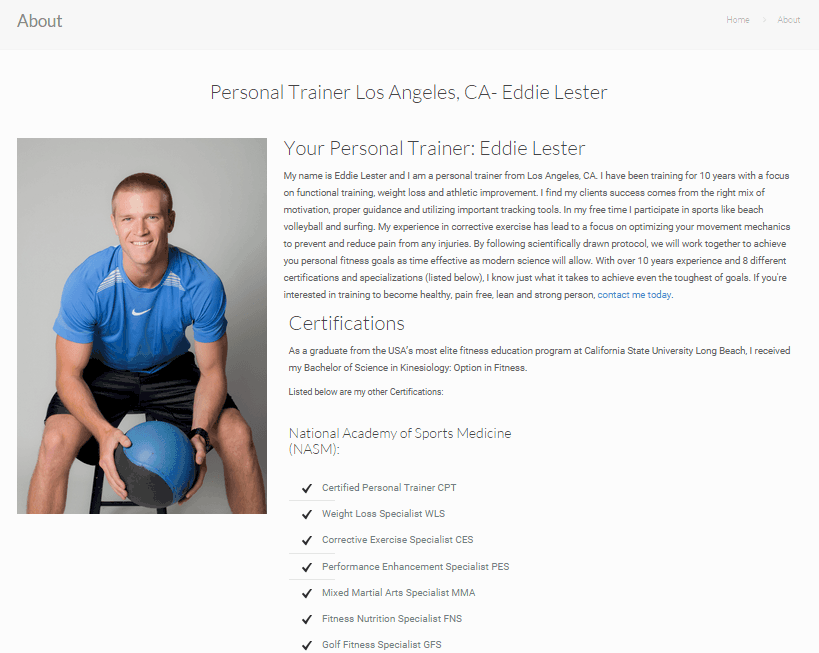
Fourth, Eddie makes good use of the services page and speaks about the services that are unique to his business. He also mentions his price points, something that most potential clients will want to know right off the bat.
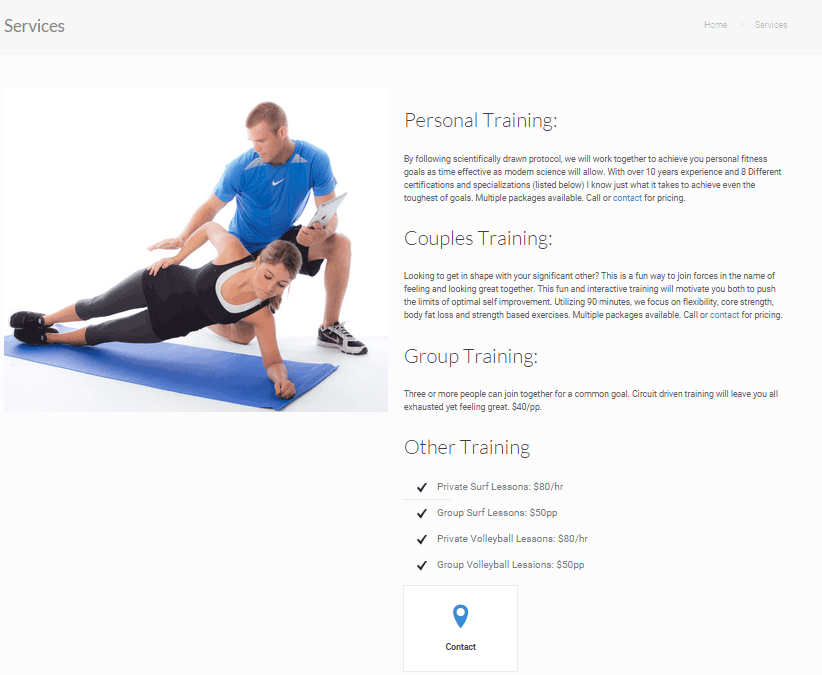
Finally, Eddie adds social proof with an up-to-date testimonial page. His contact information is also clearly displayed so that people can get in touch with him via phone, email or through social media.


One of the other, and perhaps most competitive, of personal training websites are the ones that cover specific topics. You know these sites well because the popular ones come up again and again when you do fitness-related searches.
These types of sites include, for example, Bodybuilding.com, MuscleandFitness.com, Shape.com and the more individualized versions of these sites like RomanFitnessSystems.com or JillianMicheals.com.
The difference between these websites and client-centric sites is that they create revenues in a different way than individual or group personal training sessions. In other words you can’t actually hire the trainers on these sites, they exist to sell you on something else.
What do these topic-specific sites sell? Let’s take a closer look at the examples of the sites to see if any of these relate to what you’d like to achieve:
While many of these sites feature personal trainers, the end goal of the sites is not to help the visitor’s book sessions with them. The personal trainers are mainly responsible for the content on the site or have a reputation that they use to sell products they put their names on.
If you are not yet a big name personal trainer but want to create a website that is monetized some other way, here are some website ideas that will get you on your way:
If you are going to create a website with the goal of selling products or ads, you can follow Bodybuilding.com’s model of putting the content on your shoulders and moving ahead from there.
The amount of visitors you get to any website is important but this is especially true for these topical sites. This is because the amount of ads you sell, or the amount of meal plans you sell, or the amount of books you sell, etc. will depend on your ability to drive big numbers of visitors to your site.
For comparison sake, the personal trainer who gets 1,000 people to visit their site will probably gain the interest of about 10%, or 100 of those people. Then, only about 10% of those 100, or 10 people might actually reach out to that personal trainer. If he or she is a good closer, they can expect to turn 10% of those 10, or 1, into a client.
But one new client a month for a personal trainer is probably something that could sustain a business that already had a decent number of clients (but not an entirely new business).
With a topic-specific personal training site you’ll need to have a lot more traffic to keep the money coming in which is why these types of sites are amongst the most challenging. As a rule of thumb, you’ll probably need to get your topic-specific personal training website into the 100,000 visitors per month range before you really start monetizing it.
For comparisons sake, Bodybuilding.com gets about 26 million hits per month and RomanFitnessSystems.com about 200,000 based on traffic estimates from https://www.websiteiq.com/.
In this case, you’ll probably also want to invest in search engine optimization marketing if you are looking to monetize your site.

These are the types of websites that are for multi-trainer personal training companies or for the personal trainer who has aspirations of growing their business beyond themselves.
Like the client-centric sites, these tend to market to clients in the local area but can grow to farther reaching chains not unlike a CrossFit or similar gym. These sites can also venture into group training or other trendy workout movements like yoga, Pilates or even sport-specific training.
Because the focus of these types of businesses tends to be narrow and deep, these websites should focus on the following approach:
You’ll Want Online Exposure Here Too
Yup, it’s that word again, SEO, the one you knew was coming. If you want more exposure than what you’re going to get from word-of-mouth you’ll want to take advantage of search engine optimization.
SEO will help you to rank for your specific services so that people who want them and don’t know about your brand will find you, call you and contribute to your continued success.
Personal Training Website Ideas Recap
Now you have learned a few things about personal trainer websites. You should be able to take this knowledge and decide the type of lead capture, marketing tools or call-to-actions you want to use.
You should also know the type of personal trainer website you want: local, topic-specific or brand-specific.
With these fundamentals you’ll be able to build a better website and a better career. Don’t forget, you can get a professionally-made website from a name you can trust – Fitness Mentors.
How to Become a Personal Trainer in 5 Simple Steps
Personal Trainer Salary
Top 5 Exercise Science Careers