How to Start a Personal Training Business: The Ultimate Guide for 2026

How to Start a Personal Training Business: The Ultimate Guide

Imagine waking up every day doing what you love on your own terms, with your own clients, building a business that’s entirely yours.

The opportunity is real: over 330,000 personal training jobs are projected in the US by 2026, and demand for health and wellness is only accelerating. There has never been a better time to turn your passion for fitness into a thriving career.

But here’s what no one tells you…

Passion alone won’t pay the bills.

Without a clear plan, smart pricing, and the right business foundation, even the most dedicated trainers find themselves stuck chasing clients, earning inconsistently, and never quite breaking through.

The good news? You don’t need a business degree or years of experience. You just need the right roadmap.

In this complete guide, you’ll discover:

  • The exact first steps to take before you launch
  • How to build a simple, powerful personal trainer business plan
  • The different business models available to you and how to choose the right one
  • Proven strategies to attract clients, grow your income, and become a successful personal trainer

Ready to go even deeper? The Business and Sales: The Guide to Success as a Personal Trainer masterclass walks you through how to structure your business, fill your schedule, and sell your services with confidence.

Let’s build a fitness business that actually works.

circles@2x 1
cross 1

Types of Personal Training Businesses
You Can Start

Today’s personal trainers come from a mixed bag of backgrounds. Some work at gyms, others with colleges or sports teams, many work at community centers, and some create their own personal training businesses.

The businesses that personal trainers can start usually fall into the below categories:

  • Train at a Private a Gym that Allows You to Pay Per Session
  • You Train at Clients’ Homes/Facilities
  • You Train Clients at Your Own Home
  • Start a Personal Training Business Online

Train at a Private a Gym that Allows You to Pay Per Session

In a recent post on personal trainer salaries, we discussed a payment structure where the trainer could bring in their own clients to gyms that they had relationships with. In these relationships, the personal trainer and their clients are independent from the gym’s payroll or clientbase, respectively.

The gym allows trainers and their clients to utilize their facilities and the trainer is able to charge whatever they can negotiate with their clients. The catch is that the trainer will pay the gym a fee each time the facilities are used.

In-home Personal Training: You Train at Clients’ Homes/Facilities

An increasingly popular personal training business is taking your in-person personal training services to the homes or facilities of your clients. Starting a personal training business from home allows you to create a dedicated training space such as a garage gym. If you are interested in this route, there are a few things that you’ll have to keep in mind as you start an in-home personal trainer business.

The main question and concern you’ll have as an in-home personal trainer is the type of equipment the client has or that you need to bring. If a client lives within a gated community, condo, or other association with a community gym, then you may have access to some decent machines and/or equipment.

If the training setting is, for example, your client’s living room, you’ll have to get more creative. This may limit the exercises you are able to perform and may impact the results without proper planning.

Regardless, a good trainer can adjust to the equipment on hand and will figure out a way to make the training as effective as possible.

In-home Personal Training: You Train at Your Own Home

In-home personal training in your own homes is similar to training at your clients’ homes with the exception that the training is performed at your home and your clients come to you.

Most trainers I know who train at their own homes have fairly elaborate garages that are built out to accomodate a number of different machines and equipment. This too is a popular form of personal training and can be an ideal business model for trainers who have the space within their homes or who don’t mind clients coming to their personal residences.

Start a Personal Training Business Online

How to start a personal training business online? Online personal training is by far the most exciting new personal training business model out there. Compared to the other personal training business models, this model varies in that the personal trainer does not have to meet in-person with a client to create a massive impact on their health. In fact, because of new technology, a trainer can work online from anywhere in the world and change the lives of tens, hundreds, thousands and even millions of people.

So, what is an online personal trainer?

An Online Personal Trainer is someone who enhances the health of others through internet-based technological mediums.

The variety of online personal trainer businesses is broad, but here is a overview of they types of online personal training businesses you can start:

  • Private Personalized Online Training
  • Non-Personalized PDF Fitness Programs
  • Non-Personalized Video Fitness Programs
  • Hybrid Online and In-Person Personal Trainer
  • Live Video Chat Workouts Online
  • Online Group Personal Trainer

Private Personalized Online Training

The private personal online model is most like traditional in-person training. The trainer performs all the tasks of a normal personal trainer but does not work with the client in-person. Through specific software, phone, email and text messaging, this trainer provides all the tools and programming needed to achieve a fitness goal, and the client follows along without the trainer being present.

Fitness Mentors

Non-Personalized PDF Fitness Programs

Premade, downloadable programs are made by the trainer and published online. These non-personalized models involve zero client interaction and are generally pushed over to the client through automated software.

Non-Personalized Video Fitness Programs

Video fitness programs have been around for a long time. However, the advantages for today’s  trainers are the ability to store their premade workout programs online and provide immediate access to a workout video library. Like the PDF programs, there is no client interaction.

Hybrid Online and In-Person Personal Trainer

The hybrid model utilizes the internet to deliver programs to local clients, but also involves in-person training 1-4 times per month. Using a “hybrid” model allows the client to

receive the hands-on training of a personal trainer at a lower cost, since most of

the program is performed on their own. This is a great starting point for trainers

looking to take their business online.

Live Video Chat Workouts Online

Video chats or calls allow the trainer to see, hear, and interact with a client live, but not actually in-person. This allows the trainer, and client, to benefit from immediate feedback on form, exercise demonstrations, and cueing.

Online Group Personal Trainer

The online group personal trainer performs live group fitness classes, records them, and delivers them to as many people as possible. Think of on-demand workout classes Online Boot Camp, Yoga, Pilates, Etc.- that require membership to access the content. Companies like Peloton have cornered this niche exceptionally well and proven people will subscribe to workout in the comfort of their homes

circles@2x 1
path-6-1.png
path 6@2x 1

How to Become a Successful
Personal Trainer

Now that you have gone through the foundational steps of getting certified, specializing, launching a brand, and choosing the type of personal training business you want to start, now you’ll need to move on to business development.

We do a deep dive on the below in our Business and Sales course, but here are some talking points you’ll want to include in your personal trainer business plan.

Legal Formation

Forming a personal training business typically begins with selecting a suitable business structure, such as a sole proprietorship or a corporation. One popular choice for personal trainers is forming a Limited Liability Company (LLC), which provides personal liability protection and offers tax advantages. Hiring a reputable registered agent can help you with the process of registering the business name with the state, filing the necessary articles of organization, and obtaining any required permits or licenses. When forming an LLC, it is important to consider the costs associated with filing and ongoing compliance, the need for a clear operating agreement to outline management and operational procedures, and the potential requirements for additional state-specific filings or fees. As administrative responsibilities increase, many service-based businesses explore outsourced administrative services to help manage billing, documentation, and operational processes more efficiently.

Setting Prices

Every successful personal trainer has to figure out how to price their services for maximum profit and value to the client. As your own boss, you are able to charge whatever you like. Here are some things you should consider:

  • Location- Where are you training? A trainer in Malibu will justify charging more than a trainer in Compton.
  • Economy- Personal training is a luxury item for most. When the economy turns, so does interest in luxury items. Be understanding of this when setting prices.
  • Target Population- Set a price that is attainable for your target population by understanding what they might pay for your products/services.
  • Cost to Train Client- Consider things like the travel expenses, the payments you have to make to use a private gym, tools and equipment such as machines and dumbbells, and other expenses like software. You should understand the difference between gross and net income.

Read more: How to Set a Pricing Structure for Your Personal Training Business 

25024

Addressing Buyer Hesitation

If every trainer pitched a potential client and got “Yes, I’m in” as an answer we’d all be rich. Thing is, people are not always convinced of your value and have what we call buyer hesitation.

Here are some areas that are common for buyer hesitation and how you can address them.

  • Fear of failure- The thought of accomplishment can outweigh the fear of failure; attach a positive emotion toward your service and give them a little more inclination to buy.
  • Perceived value is less than the cost- Your presentation for services must convince the buyer that the the money is worth the expense.
  • Money- Quite simply, if you have approached a potential client and they truly do not have the means to purchase, then the sale will be impossible. It is important to find that out as soon as possible rather than spend a lot of time/effort only to find you are out of their league.
  • Lack of proof- If a client does not believe what you are selling will work, they will be hesitant to buy. Combat this with examples of clients like them that have experienced the results you are selling.

Read More:

Marketing

Personal training marketing… There can be entire books written on the topic and while related to starting a personal training business, it goes so far beyond those beginning stages.

One of our most popular articles is all about personal trainer marketing and has 19 personal training ideas catered at getting you more clients. Some of these ideas include:

  • Getting featured on industry blogs
  • How to use email marketing
  • How to create effective referral documents
  • How to do personal trainer search engine marketing
  • And more…

If you are planning on getting some help with your marketing and hiring a firm or doing some advertising, note that the Money Task Force recommends spending 12 to 20 percent of your gross revenue for marketing if you are a new company, and 6-12 percent if you are an established company.

Start Your Personal Training
Business Today

This ultimate guide has nearly everything you need to begin the process of starting your very own personal training business. If you need extra guidance, or like the idea of a reputable personal training certification, check out the Fitness Mentors CPT. If you already are a trainer but want to further specialize and hone your knowledge, check out our CEU courses and blog. If you want a full course on the above with more details and step-by-step instruction, check out our Business and Sales course.

If you have any comments or questions, please post them below.
circles@2x 1
cross 1

Top 5 Exercise Science Careers and The Best Education Paths

Exercise Science Careers
Fitness Mentors NASM
Watch Our Video: Best Exercise Science Careers – Are you considering an Exercise Science degree?

Are you considering an Exercise Science degree or asking yourself “what can you do with an exercise science degree?” to help plan for your future?

Whatever your stage in life — consideration, current Exercise Science student, recent grad, or what can you do with a health and exercise science degree?– this post is for you. 

Be sure to take our quiz too!

As a previous Exercise Science graduate, I can give you a little taste of the college route (as well as other education paths) and provide insight into the options for Exercise Science careers.

But first, let’s define what Exercise Science is.

What is Exercise Science?

Exercise Science describes the study of the body under the stress of exercise including acute and chronic adaptations like the effects on overall health parameters, pathologies, and its potential to reduce, or reverse, disease progression.

Some other areas of study within Exercise Science vertical that you might see at various educational institutes are:

  • Kinesiology
  • Fitness & Health
  • Exercise Physiology
  • Biomechanics
  • Exercise Nutrition

This foundation prepares students for applied exercise science jobs that integrate science with practical fitness and health applications.

You can also expect a strong educational emphasis in the areas of anatomy, physiology, chemistry, biology, and oftentimes, physics.

What can You Do with an Exercise Science Degree?

If there is one thing I want to emphasize about studying Exercise Science is that the majority of careers in the field require additional graduate school coursework. Yes, that is worth repeating.

Exercise Science is a common prerequisite for graduate level programs in careers such as:

  • Doctor (MD)
  • Exercise Physiologist
  • Registered Dietician
  • Occupational Therapist
  • Physical Therapist
  • Physician Assistant

The important takeaway here is that for most, the bachelor’s degree in and of itself does not get them to the career that they want. Additionally, and as I will get into more below, the career you want might not require a four year college degree in Exercise Science. 

However, if you are interested in some of the above careers that require education beyond a B.S. degree, by all means continue on the path that makes the most sense for you.

I emphasize this point because I have met many people who studied Exercise Science in college only to find that they either did not realize they needed additional education to get the career they wanted, or realized there were quicker, more affordable ways to get into the career they wanted.

That said, listed below are some careers that you can get without additional education after your Bachelor’s in Exercise Science degree, including:

  • Athletic Director
  • Community Program Director
  • Massage Therapist
  • Recreation and Sports Director
  • Sports Coach
  • Sports Facility Manager
  • Strength and Conditioning Coach

Provided below are the most popular career paths in Exercise Science, which may or may not include a college education, are below.

Top 5 Exercise Science Careers That Pay Well

Personal Trainer

By far, the most common career path chosen by people looking to have an Exercise Science career, as well as who are currently studying Exercise Science, is personal training.

The benefits of a career in personal training are numerous and can even be aligned with that of any of the other careers on this list.

For starters, you don’t need to get a bachelor’s degree to become a personal trainer. In fact, there are five separate ways you can become a personal trainer, ranging from certification from accredited companies, to vocational college, to university programs, to online options, and internal gym programs.

If your heart is set on becoming a personal trainer it certainly would be helpful for you to understand your options for certification beforehand.

Now, I am certainly not knocking university or college-based personal training certification options I got my B.S. at a university and was a college instructor afterward but I do understand that it may not be an option for everyone.

But what if you want a career that requires a college degree? Would it still be beneficial to consider a personal training certification?

Let’s say you choose any of the aforementioned education routes for your career in Exercise Science: college degree or not.

Either way, you can benefit from a personal training certification no matter what route you take. If you are wanting to have a career as a personal trainer, you can get certified in as little as two to five months and start making money right away.

If you are in college and are studying Exercise Science, it is still a good idea to get a personal training certification because you can begin gaining experience within your career immediately and can even pay for your education, through your personal training income.

For example, while I was in college I used my personal training certification to my advantage. I was able to train clients around my school schedule given the flexibility of the career. This provided me industry experience, but also allowed me to pay my way through college.

I also became certified as an Online Personal Trainer and trained clients through the internet, which gave me even more freedom to complete my studies and enjoy the college experience. 

Top 5 Reasons Personal Training is a Popular Exercise Science Career

So, no matter what your long-term goals are, getting a personal training certification can help in the following ways:

  1. Puts money in your pocket
  2. Allows you to gain experience in the Exercise Science field
  3. Helps pay for college (if you are shooting for a B.S., or advanced degree)
  4. Provides a strong foundation to further your exercise science studies

Top 3 Personal Training Certifications

Below are the best certification options to choose from:

  1. NASM
  2. Fitness Mentors
  3. ACE

It is a well known fact that private personal trainers have the potential to make far more than gym trainers.

Why? Because private personal trainers can set their own rates.

There is a catch for private personal trainers, however, and that is that they have to drum up enough business to write their own paycheck. But before we get into a sample private personal trainer salary let’s define exactly what a private personal trainer is.

A private personal trainer is a trainer that is self-employed, creates their own work schedule, and is free to choose the clients that they work with. For many personal trainers, this is the end goal of their personal training careers and is what sees some trainers working with celebrities and making big bucks.

Unlike gym trainers, private personal trainers don’t get help from the gym or get funneled clients from fitness organizations. They utilize their own networking, sales, and marketing skill sets to drive leads and ultimately generate new clients.

For that reason, many private personal trainers struggle to make a decent income. You can’t simply get a personal trainer certification and expect leads to come your way. (Check out this course to learn how to build your business and get clients). This is also why so many trainers start out in the gym, get experience, make relationships, begin taking on private clients on the side, and eventually leave the corporate gym environment behind.

How Much Do Private Personal Trainers Make?

A respectable private personal trainer can make upwards of $70,000 per year.

Compare this to the full time salary of a respectable personal trainer at 24-Hour Fitness which would likely fall in the low $40,000 range. And by respectable I mean one with a couple thousand hours of sessions under their belt and training 20-30 sessions per week. This low $40,000 range is also commensurate with what NASM says their average trainer makes.

For example, a 24-Hour Fitness trainer in their middle tier (PT3) makes $13 an hour when training. If you compare a potential salary of an entry-level trainer at 24-Hour Fitness, $22,440/year, to that of a Master Trainer at 24-Hour Fitness, $58,464, and split it down the middle (which is more or less where a PT3 would be), you’d get $40,452.

Now, let’s compare the above salary of a gym trainer to that of a private personal trainer.

The average private personal trainer in the U.S. charges around $50 session. Let’s say this trainer works a total of 30 hours per week and making $1,500 in that time. Multiple this time the weeks in a year, 52, and you have a respectable private trainer who is making $78,000 a year.

Potential Salary of Private Personal Trainer

  • Charges $50/session
  • Works 30 hours per week (sessions)
  • Makes $1,500/week
  • Makes $78,000/year

That same trainer can charge $100 a session, work 15 hours a week, and make the same salary.

Gym trainers typically have to work a lot more hours than private personal trainers for a fraction of the salary which is why private training is often the more desirable route. But as we’ll learn, private personal training is not the only way to make money as a trainer outside the gym.

Interested in getting a CPT with an emphasis on entrepreneurship and business development? Check out the FM-CPT for more info.

Physical Therapist

According to the Bureau of Labor Statistics (BLS), a career in Physical Therapy has some very promising advantages.

Among the highest paying jobs with an exercise science degree, physical therapists earn a handsome amount annually. For starters, the median pay approaches $90,000 per year, is expected to grow 28% by 2016 (which is much faster than average), and consistently ranks as one of the best jobs in healthcare for work-life balance.

Physical therapy jobs tend to require a DPT degree, although some may accept a master’s degree. CostHelper.com says that doctoral physical therapy degrees can cost $35,000 (such as the doctorate in physical therapy at the University of Illinois at Chicago), or much more for out-of-state students, such as The University of Delaware’s doctoral program which costs over $75,000. That is on top of the money you spend for your bachelors degree.

Athletic Trainer

Athletic trainers also rank high on this list as the profession is similar in scope to that of personal trainers, yet requires a formal bachelor’s degree in a specialized program and the passing of a state licensure exam. Athletic trainers have a median income of $46,630 per year according to the BLS, and have a rapid rate of employment at 23% when looking out to 2016. This career highlights the connection between exercise science careers and salaries, showing how education directly impacts earning potential.

One of the coolest things I find about athletic trainer careers is that they often work alongside athletes within educational settings such as colleges of universities.This often means these professionals are the ones who work hand-in-hand with some of the best up-and-coming athletic talent in the country.

They can also work with younger students, within hospitals, or even for professional sports teams.

Related: How to Become an Online Personal Trainer in 2026

Exercise Physiologist

With a median pay of just under $50,000 per year, and a faster than average job outlook, a career in exercise physiology is a popular choice for many looking to put their Exercise Science degree to work. Many roles require advanced education, making it one of the most promising masters in exercise science jobs.

This type of career typically requires a Masters in Exercise Physiology, which on average takes 6 years of total college time as well as requires board certification through the American Society of Exercise Physiologists.

Another interesting aspect of this career is that about half of all exercise physiologists are self-employed. So if you have an entrepreneurial spirit and enjoy the freedom of owning your own business, you may be able to do well in this career.

PE Teacher

According to ZipRecruiter, PE teachers make about $42,500 per year. While this is the lowest salary on this list, you have to remember that these teachers tend to have summers off and benefit from all school holidays as well as teacher pensions.

Typical education requirements for this career include a bachelor’s degree in exercise science as well as a teaching credential or a masters in education. Often times a personal training certification will enhance the likelihood of employment as well.

We also can’t forget that PE teachers get to hang out in gym clothes all day, coach fun sports like kickball and dodgeball, and even be physical fitness role models for many of their students.

Granted there is some give and take for each of the professions on this list in terms of knocking off all the boxes of the most ideal career, but the daily life of the PE coach can be very rewarding.

Boot Camp Instructor

Boot camp instructors are personal trainers who lead group fitness classes that are usually based on military-style training methods. However, in some cases, instructors may unintentionally display behaviors related to relational aggression, such as belittling or excluding participants to create a sense of competition or control. These actions can negatively impact group dynamics and participants’ overall fitness experience.

Exercise Science Degrees and Educational Considerations

As we have learned above, not all careers within Exercise Science require a full-fledged bachelor’s degree. Similarly, we’ve learned that many sought after degrees within Exercise Science require advanced degrees such as master’s or doctoral degrees.

With that in mind below is a comprehensive list of the many careers and their educational obligations. Note that some of these careers may overlap in multiple categories.

Exercise Science Careers that don’t require Degrees

  • Personal Training
  • Aerobics Instructor
  • Fitness Coach
  • Gym Manager
  • Massage Therapist
  • Physical Therapy Assistant

Exercise Science Careers that require Bachelor’s Degrees

  • Athletic Director
  • Community Program Director
  • Kinesiologist
  • Massage Therapist
  • Athletic Trainer (ATC)
  • Physical Education Teacher
  • Recreation and Sports Director
  • Registered Nurse
  • Sports Coach
  • Sports Facility Manager
  • Strength and Conditioning Coach

Exercise Science Careers that require Master’s or Doctoral Degrees

  • Doctor (MD)
  • Exercise Physiologist
  • Chiropractor (DC)
  • Registered Dietician
  • Occupational Therapist
  • Physical Therapist (DPT)
  • Physician Assistant
  • Exercise Physiologist
  • Physical Rehabilitation

FAQs for Exercise Science Careers and The Best Education Paths

The most common way to make money with an Exercise Science career path is personal training. While personal training doesn’t require a degree, those who get certified are able to put money into their pockets quickly and build a strong foundation for further career advancement.

Exercise Science generally offers courses in Anatomy, Physiology, Kinesiology, and Nutrition. Jobs can range from personal trainers and strength and conditioning coaches to physical therapists and physician assistants – so Exercise Science can be lucrative.

Not quite. Kinesiology is a more broad study that focuses on human movement and its effects on an individual’s health. Exercise Science is a sub-field more fine-tuned into learning and influencing human responses to exercise.

Bachelor’s degrees will open you up to mid-level jobs in the fitness industry. Examples of these degrees include Bachelor’s in Sports Management, Health Sciences, Nutrition Science, or Health and Wellness. Graduate degrees, like master’s and doctorate, qualify for higher-level positions. These programs might include a master’s in Exercise Science and Wellness or Human Performance, an MBA in Health Care Management, a Ph.D. in Education for Sports Management, or a medical degree in Sports & Athletic Management. While personal training only requires a certification, you can also get an associate’s degree in Exercise Science, giving you a solid foundation to start personal training.


Closing Thoughts on Exercise Science Careers

You should now have a better idea of what you can do in the exciting field that is Exercise Science. For many, a bachelor’s degree at a college or university is the path that they will take to become educated in the many areas of movement and exercise. For others, the bachelor’s is just a stepping stone for a more advanced degree as in the case of physical therapy, physician’s assistant, or doctoral paths. Others may be surprised to learn there are many rewarding careers in Exercise Science that do not require a college degree, and the most popular career in this field, a certified personal trainer, demonstrates that.

When considering your education and career path, keep in mind the following:

  • The education required
  • The financial commitment
  • The time investment
  • The typical salary
  • Your passion for the career

With these considerations in mind, you should be able to paint a great picture of where you want your career to take you.

What is your experience with jobs and education in the Exercise Science niche? Is there any tip you wish you knew before you started your studies or career? Let us know in the comments.

How to Get Your Group Fitness Certification

How to Get Your Group Fitness Certification

If you are considering getting your group fitness certification here are a few statistics that backup your decision:

  • Over 22 million attend group fitness classes each year[*]
  • 85% of group fitness members visit their facility twice a week[*]
  • Two out of five gym-goers are involved in group exercise[*]

Although you probably don’t need any more convincing about getting a group fitness certification that will allow you to find gainful employment in an exciting industry, you probably are looking for some information on how to get your group fitness certification.

Below, we have provided info on the exact steps as well as some information on the top group fitness certifications out there. There’s even a little bonus about section group fitness certifications versus personal trainer certifications that I think you’ll find quite interesting (hint: you can become a certified personal trainer and train in a group setting (but not vice versa)).

circles@2x 1
cross 1

How to Become a Group Fitness

Instructor in 5 Steps

Here are the steps to become a group fitness instructor. There may be some variation on these steps depending on the certification body you go with, but for the most part, these steps are fairly standard no matter which group fitness certification body you go with.

1

Get Your Group Fitness Instructor Prerequisites

Before you can sit for a group fitness instructor exam, most certification bodies require the following:

  • Be 18 years old or older
  • Have a high school diploma or equivalent
  • Have a current CPR/AED certification
  • Possess a government-issued photo ID

By far, the most popular place to get a CPR/AED certification is through the American Red Cross. It is not the only option, but tends to be the most convenient. You can find a Red Cross CPR/AED class near you on their website.

Worth noting, is that you need not have all of the above prerequisites in place when you begin your group fitness studies, only when you sit for the exam. For example, you can start studying and obtain a CPR/AED certification along the way.

This brings us to our next step, finding a group fitness certification program that is right for you.

2

Choose a Group Fitness Instructor Certification

One of the most important steps in becoming a group fitness instructor is choosing the best certification for you. Now, there really is no such thing as the “best group fitness certification,” as this is a highly subjective decision.

There are a number of factors that may make a group fitness certification more appealing to you such as cost, length of program, CEU requirements, prestige of brand, job requirements, and convenience.

One area of group fitness certifications that is not subjective is the accreditation body. The gold standard in a group fitness certification is a program accredited by the National Commission for Certifying Agencies (NCCA). The Distance Education Accrediting Commission (DEAC) accreditation is also gaining some clout, and is held by ISSA.

ACE Certified Group Fitness Instructor

ACE

ACE offers NCCA accredited group fitness courses ranging from $299 to $599 (at the time of this writing). The final exam takes place at an administered location and the coursework can consist of videos, podcasts and webinars, depending on the program you register for. ACE is one of the largest name’s in fitness and boasts that their trainers benefit from agreements they have made with popular gyms such as 24 Hour Fitness, Anytime Fitness, Orange Theory, Crunch Fitness, and others.

ACSM Certified Group Exercise Instructor

ACSM

The ACSM Certified Group Exercise Instructor (ACSM-GEI) course is prided on its educational approach to intentional planning around science-based group sessions as well as motivational and leadership techniques that make training fun and effective. While ACSM claims it is the “gold standard” in group fitness certification, it is not currently an accredited certification option.

AFAA Certified Group Fitness Instructor

AFAA

AFAA has perhaps the most outstanding reputation in the group fitness certification arena. Not only is the cert NCCA certified and been in existence for nearly four decades, but is also a partner of NASM (NASM acquired AFAA in late 2017 which is why you won’t see a standalone NASM group fitness course).

AFAA courses range from $299 for self-study, to $399 for premium self-study, to $499 for an all-inclusive package with a job guarantee. On the NASM website, however, the certification is mentioned as an add-on continuing education course and has a reduced price of $224, $299, and $374 for the options mentioned above, respectively (at the time of this writing).

ISSA Specialist in Group Fitness Certification

ISSA

The ISSA Specialist in Group Fitness certification is an online course that offers a self-paced study regime. As mentioned before, this is the only certification body that is accredited by the DEAC, which is a less prestigious name in the accreditation space, but nonetheless a national accreditation. At $799, it is by far the most expensive group fitness certification on this list.

NCCPT Group Exercise Instructor Certification

NCCPT

The NCCPT Group Exercise Instructor (CGxI) credential is a self-proclaimed “entry level specialization certification” that is likely intended to be an add-on CEU for existing certified personal trainers rather than a standalone certification like many others on this list. It is also amongst the cheapest at $199 for the exam-only package, but ranges up to $299 for additional study and preparation materials.

NESTA Certified Group Exercise Instructor

NESTA

NESTA’s Group Exercise Instructor Course is 100% online and is one of the most affordable options for group fitness certification at $275. While highly convenient and amongst the least expensive group fitness certifications, The NESTA GEI is unaccredited, so many gyms may be a bit more discerning while hiring for this certification.

NETA Group Exercise Certification

NETA

NETA’s Group Fitness certification is amongst the three in the country that have earned NCCA accreditation. While the program doesn’t benefit from the brand power of ACE and AFAA (the other two accredited options), it does have a strong curriculum and multiple study options ranging from $239 to $299. The live workshop study option is popular as it allows students to attend a workshop with an experienced NETA educator.

Once you familiarize yourself with these brands and choose one that works for you, you can move on to the next step.

3

Schedule Your Exam and

Continue/Begin Studying

With most group fitness certifications you can purchase your study materials (and begin studying) before you schedule the exam. Many programs, however, require that you register for the exam within a specific time period after the purchase of the study materials.

ACE, for example, requires you to register for your exam within six months of the materials purchase date. With AFAA, you have 180 days from your enrollment date to take the certification exam.

These certification bodies require these timelines for a variety of reasons. First, they want to set that psychological goal in your head to start and finish the program in its entirety. Secondly, they make money on the study materials and the exam, so it makes sense that if you were to buy study materials, you would take the exam.

Group Fitness Exam Study Tips

While the exams of each certification body vary in difficulty and materials covered, there are some standard study tips that can help you get through all the studying in time for the final certification exam.

As a former college professor, I recommend the following approach to studying for the group fitness exam:

  • Use the target test as a marker and work backwards from that date to determine how many chapters you need to cover each week/month.

And here’s a study fast track system that works really well for those who like to knock things out fast:

  • Read one to two hours per day to maintain a solid flow of comprehension
  • Create chapter-by-chapter notes from the book to utilize the benefits of writing and reading
  • Reference study guides for hand-picked topics of reference
  • Take practice tests after you read each chapter
  • Quiz yourself on 5-10 chapters of your book every two to three weeks
  • Reread your chapter notes and build upon them based on your quiz and test results
  • Document the questions you miss in the quizzes and revisit those sections of the book
  • Take a quiz every day of the week leading up to the exam
  • Take an entire practice exam, write down the questions you missed, and revisit them again
  • Take the final certification exam when you consistently get 85% or above on practice exams

Once you are prepared for the exam, it is time to knock it out!

4

Pass Your Group Fitness Exam

The most obvious step in getting your group fitness certification is passing your exam.

But this necessary step only happens if you put in the time to learn the materials, understand the concepts behind them, and get the certification in your hand.

After you do this, you’ll be ready to start a career as a group fitness trainer!

5

Get a Job as a Group Fitness Trainer

Do you already know where you want to work? Are you going to start your own fitness club or perhaps get a job as a contractor at several?

Related: Check out this post on personal trainer salaries to see which gyms pay the most.

Once you have your certification in hand, you can begin to peruse the web for group fitness trainer openings, check in at your local gym, or visit the websites of gyms to see if they post active positions.

Gyms aren’t the only places that hire group fitness instructors though, so don’t limit your job search to these locations. Spin, yoga, and pilates studios are some of the other well-known locations to get a group fitness job. The rare country club gig or super rare cruise line job may also open up from time-to-time.

In many cases you may have to get an additional certification (ex. Spin instructor) or go through an internal training program at your place of employment.

There are also specialist programs that you may be interested in to truly hone your craft. For example, AFAA has an indoor cycling speciality course, and ACE has a Functional Aging Group Exercise specialty course. The specialization you choose largely has to do with the demographic you enjoy working with.

CEUS: Maintaining Your Group Fitness Certification

In an effort to help trainers maintain their education and the health and safety of their clients, continuing education units (CEUs) are required by every reputable certification body. The amount you need depends on the certification body, but these CEUs are not just a tool to help you maintain your certification, they are also opportunities to expand your knowledge of health and fitness.

circles@2x 1
path-6-1.png
path 6@2x 1

Bonus: Group Fitness Certification VS Personal Trainer Certification

A lot of aspiring group fitness trainers will also consider a personal trainer certification and weigh the options between each. There are some important considerations that aspiring trainers from each career option should take into account.

The first, and perhaps most important consideration, is that you are able to train group fitness classes with a personal trainer certification but are generally ineligible to train individuals at most corporate settings with a group fitness certification.

This may sway some trainers towards choosing the certified personal trainer route and considering a group fitness specialization or CEU as they can train groups and individuals.

The other important consideration for aspiring trainers is the potential income from each type of training — personal training or group training. This has a lot to do with your involvement as a trainer with your clientele.

If you are a group fitness instructor, you generally have to showcase the exercises as you teach (i.e. workout with your group), making man’s/woman’s physical limitations a factor in terms of financial gain from multiple group fitness sessions per day.

On the other hand, a personal trainer can provide guidance to multiple clients each day without having to physically exert themselves. For the entrepreneurial trainer, this may make the decision to get a CPT a more decisive one.

Granted, group trainers usually make more than personal trainers on a per session basis, but personal trainers can easily conduct five or more sessions per day whereas a group fitness trainer may be limited to two due to the physical demands of teaching.

Become a Group Fitness Trainer Today

Now you have a good idea of what the steps are to become a group fitness instructor, recognize some of the top certification bodies, and even know that you can become a certified personal trainer and train in a group setting (but not vice versa).

If you are ready to advance your group fitness career, start by knocking out your prerequisites. From there, find a group fitness certification that works for you, study hard, pass your exam, and find your dream job.

circles@2x 1
cross 1

Personal Trainer Courses: 5 Ways to Become a Trainer

Personal Trainer Courses

Personal Trainer Courses: 5 Ways to Become a Trainer

You Might Be About to Waste Money on the Wrong Personal Trainer Certification – Here’s How to Avoid It

Let me be straight with you. There’s a mistake many new personal trainers make every year. And the sad part? Most of them only realize it after they have already spent their money and time.

Think about this for a moment. You see an ad online:

“Become a certified personal trainer today for only $69!”

Sounds like a great deal, right? Fast, cheap, and easy.

But here’s the truth most people don’t tell you: some of these “certifications” are almost useless when you try to get a real job.

Not long ago, I was reading a post in a personal trainer forum. A newly certified trainer was super excited. He had just finished an online course and was ready to start his career.

But he had one simple question.

Would gyms actually accept his certification?

He said he finished the course in just a short time and paid $69.99 for it. In his own words, it felt a little too easy.

Right away, I knew what was happening.

His certificate most likely came from what is called an unaccredited personal trainer certification. In simple words, this means big gyms and serious fitness companies do not recognize it.

So when he walks into a gym to apply for a job, there’s a high chance they will simply say no.

Money gone. Time wasted. Confidence crushed.

And sadly, this story happens again and again.

Right now, thousands of people are trying to figure out which personal training course is actually worth their time and money. Some programs can open real career doors. Others just take your money and give you a piece of paper that means very little.

That’s why I decided to break everything down in a clear and simple way. No confusing words. No sales talk. Just the truth so you can make the right choice before you commit.

Below, you’ll see five different ways people become certified personal trainers.

Three of them are accredited paths that gyms respect and trust. These can help you build a real career.

Two of them are unaccredited paths that may look easy and cheap, but can cause problems later.

By the end, you’ll clearly know which path is smart and which one to avoid.

Here’s what we’ll cover.

Accredited Options

  • Certification through an accredited U.S. organization

  • Vocational college programs

  • University degrees (Bachelor’s or Master’s level)

Unaccredited Options

  • Online courses with no accreditation

  • Internal gym training programs

Let’s break them down one by one so you don’t make the same costly mistake many new trainers make. 💪

circles@2x 1
cross 1

Personal Trainer Courses: The 5 Options

to Consider for Your Career

1. Certification via Accredited US Company

Most major personal training certifications go through a vetting process to ensure that an unbiased, third-party organization can assure the public a safe standard. For personal training in particular, the National Commission for Certifying Agencies (NCCA) is the certification agency that reviews some of the most prestigious personal training courses.

Aspiring personal trainer organizations must go through a validation process analyzed by experts to ensure they meet a high standard of professionalism, health, welfare, and safety.

Some of the most popular NCCA-certified personal trainer bodies include:

  •         NASM
  •         ACE
  •         NSCA
  •         ACSM
  •         NESTA
  •         NCCPT
  •         NCSF

At the time of this writing, the AFAA is undergoing the credentialing process and will soon be added to this list.

The ISSA is worth mention as well. While not NCCA-certified, ISSA is accredited through the Distance Education Accrediting Commission (DEAC) and National Board of Fitness Examiners (NBFE), but as we note in our Best Personal Trainer Certification post, these are not as highly regarded as the NCCA.

Getting a Personal Trainer Certification through an Accredited US Company

To get a personal training certification through, for example, NASM or ACE, you have to be 18 or older, have a high school diploma or GED, and be CPR certified. From there, you can visit the website of the organizations to complete the certification process.

You’ll need to get some personal trainer study materials, prepare for the exam, and pass, to get the official license.

For a side-by-side, objective, comparison of the major certification bodies and how to go about choosing which one is right for you, check out the aforementioned blog on personal trainer certifications.

Who Accredited US Company Certifications are best for

If your goal as a trainer is to work in nearly any gym, get strong fundamentals on exercise and exercise science, and even move on to a more entrepreneurial career in personal training, this may be a route for you.

Vocational college and universities also offer accredited personal trainer courses, however, these require different financial commitments as well as time commitments. Opting to complete a personal trainer course through self-study is who this route is best for. If you don’t do well studying on your own and need constant feedback or value a school setting, the next two options may be better for you.

2. Certification via Vocational College

Vocational colleges (also known as vocational schools or trade schools) are brief, career-specific programs that help to quickly prepare you for a career in personal training. These schools partner with accredited certification bodies (ex. NASM) to develop academic programs that are specific to one type of personal trainer certification.

For example, I was a professor at California Healing Arts College (CHAC) for the Personal Fitness Trainervocational program. The objective of this program was to help graduates get into a successful personal training career with NASM certifications. This class offered two programs: one 30 weeks long, 900 clock hours, and 32 credits, and the other 42 weeks long, 900 clock hours, and 32 credits.

These timeframes are fairly standard with vocational schools, as are the opportunity to work in a professional environment while in school (externship).

The courses are in-person as opposed to online, and you can expect an experienced personal trainer as your professor. What is great about vocational colleges is that the entire course is geared towards helping you become a successful personal trainer. Contrast this to going through an accredited certification body or university, where your coursework will be geared strictly towards a certification or will include education outside of personal training, respectively.

The cost of these types of programs generally range from about $15,000 to $20,000 for a 300- to 900-hour course.

Getting a Personal Trainer Certification through a Vocational College

Perhaps the best way to find a vocational college that offers personal trainer courses is through a simple Google search. Then, find the section on Admission Requirements and follow the steps or reach out the college directly for insight.

Who Vocational College Certification is Best for

Compared to the cost of going directly through an accredited US company (generally less than $1,000), vocational colleges can be much more expensive. However, because the entire program is dedicated to helping you perform in all aspects of training, vocational programs tend to create the best trainers.

“because the entire program is dedicated to helping you perform in all aspects of training, vocational programs tend to create the best trainers.”

These programs are best for students who enjoy a school-like setting, the ability to interact with professors and their peers, benefit from hands-on experience, and who might be intimidated by self-study programs. These programs tend to be a lot shorter and less expensive than the final accredited option: going through a university.

3. Certification via University Programs with Bachelors or Masters

The most expensive and time-consuming route for a personal trainer course is by far going through a University. If you opt for this approach, expect 4+ to get a bachelor’s degree and 6+ years if you want a master’s degree.

As mentioned before, your coursework will not be entirely focused on personal training. For the bachelor’s, the first two years will have semi-focused coursework, then the final two years will have a few personal trainer classes sprinkled in. The degree is not in “personal trainer” per se, but rather something like kinesiology.

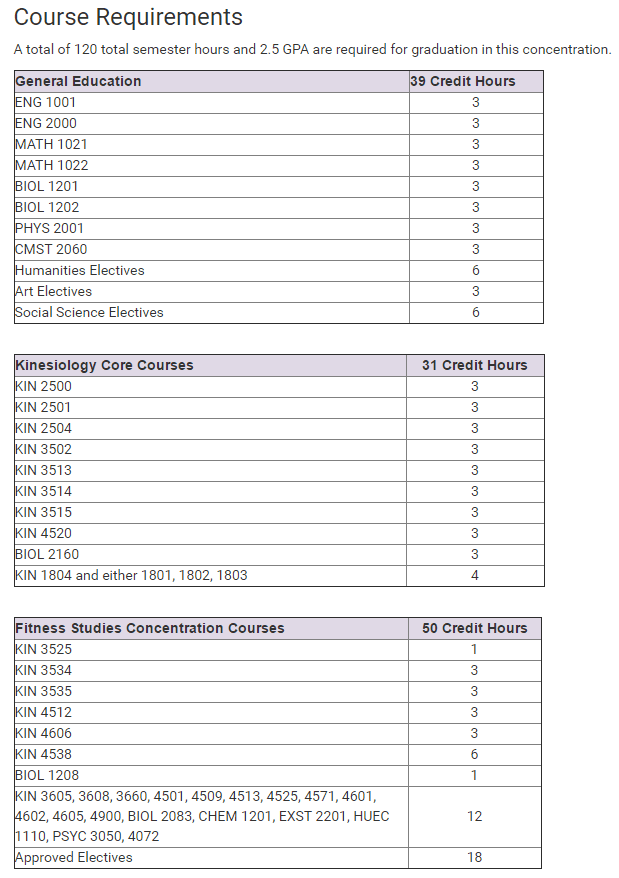
For example, Louisiana State University (LSU) offers a BS in Kinesiology, with several different areas of concentration including:

  •         Fitness Studies
  •         Human Movement Science
  •         K-12 Health & PE
  •         Physical Activity and Health

For the Fitness Studies concentration, the focus is to prepare students for careers in “personal training, strength and conditioning, corporate wellness as well as hospital, government and community-based fitness settings.”

Check out the course requirements on this program to see how it mixes general studies (ex. English, math, science, biology) with kinesiology courses and fitness studies concentration courses:

BS in Kinesiology

SourceLSU

sIf you were to continue your studies into the graduate level, your master’s wouldn’t be in personal trainer either. It would be a Masters in Kinesiology, or some other specific science (physical therapy, athletic training, exercise physiology).

Getting a Personal Trainer Certification through a University Program

Should you decide that going through a University is the right career path for you, you’ll have to check out the initial admissions requirements of the university you want to attend and apply to get in. Once in, you’ll have to satisfy the coursework for that particular concentration of study. Go to the website’s of the universities with personal trainer-like programs, and get in contact with the school to ensure it matches up with your career goals and to get guidance.

Going through the university route is a bit more daunting than the other accredited options on this list, however, a quick call to the admissions office will help you determine if a program is right for you and how to go about getting in.

Who University Programs are Best for

If you are in a rush to get into the personal training industry and want to get to work fast, it should be obvious that four to six years of school is not going to get you there. This is not to say you can’t xenical orlistat price work on your personal trainer certification with an accredited US company while in college, but if you want to focus on your education this method clearly takes the longest.

University programs tend to be best for people who want to experience college, round out their knowledge in other areas, like the idea of having an actual degree to fall back on, or who want to pursue higher education like a master’s degree.

However, a master’s in Kinesiology or other health and fitness science won’t really get you anywhere as a personal trainer in my experience; this is best suited for those who want to be more involved in research-style work or athletic management-style work. If you just want to be a personal trainer, a master’s degree is likely and overextension of your time and money and is unlikely to attract more clients than a trainer with a bachelor’s, a vocational degree, or a certification from an US accredited program.s

4. Certification via Unaccredited

Online Options

computer desk electronics 374074

Compared to the previous three options, the title of this approach, “unaccredited online options,” may seem like a terrible choice. However, like many things, it has its place for certain people. I am not one of those people, but perhaps you are!

We learned above about personal trainer credentialing agencies like the NCCA, an organization that stands to uphold standards of professionalism, health, welfare, and safety. These standards are important to gyms and other types of employers, and should be important to you if you want a job at an established fitness institution.

A personal trainer may not be held in the same regard as an attorney with a law degree and who has passed the bar exam, or an accountant who has a CPA recognition, but the credibility behind these certificates is meaningful. With an unaccredited personal trainer certification, you’d kind of be like a person who takes a nutrition class and claims they are a nutritionist.

“if you were trying to get private clients who didn’t care if you had credentials, this certification would be fine.”

On the other hand, if you were trying to get private clients who didn’t care if you had credentials, this certification would be fine. But, like our friend from the forum who speculated that his online certification was a bit too easy, you’d probably be ill-suited to represent personal training and may be doing a disservice to your clients due to your lack of knowledge.

Getting a Personal Trainer Certification through an Unaccredited Online Option

The obvious way to find one of these unaccredited personal trainer courses is by a Google search for “online personal trainer certificate” or some equivalent. If you stumble across an online personal trainer course and are not sure if it is accredited, you’ll probably know because of the inherent low cost of entry. You should also be able to do some research on the site to see if the program is credentialed or not.

Who Unaccredited Online Certifications are best for

Again, this type of certification might work for you if your clients really don’t care about your credentials or if you don’t want to get a job at a formal fitness intuition like a 24-Hour Fitness, L.A. Fitness, or some other professional industry setting.

If you want to do the minimum to have an essentially worthless certificate, an inexpensive, non-credentialed option might be for you.

5. Certification via Gym Program

Most corporate gyms have in-house programs to help their trainers utilize skillsets and approaches that are important to the gym. However, while these programs may help you to progress within a specific gym or brand, they will not necessarily transfer to other gyms and will not mean you are accredited.

“these programs may help you to progress within a specific gym or brand, they will not necessarily transfer to other gyms and will not mean you are accredited.”

One of the best examples we’ve found of an internal gym program is the Equinox Fitness Training Institute (EFTI) available at Equinox gyms. Equinox, like other gyms who offer internal personal training programs, teach you specific skills that relate to Equinox, almost like an internship where the student pays.

There are a lot of pros to this type of program, you’ll learn lots of skills and concepts to help you become a good trainer and benefit from a well-thought education format (as is the case with Equinox). The cons, however, are that you’ll have to pay for a non-accredited program (Equinox charges $1,399 for non-members), you don’t get a personal trainer certification, and the certification of completion you get from the gym won’t transfer to other gyms should you seek employment elsewhere. Furthermore, many of these types of programs want you to get an accredited certification after you complete their program anyway.

To learn more about the Equinox experience, and to give you a good idea of what to expect within these gym-specific programs, we reached out to a friend of ours who was a trainer at an Equinox in New York. Jamie Wolff, now an Integrative Health Coach with Walnut Health, shared some insight regarding her experience at Equinox:

On choosing Equinox?

Jamie, like many trainers looking for some specific PT course or path that would provide her real-life experience, was new to the industry. When she heard Equinox had a training program, she went for it.

“It was the only gym I knew of that really invested education in their trainers – which I needed as a newbie. The beautiful space motivated, as opposed to many other gyms, which are dark and less-than-inspiring.”

On skills learned

Most gym programs will help you learn about sciences like anatomy and physiology, kinesiology, strength and cardiovascular training, and design personal training programs for your clients. The gym program also taught Jamie sales skills that are difficult to come by on your own:

“I was blessed with a wonderful manager (which isn’t always the case) who understood my strengths and weaknesses. But I also learned some basic sales “skills” like the need to move slightly beyond your comfort zone – which helped me.”

On getting an accreditation

Jamie already was NASM-certified before she joined Equinox, but mentioned you can also get hired if you haven’t finished an accreditation course. She did say that the gym had a requirement to get an accredited certification within a few months of completing their program, however.

Getting a Personal Trainer Certification through a Gym Program

Programs like the ones offered at Equinox and other corporate gyms don’t actually provide you with accredited personal trainer certs. As mentioned on the Equinox site, “Equinox Academy is a training program, not a certification.”

With these programs, you get a certificate of completion, not an actual license that is recognized at other gyms.

However, as we learned with Jamie, the experience of working with a gym to hone your skills can be rewarding. If you are interested in this path, contact the local corporate gyms you’re interested working at and inquire about their programs. Similarly, you may be able to find information on these programs online.

Who Gym Programs are best for

Gym programs are best for the personal trainer newbie who wants to be brought into an environment where they will be able to interact with other experienced trainers as well as potential clients. The programs will provide a soft introduction to national certifications and help you establish some knowledge of the coursework within national certs such as exercise science, anatomy, program design, and other concepts.

Many aspiring trainers look to these programs as guaranteed pathways to careers with gyms, however that is not the case. Equinox notes this on their website, and mentions their program is designed to help novice trainers but does not guarantee participants with jobs at their gyms.

Think of the gym program as an introduction to personal training under a live setting.

Which Personal Trainer Course is Right

for You?

Choosing the right personal trainer course is not the same for everyone. The best option really depends on a few important things in your life.

For example, think about your career goals. Do you want to work in a big gym? Start your own coaching business? Or train people online?

You also need to think about time. Some programs can be finished in a few months, while others may take years. Then there is the cost. Some courses cost a few hundred dollars, while others can cost thousands.

Another thing to consider is how you like to learn. Some people enjoy studying on their own online. Others prefer a classroom where teachers guide them step by step. And finally, think about the experience you want before becoming a trainer, because some paths give more hands-on practice than others.

Let’s break down the main paths so you can clearly see which one may fit you best.

Accredited Certification (The Most Popular Path)

For most people who want to start working as soon as possible, a nationally accredited certification is the smartest and most practical choice.

Programs like ACE, NASM, and NSCA are widely accepted in the fitness industry. Many gyms and health clubs look for these certifications when hiring new trainers.

Here’s why this path is popular:

  • You can usually finish the program in 3–6 months

  • The cost is often much lower than college programs

  • Most gyms recognize and trust these certifications

  • You can study online at your own pace

These programs also teach the core skills trainers need, such as:

  • Exercise science basics

  • Workout program design

  • Client safety and injury prevention

  • Basic nutrition guidance

  • Coaching and communication skills

For someone who wants to start training clients quickly and build experience fast, this path is often the best choice.

Vocational College Programs (Structured Learning)

If you prefer a more organized classroom-style environment, a vocational college program might be better.

These programs usually run through fitness schools or technical colleges. They offer structured lessons, regular classes, and sometimes hands-on practice in gym settings.

Benefits of this path include:

  • A clear learning schedule

  • Teachers who guide you through the material

  • Hands-on practice with equipment and clients

  • A more traditional school learning experience

However, these programs often take longer to complete and may cost more than national certification courses.

Still, they can be a good choice if you learn better with direct instruction and real-life training practice.

University Degrees (Long-Term Career Path)

Some people choose to study fitness through a university degree, such as exercise science, kinesiology, or sports science.

This path usually takes three to four years, but it provides very deep knowledge about the human body, movement, and health.

A university path can open doors beyond personal training, including:

  • Strength and conditioning coaching

  • Fitness management

  • Sports performance training

  • Rehabilitation support roles

  • Corporate wellness programs

It’s a strong option if you are already planning to attend college and want to build a long-term career in health, sports, or fitness leadership.

However, it is the most expensive and time-consuming path, so it’s not always necessary if your main goal is simply to start training clients.

Unaccredited Online Courses (Be Careful)

Now let’s talk about the option that often causes problems.

Many websites offer very cheap online personal trainer courses. They promise fast certifications and quick results.

But the problem is simple: many of these programs are not accredited.

This means:

  • Most gyms will not recognize the certificate

  • Employers may refuse to hire you

  • The education may be very basic or incomplete

The only situation where this might still work is if you plan to do private personal training and your clients do not care about formal credentials.

Even then, building trust without recognized education can be very difficult.

So while these courses may look attractive because they are cheap and fast, they often do more harm than good.

Internal Gym Training Programs

Some gyms offer their own internal training programs for new trainers.

These programs can actually be helpful because they allow you to:

  • Learn inside a real gym environment

  • Gain hands-on experience with clients

  • Understand how gyms operate

  • Improve your coaching skills quickly

But there is one big limitation.

Most of these programs do not give you an accredited certification. The training is usually only recognized inside that specific gym.

Because of this, the best strategy is often to combine both paths:

  1. Get a nationally accredited certification

  2. Gain real experience through a gym training program

This combination can help you build both knowledge and practical skills, which is what great trainers really need.


FAQs:

Do all personal trainer certifications let me work at any gym?

Not all of them. Only accredited ones like NASM, ACE, NSCA, ACSM are widely recognized by gyms and fitness institutions. Unaccredited online courses or internal gym programs usually won’t open the same doors.

What’s the fastest way to get certified?

If your goal is speed and cost-efficiency, going through an accredited US company like NASM or ACE is the quickest route. You can often complete self-paced study and the exam in a few months.

Are vocational college programs worth it?

Absolutely if you prefer hands-on learning, school structure, and mentorship. They’re more expensive and take longer than self-study certifications, but they prepare you thoroughly for a career in personal training.

Should I get a university degree to become a personal trainer?

Only if you want a broader education, managerial opportunities, or advanced research roles. A bachelor’s or master’s in kinesiology is time-consuming and costly and isn’t required to become a competent personal trainer.

Can I do private training with an unaccredited online certification?

Yes but only if your clients don’t care about formal credentials. These courses are inexpensive and fast but won’t be recognized by gyms or professional institutions, and the knowledge may be limited.

What about internal gym programs?

Gym programs, like Equinox Academy, are great for experience and skill-building in a live environment, but they don’t provide an accredited certification. Often, gyms require you to pursue a national certification alongside their program.

circles@2x 1
cross 1

Personal Trainer Career Roadmap

Featured Posts

Subscribe
To Our Blog